Type text, add images, blackout confidential details, add comments, highlights and more.

02. Sign it in a few clicks
Draw your signature, type it, upload its image, or use your mobile device as a signature pad.

03. Share your form with others
Send it via email, link, or fax. You can also download it, export it or print it out.

How to use or fill out staff separation with our platform
Ease of Setup
DocHub User Ratings on G2
Ease of Use
DocHub User Ratings on G2
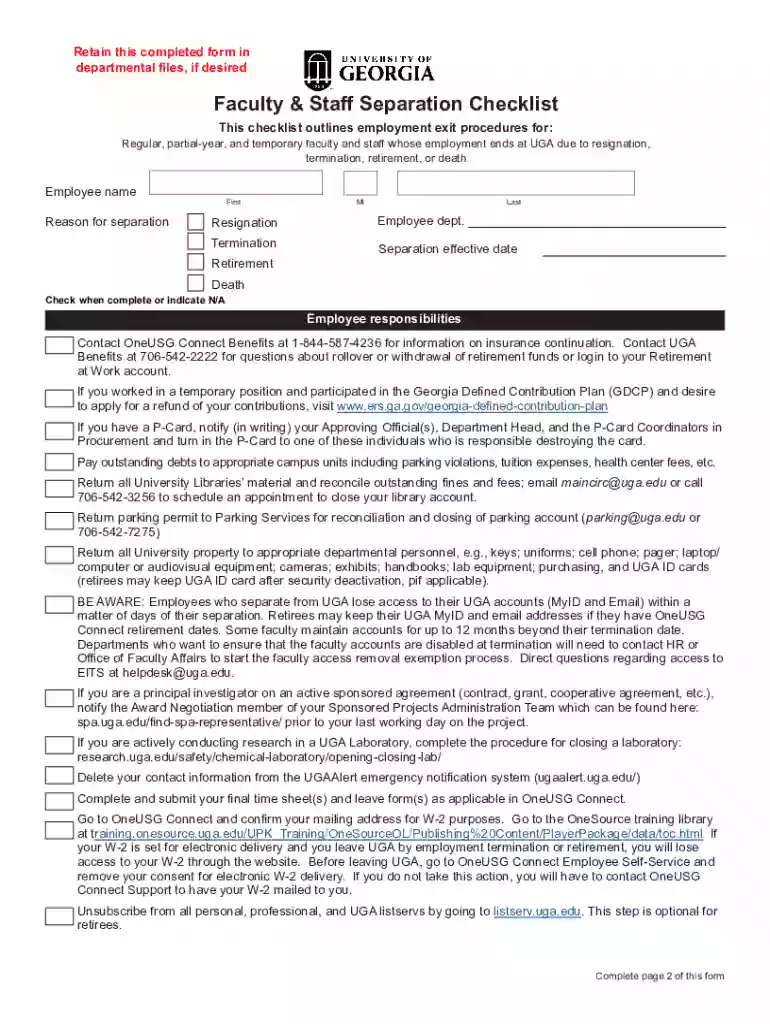
Click ‘Get Form’ to open the staff separation checklist in the editor.
Begin by filling in your personal details: enter your first name, middle initial, and last name in the designated fields.
Select the reason for your separation from the options provided: resignation, termination, retirement, or death.
Indicate your department and specify the effective date of your separation.
Review the employee responsibilities section carefully. Ensure you contact OneUSG Connect Benefits for insurance continuation and follow through on returning any university property.
Complete page 2 of the form as required, ensuring all necessary signatures are obtained before finalizing.
Start using our platform today to streamline your staff separation process effortlessly!
Employee separations can be broadly divided into two main types, voluntary and involuntary. Voluntary separation is when an employee decides that they wish to leave. Involuntary separations are decided by the employer.
What are the two major types of employee separation processes?
There are many ways in which a work separation can be involuntary: Layoff, reduction in force, or downsizing - work separation due to economic inability to keep the employee on the payroll. Temporary job comes to an end - work separation due to work no longer being available because the job is simply finished.
What is employee separation?
Termination of employment or separation of employment is an employees departure from a job and the end of an employees duration with an employer. Termination may be voluntary on the employees part (resignation), or it may be at the hands of the employer, often in the form of dismissal (firing) or a layoff.
Related Searches
Types of employee separationSeparation of employment vs terminationStaff separation examplesStaff separation letterSeparation from employment letterEmployee separation exampleEmployee separation processReasons for employee separation
Security and compliance
At DocHub, your data security is our priority. We follow HIPAA, SOC2, GDPR, and other standards, so you can work on your documents with confidence.
Cookie consent notice
This site uses cookies to enhance site navigation and personalize your experience.
By using this site you agree to our use of cookies as described in our Privacy Notice.
You can modify your selections by visiting our Cookie and Advertising Notice.