
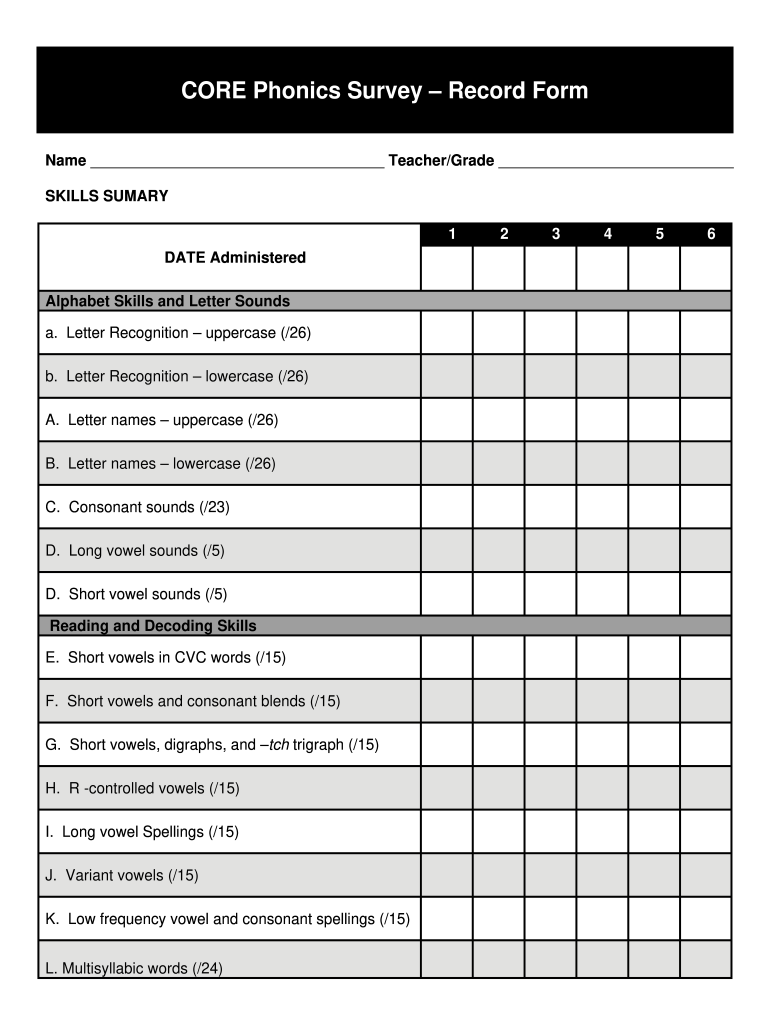







Definition and Purpose of the Core Survey Record Form
The Core Survey Record Form is an essential tool used primarily in educational settings to assess and document student performance in phonics. This structured assessment captures various aspects of a student's phonics capabilities, which are crucial for their reading and writing development. Teachers utilize this form to evaluate skills such as letter recognition, sound associations, decoding abilities, and understanding of phonetic components including vowel sounds and consonant blends. By systematically recording this data, educators can identify students who may require additional support and tailor their instruction to meet diverse learning needs.
- Assessment Areas:
- Alphabet skills
- Letter sounds
- Decoding proficiency
- Vowel sounds and blends
The form ensures that evaluations are comprehensive, providing a clear snapshot of a student's phonics skills at a given time. This documentation is invaluable for tracking progress throughout the academic year and fulfilling educational standards.
Steps for Completing the Core Survey Record Form
Completing the Core Survey Record Form involves a systematic approach that helps ensure accuracy and comprehensiveness in assessing a student’s phonics skills.
-
Preparation:
- Gather necessary materials, including the form, writing tools, and assessment resources.
- Ensure a quiet environment conducive to focus during the assessment.
-
Administering the Assessment:
- Begin with presenting the phonics tasks outlined in the form.
- Record student responses carefully in the designated sections of the form.
- Provide prompts as necessary to facilitate understanding and demonstrate tasks.
-
Documentation:
- Note each student's performance meticulously in the appropriate sections.
- Utilize the form’s structured categories to maintain organization and clarity.
-
Analysis and Review:
- After completing the assessments, analyze the recorded data to identify trends in student performance.
- Discuss findings with colleagues or educational specialists to determine instructional strategies.
Key Elements of the Core Survey Record Form
The Core Survey Record Form consists of several critical components that enhance its effectiveness as an assessment tool. Understanding these elements is vital for educators aiming to maximize its utility in phonics evaluation.
-
Structured Sections:
- The form is divided into clear sections targeting different phonics skills. Each section allows teachers to assess specific abilities.
-
Scoring System:
- A standardized scoring system is included, making it easier to interpret results. This often includes criteria to categorize performance levels, such as 'proficient', 'developing', or 'needs improvement'.
-
Student Information:
- Sections dedicated to student identifiers (name, grade, etc.) ensure that assessments are appropriately categorized and associated with individual progress.
-
Comments and Observations:
- A space for teacher comments allows educators to add qualitative observations about the student’s ability, behavior, and other relevant information during the assessment.
Importance of Accurate Record-Keeping
Accurate record-keeping with the Core Survey Record Form is crucial for several reasons. It not only helps in monitoring student progress but also serves as a legal record of educational assessments that can be referenced in future evaluations or meetings.
-
Compliance with Educational Standards:
- Maintaining detailed records aligns with state and federal educational requirements, ensuring that all assessments conducted are documented for accountability purposes.
-
Tracking Progress Over Time:
- By comparing records across assessments, educators can gain insights into a student’s phonics development and identify areas needing intervention or enrichment.
-
Communication with Stakeholders:
- Well-maintained records facilitate discussions with parents, other educators, and administrators regarding a student’s performance and necessary support.
Variants of the Core Survey Record Form
While the Core Survey Record Form is a standard assessment tool, various versions are tailored to meet diverse educational needs and contexts. Understanding these variants enhances educators' ability to select the appropriate form for their students.
-
Language-Specific Forms:
- Variants may exist for students who are non-native English speakers, such as Spanish phonics assessments, which are designed to evaluate phonics skills in another language.
-
Grade-Level Variations:
- Forms may be adapted for different grade levels to ensure that the language, tasks, and expectations are appropriate for a student’s developmental stage.
-
Digital Formats:
- With the rise of technology in education, digital versions of the Core Survey Record Form are available, allowing for ease of data entry and analysis.
Examples of How to Use the Core Survey Record Form Effectively
Using the Core Survey Record Form effectively can significantly enhance the assessment process and provide valuable insights into student learning. Here are practical examples demonstrating its application.
-
Small Group Evaluations:
- During guided reading sessions, teachers can utilize the form to assess multiple students simultaneously, recording their performance in real-time to facilitate immediate instructional adjustments.
-
Individual Progress Monitoring:
- A teacher might choose to conduct one-on-one assessments using the Core Survey Record Form at regular intervals to track individual progress and inform tailored instruction.
-
Parental Engagement:
- The recorded results can be shared with parents during conferences, providing them with concrete evidence of their child's phonics skills and areas for growth.
By understanding each of these facets of the Core Survey Record Form, educators can leverage this tool to foster better learning outcomes and more targeted teaching strategies for their students.




