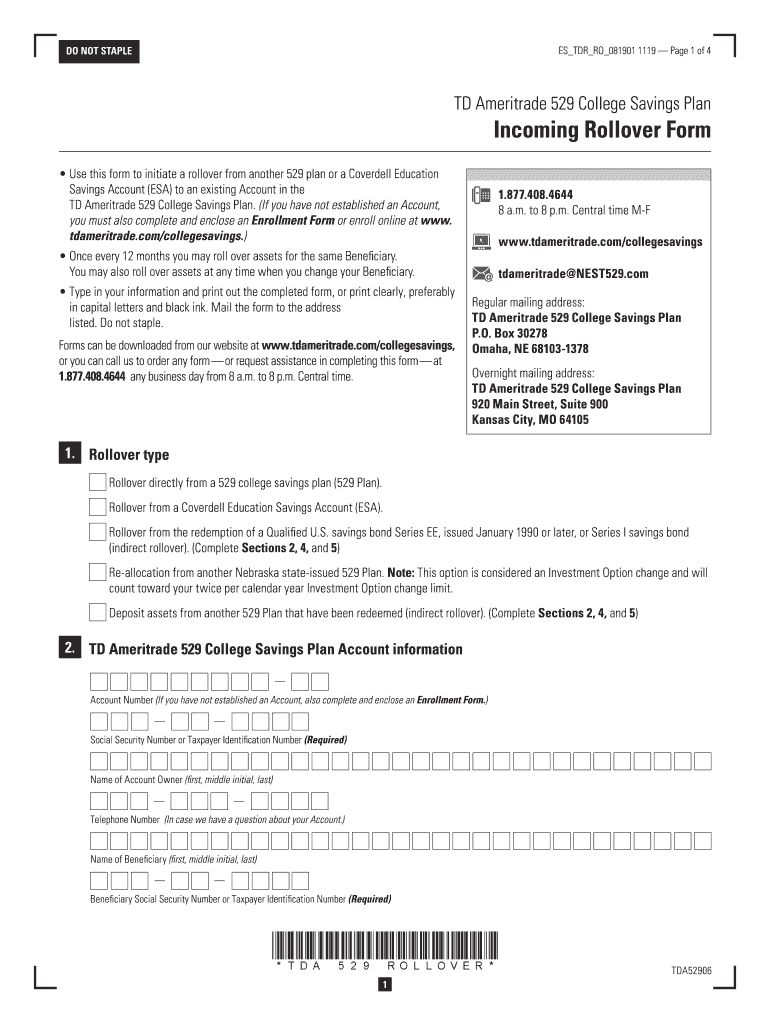
529 College Savings Plan Incoming Rollover Form - TD 2026

Get Form
529 College Savings Plan Incoming Rollover Form - TD Preview on Page 1

Here's how it works

01. Edit your form online
Type text, add images, blackout confidential details, add comments, highlights and more.
02. Sign it in a few clicks
Draw your signature, type it, upload its image, or use your mobile device as a signature pad.
03. Share your form with others
Send it via email, link, or fax. You can also download it, export it or print it out.

How to use or fill out 529 College Savings Plan Incoming Rollover Form - TD

Form edit decoration
9.5
Ease of Setup
DocHub User Ratings on G2
9.0
Ease of Use
DocHub User Ratings on G2
  1. Click ‘Get Form’ to open it in the editor.
  2. Begin by selecting the type of rollover you are initiating. Choose from options such as a direct rollover from another 529 plan or a Coverdell ESA.
  3. Fill in your TD Ameritrade 529 College Savings Plan account information, including your account number and Social Security Number. Ensure that all details are accurate.
  4. Provide the current 529 plan or ESA custodian's information if applicable. This is crucial for direct rollovers.
  5. If assets have been redeemed, include the total amount of redemption and specify the principal and earnings amounts.
  6. Sign and date the form at the bottom to certify your understanding of the terms and conditions.

Start using our platform today to complete your form online for free!

See more 529 College Savings Plan Incoming Rollover Form - TD versions

We've got more versions of the 529 College Savings Plan Incoming Rollover Form - TD form. Select the right 529 College Savings Plan Incoming Rollover Form - TD version from the list and start editing it straight away!
Versions Form popularity Fillable & printable
2020 4.8 Satisfied (62 Votes)
2019 4.3 Satisfied (210 Votes)
be ready to get more

Complete this form in 5 minutes or less

Get form

Got questions?

We have answers to the most popular questions from our customers. If you can't find an answer to your question, please contact us.
Contact us
Note: The IRS allows only one tax-free rollover of a 529 account per beneficiary in a 12-month period. Refer to IRS Publication 970 for more information on this.
For California taxpayers, a rollover from a 529 plan account to a Roth IRA will be treated as a non-qualified withdrawal and the earnings portion of the withdrawal will be subject to California state income tax, including the additional 2.5% California tax.
Unused 529 funds can be rolled into the beneficiarys Roth IRA without a tax penalty. But thats probably not a reason to overfund 529s. 529 plans are a tool for helping families save and invest for collegebut you can also use leftover 529 plan funds to help save for retirement, as well.
The 529 plan account must be open for 15 or more years, ending with the date of the rollover (15-year rule); Contributions and associated earnings that you transfer to the Roth IRA must be in the 529 plan account for more than five (5) years, ending with the date of the rollover (5-year rule);
Most 529 savings plans facilitate direct transfers to a new account without liquidating the plan assets and mailing you a check. Direct transfers must be completed within 60 days to avoid any tax consequences. Some states may assess a recapture tax on past tax deductions for out-of-state rollovers.

Security and compliance

At DocHub, your data security is our priority. We follow HIPAA, SOC2, GDPR, and other standards, so you can work on your documents with confidence.

Learn more
ccpa2
pci-dss
gdpr-compliance
hipaa
soc-compliance

People also ask

529 cons. If not used for college expenses, there is a 10% additional tax on earnings. If not used for qualified expenses, all earnings are taxed as ordinary income (even if the actual earnings were capital gains). The management fees for a 529 account are typically higher than the fees for comparable mutual funds.
Initiate the Rollover You have two options for transferring the funds: Direct Rollover: Complete the rollover form provided by the new 529 plan administrator, and they will handle the transfer on your behalf. Indirect Rollover: Withdraw the funds from your current 529 plan and deposit them into the new plan yourself.
Basically, the answer to the question posed in the title is simple: 97% of people are not wealthy enough. Also missing from the article was the mantra that a family should not contribute to a 529 plan unless they have made the maximum contributions to retirement plans first.

Related links