




Fl 105 2026

Get Form
divorce filing california Preview on Page 1

Here's how it works

01. Edit your divorce filing california online
Type text, add images, blackout confidential details, add comments, highlights and more.
02. Sign it in a few clicks
Draw your signature, type it, upload its image, or use your mobile device as a signature pad.
03. Share your form with others
Send divorce rights california via email, link, or fax. You can also download it, export it or print it out.

Definition and Purpose of Form FL-105

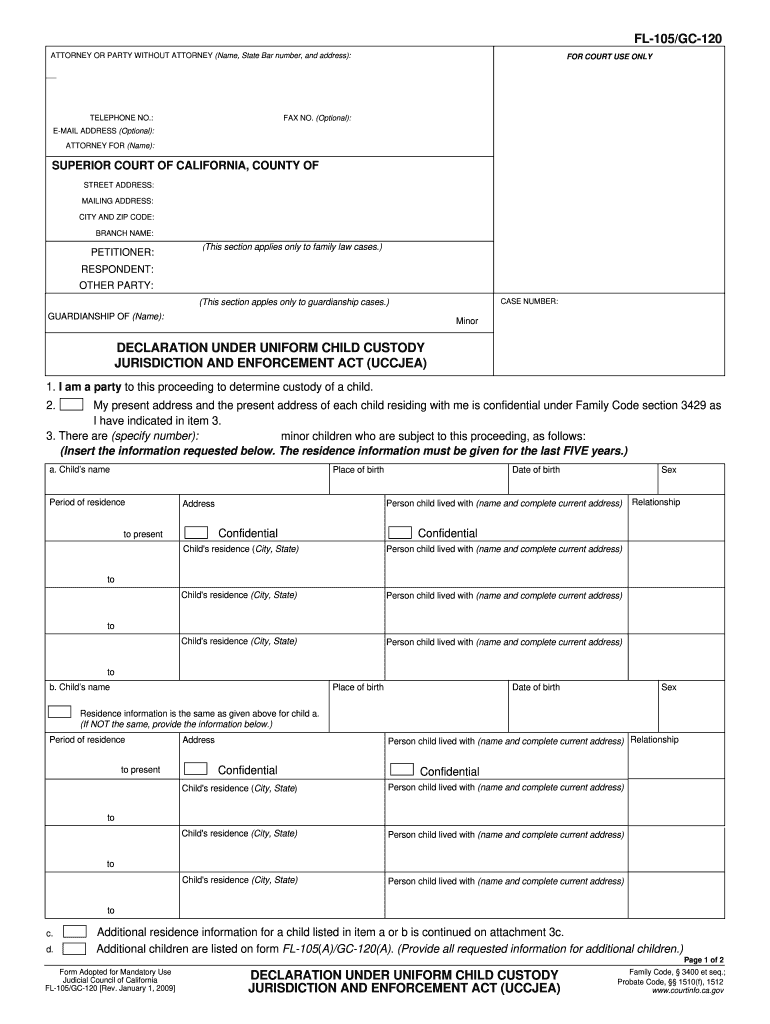
Form FL-105, also referred to as GC-120, is a California family law document used in custody cases to provide information under the Uniform Child Custody Jurisdiction and Enforcement Act (UCCJEA). This form is essential for individuals involved in custody proceedings, as it requires them to disclose information about minor children's residences, participation in other custody cases, and any existing domestic violence restraining orders. The UCCJEA is designed to help determine the appropriate jurisdiction for child custody matters and ensure that all relevant information is presented to the court. Given its sensitive nature, the form emphasizes confidentiality and the importance of providing accurate and comprehensive details.

Key Components of Form FL-105

  • Residence History: The form requires a detailed history of where the child has lived over the past five years, including dates and addresses. This is crucial for establishing jurisdiction.
  • Participation in Other Cases: Parties must mention if the child has been involved in other custody or guardianship cases. This helps avoid conflicting orders and ensures consistent decision-making.
  • Existing Restraining Orders: Information about any restraining orders related to domestic violence is necessary to protect the safety and wellbeing of the child and parties involved.
  • Confidentiality Notice: The form highlights the need to keep certain details confidential to protect the child’s privacy.

How to Use Form FL-105

The form is used during legal proceedings in family court, primarily for issues involving child custody. The process involves:

  1. Filling Out the Form: Provide accurate information about the child's residential history, any other custody matters, and any relevant restraining orders.
  2. Submitting to Court: Along with other required documents, submit Form FL-105 to the appropriate family court handling your custody case.
  3. Supplemental Documentation: Attach any necessary supplemental documentation, such as prior court orders or birth certificates, to support the information provided on the form.

Using this form appropriately ensures all necessary information is available to the court, aiding in fair and informed decision-making regarding custody matters.

Steps to Complete Form FL-105

Completing the FL-105 requires meticulous attention to detail:

  1. Section I: Child Information: Include basic details such as name, date of birth, and current residence.
  2. Section II: Residence Information: List all addresses where the child has lived for the past five years, along with the dates of residence.
  3. Section III: Custody Cases: Disclose involvement in any other custody or guardianship cases, providing case numbers and court locations if applicable.
  4. Section IV: Restraining Orders: Identify any active restraining orders or similar restrictions affecting any involved parties.
  5. Review for Accuracy: Before submission, review all entries for accuracy to prevent delays or legal complications.
  6. Confirmation and Submission: Sign the completed form and submit it to the court clerk's office as part of your custody case documentation.

Who Typically Uses Form FL-105

Form FL-105 is predominantly used by:

  • Parents: Individuals involved in custody disputes need this form to present relevant jurisdictional details to the court.
  • Guardians and Caregivers: Those seeking custody or guardianship orders for minors must complete this form as part of their legal proceedings.
  • Attorneys and Legal Representatives: Lawyers drafting or reviewing documents for custody cases will utilize this form to ensure compliance with UCCJEA requirements.

Access to the form is necessary for any party required to provide the court with comprehensive details about a child's custody history.

Legal Use of Form FL-105

The legal use of Form FL-105 centers around its role in:

  • Establishing Jurisdiction: It helps identify the proper jurisdiction for custody matters by providing the child's living history.
  • Avoiding Conflicting Orders: Ensures that the court is aware of existing orders or ongoing cases, preventing contradictory decisions.
  • Promoting Child Safety: Information about restraining orders aids in protecting children from potential harm and exposure to unsafe environments.

The form is a critical legal document in custody cases, ensuring that decisions are made in the child's best interest following all legal standards.

Important Terms Related to Form FL-105

Understanding key terms related to FL-105 is vital for accurate completion:

  • UCCJEA: Uniform Child Custody Jurisdiction and Enforcement Act, which guides jurisdictional issues in custody cases.
  • Jurisdiction: The authority of a specific court to hear and decide on a case, particularly in relation to where a child has lived.
  • Residency: Refers to where the child has lived, affecting which court has jurisdiction over the custody matter.

Familiarity with these terms assists in completing the form accurately and aids in understanding its implications in legal proceedings.

Required Documents for Form FL-105

To accompany Form FL-105, certain documents may be necessary:

  • Birth Certificates: To confirm the child's identity and parental relationships.
  • Court Orders: Copies of any existing custody or restraining orders.
  • Previous Case Documents: If the child has been involved in other custody matters, submitting related documents ensures the court is fully informed.

Including these documents with the completed form helps provide a comprehensive picture to the court, facilitating a more informed decision-making process.

State-Specific Rules for Form FL-105

While Form FL-105 is a California-specific form, awareness of state-specific rules is crucial:

  • Residency Requirements: Ensure that the form complies with California's residency requirements for custody jurisdiction.
  • Filing Procedures: Follow California’s specific procedures for filing family law documents to avoid administrative errors.
  • Confidentiality Statutes: Adhere to California laws on maintaining confidentiality of the information provided in the form, especially concerning minor children.

Compliance with state rules is essential, as failure to adhere can result in delays or legal consequences. Understanding how state-specific guidelines impact the use and submission of Form FL-105 ensures a smoother legal process.

See more fl 105 versions

We've got more versions of the fl 105 form. Select the right fl 105 version from the list and start editing it straight away!
Versions Form popularity Fillable & printable
2009 4.8 Satisfied (46 Votes)
2003 4 Satisfied (58 Votes)
be ready to get more

Complete this form in 5 minutes or less

Get form

Got questions?

We have answers to the most popular questions from our customers. If you can't find an answer to your question, please contact us.
Contact us
Fill out these 3 forms: Petition for Custody and Support of Minor Children (form FL-260) Summons (Uniform Parentage Petition for Custody and Support) (form FL-210) Declaration Under Uniform Child Custody Jurisdiction and Enforcement Act (UCCJEA) (form FL-105/GC-120)
FL-105 is the California Judicial Council form for the Declaration Under the Uniform Child Custody Jurisdiction and Enforcement Act (UCCJEA), a mandatory document in family law cases involving minor children (divorce, paternity, custody) that provides courts with crucial details about the childrens residence history, ensuring the proper jurisdiction for custody orders. It requires information like childrens names, birthplaces, dates of birth, addresses for the last five years, and any other related court cases, with an attachment (FL-105A) for more than two children. Purpose of Form FL-105: Establishes Jurisdiction: Informs the court where the children have lived to determine if California has the authority to make custody orders. Provides Child Information: Details the childrens residence history, who they lived with, and their relationship to the parties. Reveals Other Cases: Discloses any other court cases or orders involving the childrens custody or visitation. When to Use It: When filing for divorce, legal separation, or nullity if you have children with your spouse/partner. In actions to establish parentage or for custody/support of minor children. It must be completed by both the petitioner and respondent (if they have children together). Key Information Required: Your contact details. Court location and case number (left blank initially). Petitioner and Respondent names. For each child: Name, place of birth, date of birth, sex, and residence history for the last five years. Information about other court cases or restraining orders. AI can make mistakes, so double-check responsesDeclaration Under Uniform Child Custody Jurisdiction and Enforcement Act (UCCJEA) (FL-105)California Courts | Self Help Guide (.gov)California Divorce Form FL-105 - Cristin Lowe LawCristin Lowe Law
The biggest mistake in a custody battle is losing focus on the childs best interests by letting anger, revenge, or adult conflict drive decisions, which courts view very negatively, damaging your credibility and case by showing an inability to co-parent. Other major errors include misusing children as weapons, badmouthing the other parent, failing to follow court orders, engaging in inappropriate communication (especially online), and creating instability for the child. Key Mistakes to Avoid: Prioritizing Conflict Over the Child: Letting your own hurt feelings or desire to win overshadow whats truly best for the child. Using Kids as Pawns: Involving children in adult disputes, making them choose sides, or asking them to provide emotional support (parentification). Badmouthing the Other Parent: Trash-talking your ex in front of the child or in court signals to the judge an inability to cooperate. Poor Communication: Inappropriate texts, emails, or social media posts can be used as evidence against you; always be friendly, factual, and firm. Being Inflexible: Refusing to communicate or collaborate on decisions about the childs health, education, or activities. Ignoring Court Orders: Failing to pay support or follow existing orders shows disrespect for the legal process and the childs stability. Creating Instability: Unnecessarily disrupting the childs routines, school, or support network. Disengaging as a Parent: Showing a lack of commitment to the childs daily life, school, or medical care. What Courts Look For: Cooperation: The ability to work with the other parent for the childs benefit. Stability: A consistent and secure environment for the child. Support for Both Parents: Willingness to encourage the childs relationship with the other parent (unless safety is a concern). Emotional Maturity: Taking the high road and avoiding emotionally driven decisions. AI can make mistakes, so double-check responsesWhat Is the Biggest Mistake in Custody Battle? - Inman TourgeeJan 1, 2026 The biggest mistake in a custody battle is losing sight of your childs best interests. When parents let anger or hurt Inman Tourgee Attorneys At LawWhat Is the Biggest Mistake in a Custody BattleFeb 2, 2026 its a huge mistake. And when the court gets wind that youre doing that thats the moment you start to lose your caseYouTube ChooseGoldman - Goldman Associates Law Firm
There are exceptions to the home state rule. In some cases, you can file for custody in a state where the children and at least one parent have DocHub connections. Usually, however, you can only do this if there is no home state or if the home state has agreed to let another state have jurisdiction.
Family court handles legal issues involving children and domestic matters, such as divorce, child custody, support, paternity, domestic violence, adoption, guardianship, and juvenile delinquency, providing a specialized forum to resolve family conflicts and protect vulnerable individuals, though specific jurisdictions and case types can vary. Its main goal is to resolve these issues fairly, often focusing on the best interests of children and promoting cooperation between parents. Common Cases Heard in Family Court: Divorce Separation: Dissolving marriages, dividing assets, and determining spousal support (alimony). Child-Related Issues: Custody, visitation, child support, and paternity establishment. Domestic Violence: Issuing protective orders (restraining orders) and handling cases of abuse or neglect. Adoption Guardianship: Legal processes for adopting children or appointing guardians for minors or incapacitated adults. Juvenile Matters: Cases involving juvenile delinquency or children in need of supervision (PINS). Probate Matters: In some courts, wills, estates, trusts, and name changes. Key Functions: Protecting Children: Ensuring child welfare by making decisions about custody, support, and safety in abuse/neglect cases. Resolving Disputes: Mediating disagreements between parents or family members on shared responsibilities. Providing Legal Relief: Granting orders for protection, child support, and other family-related legal remedies. How it Differs: While divorce may start in a higher court (like Supreme Court in NY), Family Court often handles immediate issues like custody and support before divorce finalization. The specific laws and types of cases handled can differ by state and county. AI can make mistakes, so double-check responsesProbate and Family Court | Mass.govAbout the Probate Family Court. The Probate and Family Court Department handles court matters that involve families and childrenMass.govFamily Court Services | Superior Court of California - County of San DiegoAssist families in the settlement of domestic controversies involving the welfare of children where there is an action in Family CSan Diego Superior Court (.gov)

Security and compliance

At DocHub, your data security is our priority. We follow HIPAA, SOC2, GDPR, and other standards, so you can work on your documents with confidence.

Learn more
ccpa2
pci-dss
gdpr-compliance
hipaa
soc-compliance

People also ask

Declaration Under Uniform Child Custody Jurisdiction and Enforcement Act (UCCJEA) (FL-105) Give the court important information about the children you have with your spouse or domestic partner. The court considers this information before making child custody and visitation orders.
In short, the UCCJEA helps California residents, parents that recently arrived in California, and out of state parents to understand a clear set of rules determining whether California courts can make any orders with respect to child custody and visitation for a particular family.

fl 105