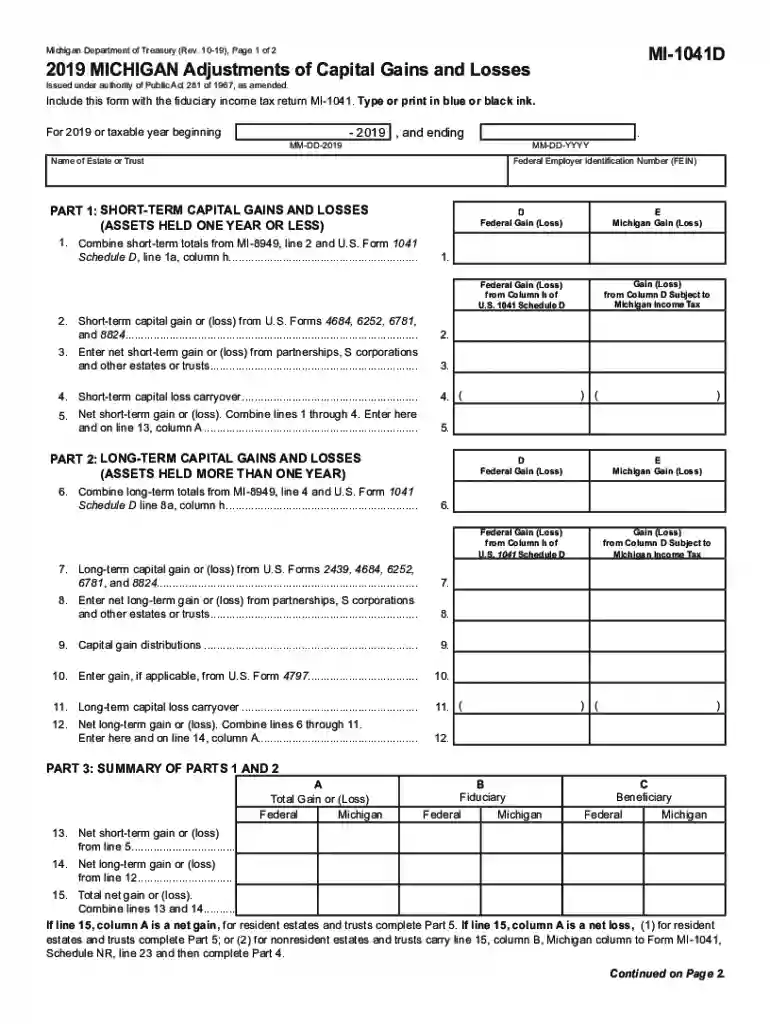
2019 MICHIGAN Adjustments of Capital Gains and Losses MI-1041D. 2019 MICHIGAN Adjustments of Capital Gains and Losses MI-1041D-2026

Get Form
2019 MICHIGAN Adjustments of Capital Gains and Losses MI-1041D. 2019 MICHIGAN Adjustments of Capital Gains and Losses MI-1041D Preview on Page 1

Here's how it works

01. Edit your form online
Type text, add images, blackout confidential details, add comments, highlights and more.

02. Sign it in a few clicks
Draw your signature, type it, upload its image, or use your mobile device as a signature pad.

03. Share your form with others
Send it via email, link, or fax. You can also download it, export it or print it out.

How to use or fill out 2019 MICHIGAN Adjustments of Capital Gains and Losses MI-1041D with our platform

Form edit decoration
9.5
Ease of Setup
DocHub User Ratings on G2
9.0
Ease of Use
DocHub User Ratings on G2
  1. Click ‘Get Form’ to open the 2019 MICHIGAN Adjustments of Capital Gains and Losses MI-1041D in the editor.
  2. Begin by entering the name of the estate or trust and the Federal Employer Identification Number (FEIN) at the top of the form.
  3. In Part 1, input your short-term capital gains and losses. Combine totals from MI-8949 and U.S. Form 1041 Schedule D as instructed.
  4. Proceed to Part 2 for long-term capital gains and losses. Follow similar steps as in Part 1, ensuring all relevant figures are accurately transferred.
  5. Complete Part 3 by summarizing your net short-term and long-term gains or losses, ensuring totals align with Form MI-1041.
  6. If applicable, fill out Parts 4, 5, and 6 for loss limitations and adjustments based on your specific situation.

Start using our platform today to simplify your form completion process for free!

See more 2019 MICHIGAN Adjustments of Capital Gains and Losses MI-1041D. 2019 MICHIGAN Adjustments of Capital Gains and Losses MI-1041D versions

We've got more versions of the 2019 MICHIGAN Adjustments of Capital Gains and Losses MI-1041D. 2019 MICHIGAN Adjustments of Capital Gains and Losses MI-1041D form. Select the right 2019 MICHIGAN Adjustments of Capital Gains and Losses MI-1041D. 2019 MICHIGAN Adjustments of Capital Gains and Losses MI-1041D version from the list and start editing it straight away!
Versions Form popularity Fillable & printable
2023 4.5 Satisfied (34 Votes)
2022 4.4 Satisfied (38 Votes)
2021 4.9 Satisfied (43 Votes)
2020 4.3 Satisfied (35 Votes)
2019 4.3 Satisfied (180 Votes)
2018 4.3 Satisfied (140 Votes)
2017 4.4 Satisfied (57 Votes)
be ready to get more

Complete this form in 5 minutes or less

Get form

Got questions?

We have answers to the most popular questions from our customers. If you can't find an answer to your question, please contact us.
Contact us
Consider your holding period The easiest way to lower capital gains taxes is to simply hold taxable assets for one year or longer to benefit from the long-term capital gains tax rate.
This can only be used if you dont normally complete a tax return. It allows those with one-off capital gains to avoid the need to complete a full self-assessment. Losses may be carried forward indefinitely but need to be reported to HMRC within four years from the end of the tax year in which they arise.
State capital gains tax: Michigan treats capital gains as regular income, subjecting them to the states flat 4.25% tax rate.
In computing accumulated taxable income, a deduction from taxable income is allowed for the excess of net long-term capital gain over net short-term capital loss, minus the amount of tax attributable to the gain (IRC 535(b)(6)).
Michigan. Taxes capital gains at the same rate as income, at a flat rate of 4.05%.

Security and compliance

At DocHub, your data security is our priority. We follow HIPAA, SOC2, GDPR, and other standards, so you can work on your documents with confidence.

Learn more
be ready to get more

Complete this form in 5 minutes or less

Get form

People also ask

To qualify for the capital gains exclusion, you must have owned and lived in the home as your primary residence for at least 2 of the 5 years before the sale. This doesnt need to be continuous time, but it must add up to 24 months within that 5-year window.
In Michigan, the transfer tax for real estate transactions is composed of both a state and a county component. The state transfer tax rate is $3.75 for every $500 of the propertys value. The county transfer tax rate is $0.55 for every $500 of the propertys value.
How to calculate capital gains taxstep-by-step Determine your basis. Determine your net proceeds. Subtract your basis (what you paid) from the realized amount (how much you sold it for) to determine the difference. Review the descriptions in the section below to know which tax rate may apply to your capital gains.

Related links