K1 2026

Get Form
k1 Preview on Page 1

Here's how it works

01. Edit your form online
Type text, add images, blackout confidential details, add comments, highlights and more.

02. Sign it in a few clicks
Draw your signature, type it, upload its image, or use your mobile device as a signature pad.

03. Share your form with others
Send it via email, link, or fax. You can also download it, export it or print it out.

How to use or fill out k1 with our platform

Form edit decoration
9.5
Ease of Setup
DocHub User Ratings on G2
9.0
Ease of Use
DocHub User Ratings on G2
  1. Click ‘Get Form’ to open the K-1 in the editor.
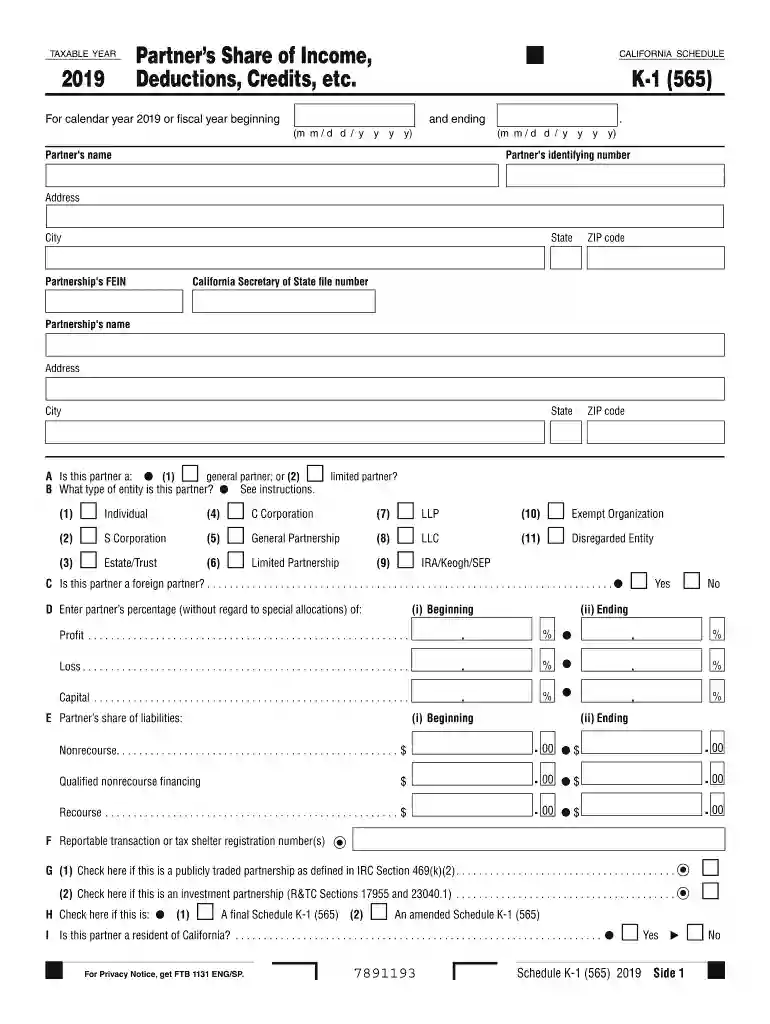
  2. Begin by entering the taxable year at the top of the form. Ensure you specify whether it’s for calendar year 2019 or a fiscal year.
  3. Fill in the partner's name, identifying number, and address details accurately. This information is crucial for proper identification.
  4. Indicate whether the partner is a general or limited partner and select the type of entity from the provided options.
  5. Complete sections regarding profit, loss, and capital percentages. Enter these values without special allocations as required.
  6. Review all entries for accuracy before saving your changes. Utilize our platform’s features to easily modify any fields if necessary.

Start filling out your K-1 form online for free today!

See more k1 versions

We've got more versions of the k1 form. Select the right k1 version from the list and start editing it straight away!
Versions Form popularity Fillable & printable
2022 4.5 Satisfied (40 Votes)
2021 4.8 Satisfied (83 Votes)
2020 4.4 Satisfied (238 Votes)
2019 4.3 Satisfied (80 Votes)
2018 4.4 Satisfied (52 Votes)
2017 4.4 Satisfied (58 Votes)
2016 4.3 Satisfied (247 Votes)
2015 4.4 Satisfied (44 Votes)
2012 4.2 Satisfied (60 Votes)
2011 4 Satisfied (38 Votes)
be ready to get more

Complete this form in 5 minutes or less

Get form

Got questions?

We have answers to the most popular questions from our customers. If you can't find an answer to your question, please contact us.
Contact us
Schedule K-1 income is not automatically considered earned income for all purposes. Whether its considered earned income depends on the nature of your involvement in the pass-through entity. If youre actively involved, for example, it may be considered earned income for some programs.
Schedule K-1 is a tax form prepared annually by U.S. pass-through entitiessuch as business partnerships, limited liability companies (LLCs), S-corporations, trusts, and estates.
While 1099 income generally falls into simple categories, K-1 income maintains its specific character as it flows through from the business entity, potentially including ordinary business income, rental income, royalties, and guaranteed payments.
K-1s are tax forms that are used for business partnerships to report to the IRS a partners income, losses, capital gain, dividends, etc., from the partnership for the tax year. With the K-1, a partners earnings can be taxed at an individual tax rate versus the corporate tax rate.
A Schedule K-1 can impact your personal taxes in key ways. It reports income from partnerships, S-corporations, and trusts. This income is often considered pass-through, meaning it goes directly to you without being taxed at the entity level.

Security and compliance

At DocHub, your data security is our priority. We follow HIPAA, SOC2, GDPR, and other standards, so you can work on your documents with confidence.

Learn more
ccpa2
pci-dss
gdpr-compliance
hipaa
soc-compliance

People also ask

Some trusts and estates pass income through to the beneficiaries. In these cases, the beneficiaries receive a K-1. It shows the income they must report on their tax returns.
A K-1 form is usually prepared by the accountant who manages the entitys taxes, before being issued to each partner, shareholder, or beneficiary.
Schedule K-1 is used to report the amount of income each party is responsible for in a pass-through entity, like an S corporation or partnership. Each shareholder or partner will receive a Schedule K-1.

Related links