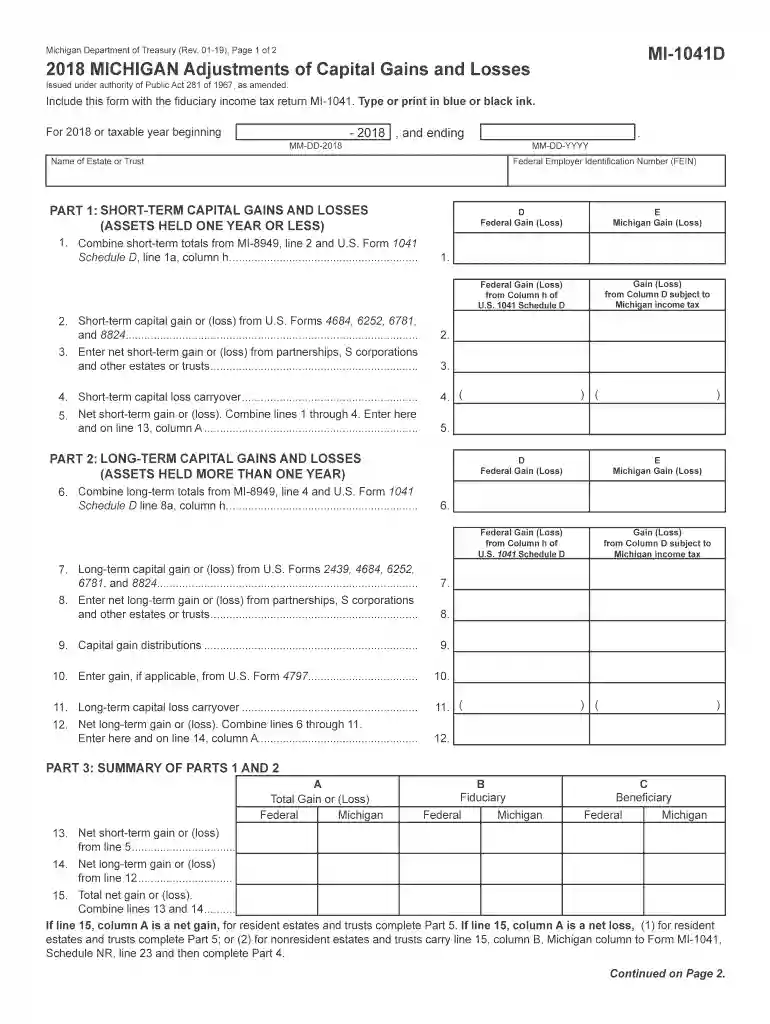
Mi 1041d 2018-2026

Get Form
mi 1041d 2018 Preview on Page 1

Here's how it works

01. Edit your form online
Type text, add images, blackout confidential details, add comments, highlights and more.

02. Sign it in a few clicks
Draw your signature, type it, upload its image, or use your mobile device as a signature pad.

03. Share your form with others
Send it via email, link, or fax. You can also download it, export it or print it out.

How to use or fill out mi 1041d 2018 with our platform

Form edit decoration
9.5
Ease of Setup
DocHub User Ratings on G2
9.0
Ease of Use
DocHub User Ratings on G2
  1. Click ‘Get Form’ to open the MI-1041D in the editor.
  2. Begin by entering the name of the estate or trust and the Federal Employer Identification Number (FEIN) at the top of the form.
  3. In Part 1, input your short-term capital gains and losses. Combine totals from MI-8949 and U.S. Form 1041 Schedule D as instructed.
  4. Proceed to Part 2 for long-term capital gains and losses. Again, follow similar steps by combining relevant figures from MI-8949 and U.S. Form 1041 Schedule D.
  5. In Part 3, summarize your net short-term and long-term gains or losses. Ensure that totals align with Form MI-1041, Schedule 4.
  6. Complete Parts 4, 5, and 6 as necessary based on your specific tax situation, ensuring all calculations are accurate.

Start using our platform today to fill out your MI-1041D form online for free!

See more mi 1041d 2018 versions

We've got more versions of the mi 1041d 2018 form. Select the right mi 1041d 2018 version from the list and start editing it straight away!
Versions Form popularity Fillable & printable
2023 4.5 Satisfied (34 Votes)
2022 4.4 Satisfied (38 Votes)
2021 4.9 Satisfied (43 Votes)
2020 4.3 Satisfied (35 Votes)
2019 4.3 Satisfied (180 Votes)
2018 4.3 Satisfied (140 Votes)
2017 4.4 Satisfied (57 Votes)
be ready to get more

Complete this form in 5 minutes or less

Get form

Got questions?

We have answers to the most popular questions from our customers. If you can't find an answer to your question, please contact us.
Contact us
Short-term capital gains are taxed at the same rate as your ordinary income. Meanwhile, long-term gains are taxed at either 0%, 15%, or 20%. The rate you pay is based on your taxable income. Just like with ordinary income tax rates, the higher your income, the higher your long-term capital gains tax rate.
Net capital gains are taxed at different rates depending on overall taxable income, although some or all net capital gain may be taxed at 0%. For taxable years beginning in 2024, the tax rate on most net capital gain is no higher than 15% for most individuals.
The Michigan individual income tax was first adopted in 1967 . It is a direct flat-rate tax, which means that everyone is assessed the same tax rate (4 . 25 percent for 2024), regardless of their level of income .
Long-Term Capital Gains tax rate is 12.5% and Short-Term Capital Gains tax rate is 20% or at slab rates as updated in Budget 2024. An exemption of Rs. 1.25 lakh is available on Long-term capital gains on transfer of equity shares or equity-oriented mutual funds.
Unlike states with no income tax, Michigan imposes a flat 4.25% tax on most forms of income, including capital gains. This means that when you sell an asset for a profit, youll need to account for both federal and state capital gains taxes, which can impact your overall returns.

Security and compliance

At DocHub, your data security is our priority. We follow HIPAA, SOC2, GDPR, and other standards, so you can work on your documents with confidence.

Learn more
be ready to get more

Complete this form in 5 minutes or less

Get form

People also ask

Unlike the federal government, Michigan makes no distinction between short-term and long-term capital gains or even between capital gains and ordinary income. Instead, it taxes all capital gains as ordinary income, using the same rates and brackets as the regular state income tax.
In addition, current year commonly used forms will continue to be available at Michigan Department of Treasury offices, most public libraries, Northern Michigan post offices, and Michigan Department of Health and Human Services (MDHHS) county offices.
This means that you are the person responsible for overseeing the estate or trustwhich includes filing all necessary tax returns. The IRS requires the filing of an income tax return for trusts and estates on Form 1041formerly known as the fiduciary income tax return.

Related links