Nyc form 4s 2026

Get Form
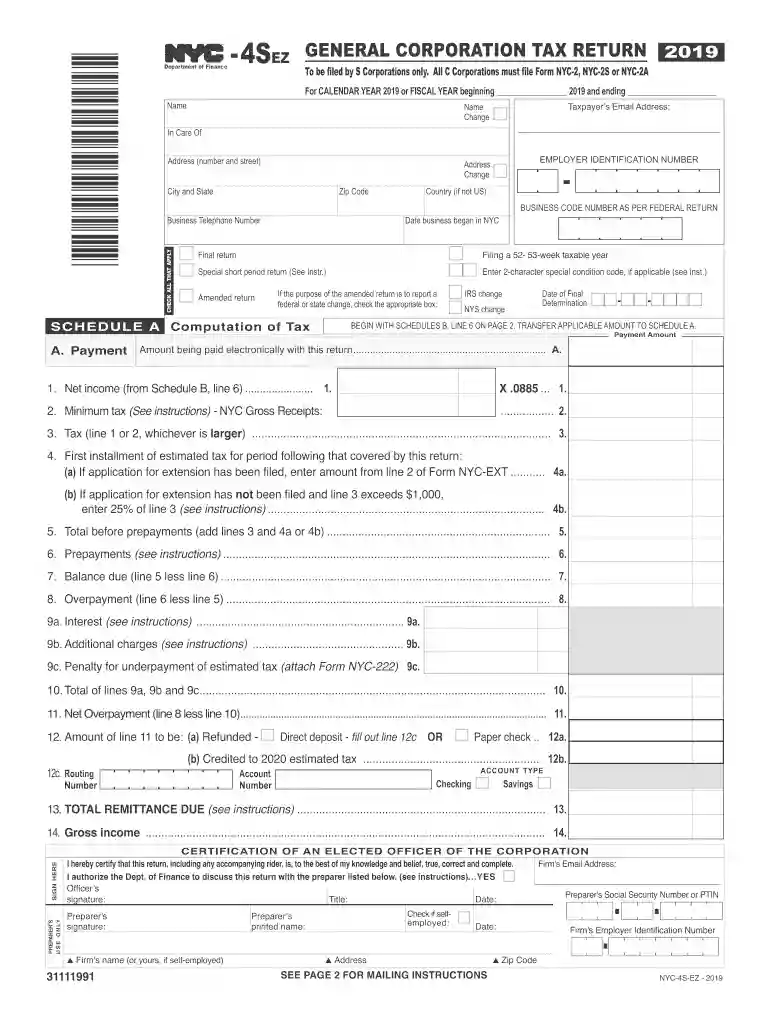
nyc 4s Preview on Page 1

Here's how it works

01. Edit your nyc 4s online
Type text, add images, blackout confidential details, add comments, highlights and more.

02. Sign it in a few clicks
Draw your signature, type it, upload its image, or use your mobile device as a signature pad.

03. Share your form with others
Send it via email, link, or fax. You can also download it, export it or print it out.

How to use or fill out NYC Form 4S with our platform

Form edit decoration
9.5
Ease of Setup
DocHub User Ratings on G2
9.0
Ease of Use
DocHub User Ratings on G2
  1. Click ‘Get Form’ to open NYC Form 4S in the editor.
  2. Begin by entering your business name and address in the designated fields. Ensure accuracy as this information is crucial for identification.
  3. Fill in your Employer Identification Number (EIN) and business code number as per your federal return. This helps streamline processing.
  4. Indicate if this is a final return or if you are filing for a special period by checking the appropriate boxes provided.
  5. Proceed to Schedule A, where you will compute your tax. Enter net income from Schedule B, line 6, and calculate the tax based on the provided rates.
  6. Complete any additional required information, such as rental payments and K1 returns attached, ensuring all relevant details are included.
  7. Finally, review all entries for accuracy before signing and submitting your form electronically or via mail as instructed.

Start using our platform today to simplify your NYC Form 4S completion process for free!

See more nyc form 4s versions

We've got more versions of the nyc form 4s form. Select the right nyc form 4s version from the list and start editing it straight away!
Versions Form popularity Fillable & printable
2022 4.3 Satisfied (27 Votes)
2021 4.8 Satisfied (88 Votes)
2020 4.4 Satisfied (99 Votes)
2019 4.4 Satisfied (170 Votes)
2018 4.3 Satisfied (30 Votes)
2017 4.3 Satisfied (47 Votes)
2016 4.2 Satisfied (75 Votes)
2015 4.2 Satisfied (53 Votes)
2014 4 Satisfied (54 Votes)
2013 4 Satisfied (53 Votes)
be ready to get more

Complete this form in 5 minutes or less

Get form

Got questions?

We have answers to the most popular questions from our customers. If you can't find an answer to your question, please contact us.
Contact us
FILE FORM NYC-4S Corporations (as defined in Section 11- 602.1 of the New York City Administra- tive Code) doing business, employing capital, or owning or leasing property in a corporate or organized capacity, or main- taining an office in New York City must file a General Corporation Tax return.
What are the key differences between these two business structures? The simple answer is that an LLC is a business entity whereas an S-corporation is a tax classification for a corporation. An S-Corporation is an elective tax classification that offers liability safeguards and transfers income through to the owners.
This certificate, Form IT-2104, is completed by an employee and given to the employer to instruct the employer how much New York State (and New York City and Yonkers) tax to withhold from the employees pay. The more allowances claimed, the lower the amount of tax withheld.
Corporations (as defined in Section 11-602.1 of the New York City Administrative Code) doing business, employing capital, owning or leasing property in a corporate or organized capacity, or maintaining an office in New York City must file a General Corporation Tax return.
Unincorporated business tax (UBT) A person who is performing services as an employee. A person or entity, other than a dealer, who is only engaged in the purchase, holding, and sale of property for their own personal account (for example, a person who owns and rents a two-family house)

Security and compliance

At DocHub, your data security is our priority. We follow HIPAA, SOC2, GDPR, and other standards, so you can work on your documents with confidence.

Learn more
ccpa2
pci-dss
gdpr-compliance
hipaa
soc-compliance

People also ask

Class 4: All commercial and industrial properties, such as office, retail, factory buildings, and all other properties not included in tax classes 1, 2, or 3.

Related links