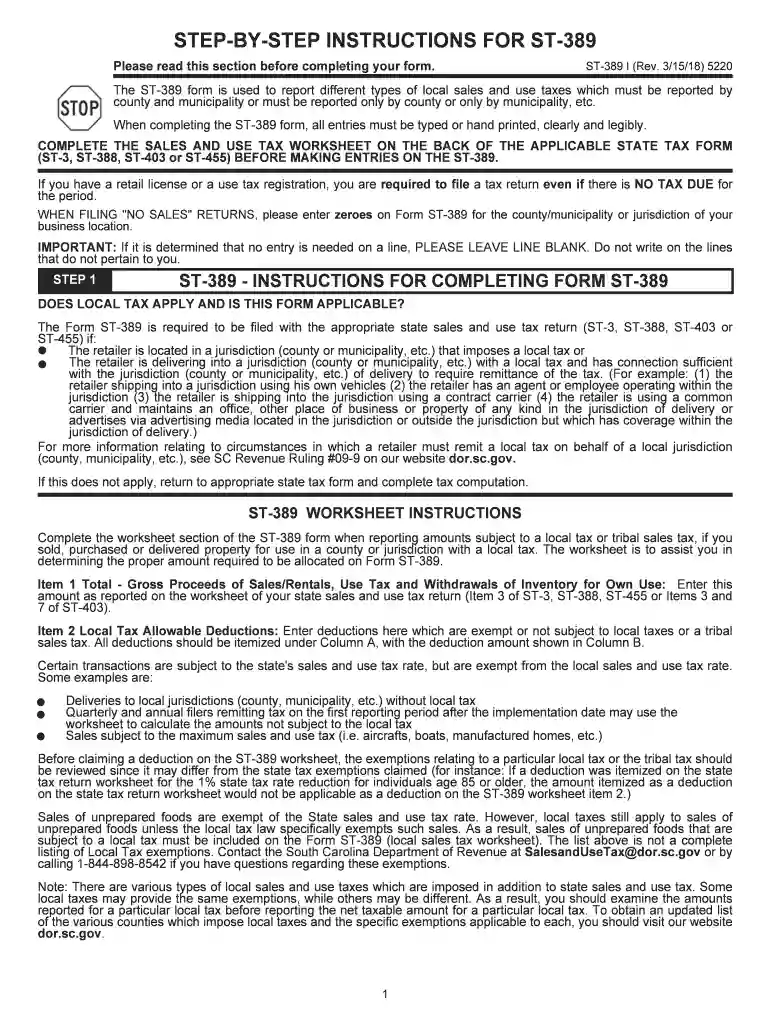
St 389 2026

Get Form
st 389 Preview on Page 1

Here's how it works

01. Edit your form online
Type text, add images, blackout confidential details, add comments, highlights and more.

02. Sign it in a few clicks
Draw your signature, type it, upload its image, or use your mobile device as a signature pad.

03. Share your form with others
Send it via email, link, or fax. You can also download it, export it or print it out.

How to use or fill out st 389 with our platform

Form edit decoration
9.5
Ease of Setup
DocHub User Ratings on G2
9.0
Ease of Use
DocHub User Ratings on G2
  1. Click ‘Get Form’ to open the ST-389 in the editor.
  2. Begin by completing the Sales and Use Tax Worksheet on the back of your applicable state tax form (ST-3, ST-388, ST-403, or ST-455) before entering any data on the ST-389.
  3. In Section 1, enter your business name, retail license number, and the period ended as indicated on your state tax form. Ensure all entries are clear and legible.
  4. For each county or municipality where sales occurred, input the name and corresponding code. Use only one entry per line; if more lines are needed, duplicate the page.
  5. Calculate local taxes by multiplying the net taxable amount by 1% for each jurisdiction and enter these amounts in Column B.
  6. Finally, total all net taxable sales and local taxes due at the bottom of page 5. Make sure to attach all applicable pages of Form ST-389 to your state tax return.

Start using our platform today for free to streamline your document editing and form completion!

See more st 389 versions

We've got more versions of the st 389 form. Select the right st 389 version from the list and start editing it straight away!
Versions Form popularity Fillable & printable
2022 4.5 Satisfied (44 Votes)
2021 4.8 Satisfied (72 Votes)
2020 4.3 Satisfied (203 Votes)
2018 4.3 Satisfied (109 Votes)
2016 4.3 Satisfied (141 Votes)
2015 4.2 Satisfied (46 Votes)
2010 4.1 Satisfied (53 Votes)
be ready to get more

Complete this form in 5 minutes or less

Get form

Got questions?

We have answers to the most popular questions from our customers. If you can't find an answer to your question, please contact us.
Contact us
Tax-exempt goods Some goods are exempt from sales tax under South Carolina law. Examples include most non-prepared food items, prescription drugs, and medical supplies.
South Carolina Groceries: Exempt. Restaurant meals, food ready to eat: Taxable.
Zero-rated supplies basic groceries such as milk, bread, and vegetables. agricultural products such as grain, raw wool, and dried tobacco leaves. most farm livestock. most fishery products such as fish for human consumption.
Form ST3, Certificate of Exemption. Purchaser: Complete this certificate and give it to the seller. Seller: If this certificate is not completed, you must charge sales tax. Keep this certificate as part of your records. This is a blanket certificate, unless one of the boxes below is checked.
South Carolina does not impose an estate tax or a gift tax. Counties, cities, and school districts are authorized to impose ad valorem taxes on real and personal property. Local governments assess and collect most property taxes which support public schools and services.

Security and compliance

At DocHub, your data security is our priority. We follow HIPAA, SOC2, GDPR, and other standards, so you can work on your documents with confidence.

Learn more
ccpa2
pci-dss
gdpr-compliance
hipaa
soc-compliance
be ready to get more

Complete this form in 5 minutes or less

Get form

People also ask

South Carolina Department of Revenue (SCDOR) Close your SCDOR accounts: Online at MyDORWAY.dor.sc.gov , or. Closing: By paper with the C-278 Account Closing Form . Changes: By paper with Form SC 8822B .
How to fill out the Form ST3 Certificate of Exemption Instructions? Collect necessary information about the purchaser and seller. Fill out the purchaser details including the tax ID number. Indicate the reason for exemption accurately. Sign the form to confirm the information is correct.
Services are generally not taxable in South Carolina, though there are exceptions: Admissions to places of amusement when an admission fee has been charged. Furnishing of accommodations (the state rate for this service is 7%) Dry cleaning and laundering services.

Related links