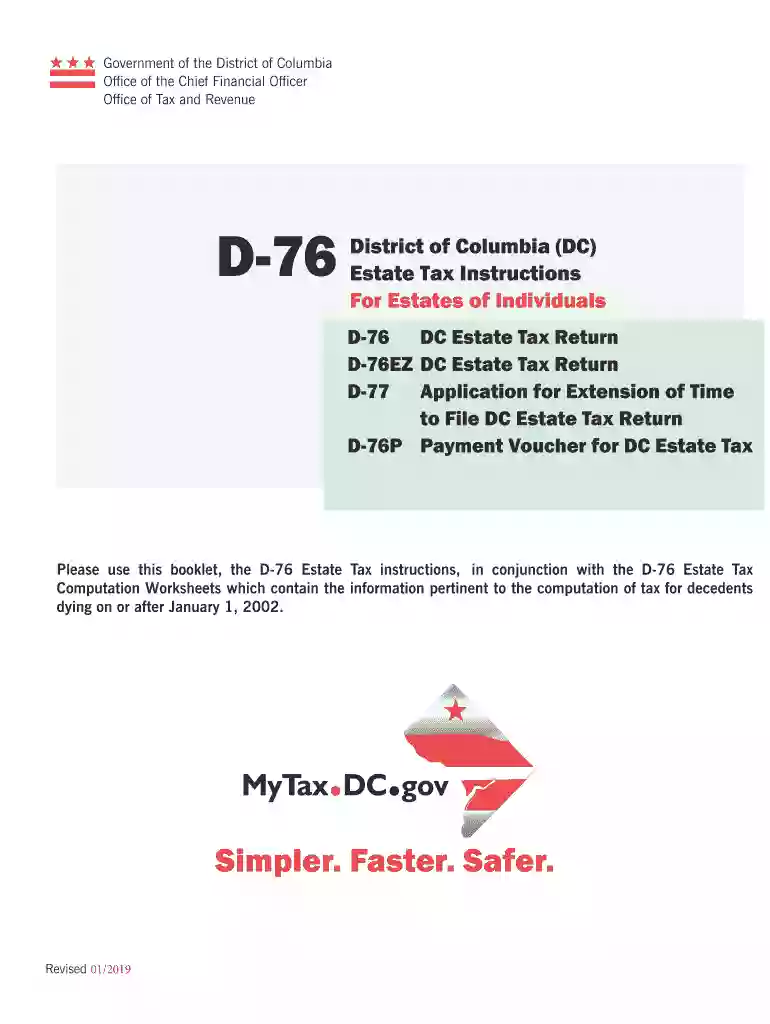
Dc estate tax return 2026

Get Form
dc estate tax return Preview on Page 1

Here's how it works

01. Edit your dc estate tax return online
Type text, add images, blackout confidential details, add comments, highlights and more.

02. Sign it in a few clicks
Draw your signature, type it, upload its image, or use your mobile device as a signature pad.

03. Share your form with others
Send it via email, link, or fax. You can also download it, export it or print it out.

How to use or fill out DC Estate Tax Return with our platform

Form edit decoration
9.5
Ease of Setup
DocHub User Ratings on G2
9.0
Ease of Use
DocHub User Ratings on G2
  1. Click ‘Get Form’ to open the DC Estate Tax Return (Form D-76) in the editor.
  2. Begin by entering the gross value of property located in the District of Columbia on Line 1. Ensure that this value is accurate and based on fair market appraisals.
  3. Proceed to Line 2 and input the total gross estate amount from Line 13 of the Recapitulation. Attach a copy of the appraisal for verification.
  4. On Line 3, enter total allowable deductions as calculated from Line 24 of Form D-76. This will help determine your taxable estate.
  5. Calculate your tentative taxable estate by subtracting the total allowable deductions (Line 3) from the total gross estate (Line 2) on Line 4.
  6. Use the Tax Table on the Estate Tax Computation Worksheet to calculate the DC Estate Tax due, and enter this amount on Line 5.
  7. If applicable, indicate any payment made with an extension request on Line 6, and check for any overpayment on Line 7.
  8. Complete Lines 8 through 11 to finalize your tax calculations, ensuring all penalties and interest are accounted for accurately.

Start filling out your DC Estate Tax Return today using our platform for a seamless experience!

See more dc estate tax return versions

We've got more versions of the dc estate tax return form. Select the right dc estate tax return version from the list and start editing it straight away!
Versions Form popularity Fillable & printable
2025 4.5 Satisfied (28 Votes)
2022 4.8 Satisfied (23 Votes)
2022 4.9 Satisfied (22 Votes)
2021 4.8 Satisfied (50 Votes)
2020 4.4 Satisfied (111 Votes)
2019 4.3 Satisfied (37 Votes)
2018 4 Satisfied (28 Votes)
2013 4.3 Satisfied (115 Votes)
be ready to get more

Complete this form in 5 minutes or less

Get form

Got questions?

We have answers to the most popular questions from our customers. If you can't find an answer to your question, please contact us.
Contact us
The executor or the trustee, as applicable, is responsible for filing the required federal and state estate tax returns and ensuring that all taxes are paid from the estate. After confirming no additional liabilities exist, the executor or trustee will distribute the remaining assets to the named beneficiaries.
An estate tax return is required if the gross value of the estate is over a certain threshold. For individuals who die in 2025, the threshold is $13.99 million (up from $13.61 million in 2024). Almost anything belonging to the deceased with a tangible cash value is included in the value of the estate.
Washington, D.C. Estate Tax Rate and Estate Tax Exemption In DC, the estate tax rate is 11.2% to 16% for those who die on or after January 1, 2023. The estate tax is progressive, which means the higher the estates value, the higher the tax rate.
For 2025, the Washington, D.C. estate tax exemption is $4,873,200.
Estate taxes are paid by a decedents estate before assets are distributed to heirs and are thus imposed on the overall value of the estate. Inheritance taxes are remitted by the recipient of a bequest and are thus based on the amount distributed to each beneficiary.

Security and compliance

At DocHub, your data security is our priority. We follow HIPAA, SOC2, GDPR, and other standards, so you can work on your documents with confidence.

Learn more
ccpa2
pci-dss
gdpr-compliance
hipaa
soc-compliance

People also ask

Estate tax returns are legal documents filed with the government after an individuals death to report the total value of their estate, including assets and liabilities, for tax assessment purposes.
An estate tax is levied on the estate of the deceased while an inheritance tax is levied on the heirs of the deceased. Only 17 states and the District of Columbia currently levy an estate or inheritance tax.
Some states have inheritance taxes, but California is not one. However, its essential to be aware that even though there is no inheritance tax in California, there may still be federal estate tax to consider.

Related links