




Here's how it works

01. Edit your form online
Type text, add images, blackout confidential details, add comments, highlights and more.

02. Sign it in a few clicks
Draw your signature, type it, upload its image, or use your mobile device as a signature pad.

03. Share your form with others
Send it via email, link, or fax. You can also download it, export it or print it out.
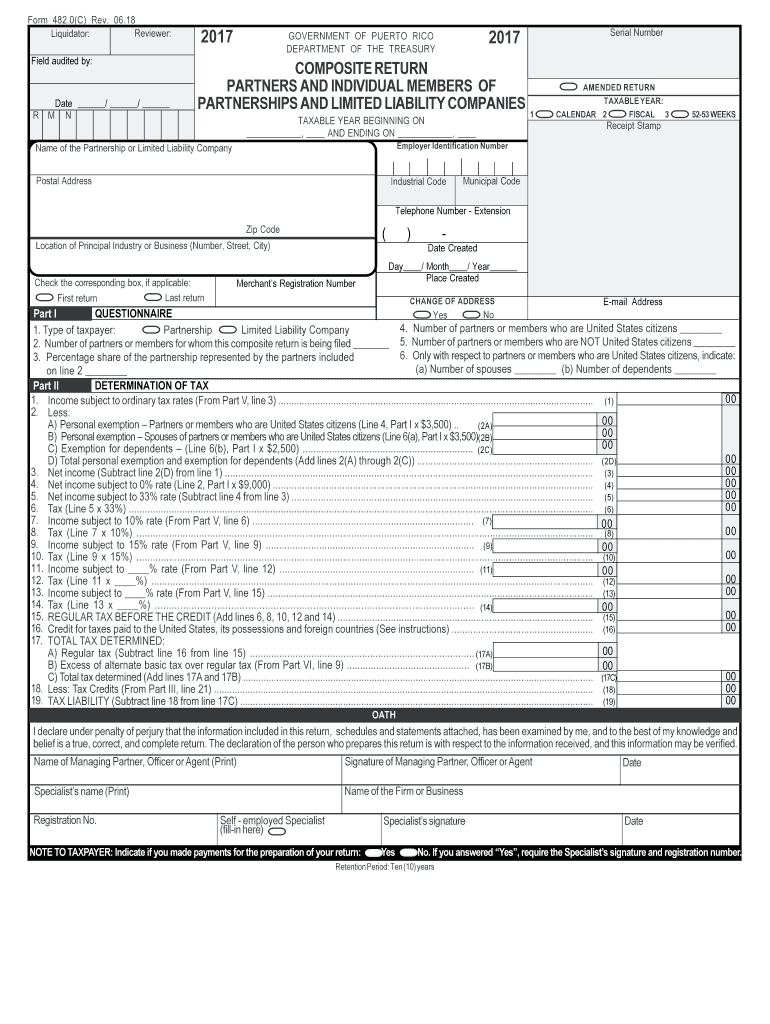
How to use or fill out 482.0(C) COMPOSITE PARTNER RETURN Rev. 06.18 with our platform

- Click ‘Get Form’ to open the 482.0(C) COMPOSITE PARTNER RETURN in the editor.
- Begin by filling out the heading section, including the taxable year and partnership details such as name, address, and employer identification number.
- In Part I, complete the Questionnaire by indicating the type of taxpayer (Partnership or LLC), number of partners, and their citizenship status.
- Proceed to Part II for Determination of Tax. Enter income subject to ordinary tax rates and calculate personal exemptions based on U.S. citizen partners.
- In Part III, list any applicable credits that may reduce your tax liability, ensuring all calculations are accurate.
- Complete Part IV regarding tax due or overpaid amounts, ensuring you account for any payments made during the year.
- Finally, review all sections for accuracy before signing and submitting your return through our platform.
Start using our platform today to simplify your form completion process for free!
Fill out 482.0(C) COMPOSITE PARTNER RETURN Rev. 06.18. 482.0(C) COMPOSITE PARTNER RETURN Rev. 06.18 online
It's free
It's free
See more 482.0(C) COMPOSITE PARTNER RETURN Rev. 06.18. 482.0(C) COMPOSITE PARTNER RETURN Rev. 06.18 versions
We've got more versions of the 482.0(C) COMPOSITE PARTNER RETURN Rev. 06.18. 482.0(C) COMPOSITE PARTNER RETURN Rev. 06.18 form. Select the right 482.0(C) COMPOSITE PARTNER RETURN Rev. 06.18. 482.0(C) COMPOSITE PARTNER RETURN Rev. 06.18 version from the list and start editing it straight away!
Security and compliance
At DocHub, your data security is our priority. We follow HIPAA, SOC2, GDPR, and other standards, so you can work on your documents with confidence.
Learn more


Related forms

Dcff2742-E Child Care Authorization Worksheetdoc - dcf wisconsin
The Child Care Authorization Worksheet is a non-mandatory form used by the Department of Children and Families to determ ...

Dcf-f-dwsp2012 doc
The document is a medical examination form used by the Wisconsin Department of Children and Families for participants in ...

Form patient history form - Story Physical Therapy
The document is a patient history form that collects essential information regarding a patient's current medical conditi ...

Mv2688
The document is a Monthly Vehicle Mileage and Fuel Summary form from the Wisconsin Department of Transportation. It requ ...

Small Claims Application Form
The document is an application form for filing small claims in the Ninth Judicial District's City Court. It outlines the ...
TUITION PAYMENT AGREEMENT-HIGH SCHOOL
The document is a Tuition Payment Agreement for a high school, outlining the payment terms for a parent or legal guardia ...

Liability Waiver And Release Agreement
The document is a Liability Waiver and Release Agreement for participants in the 'Move and Groove with Seniors' classes ...

EXTERNAL APPEAL APPLICATION - activehealthcom
The document outlines the process for filing an External Appeal Application with the New Jersey Department of Banking an ...


