




01. Edit your 1120 reit online
Type text, add images, blackout confidential details, add comments, highlights and more.

Type text, add images, blackout confidential details, add comments, highlights and more.

Draw your signature, type it, upload its image, or use your mobile device as a signature pad.

Send it via email, link, or fax. You can also download it, export it or print it out.
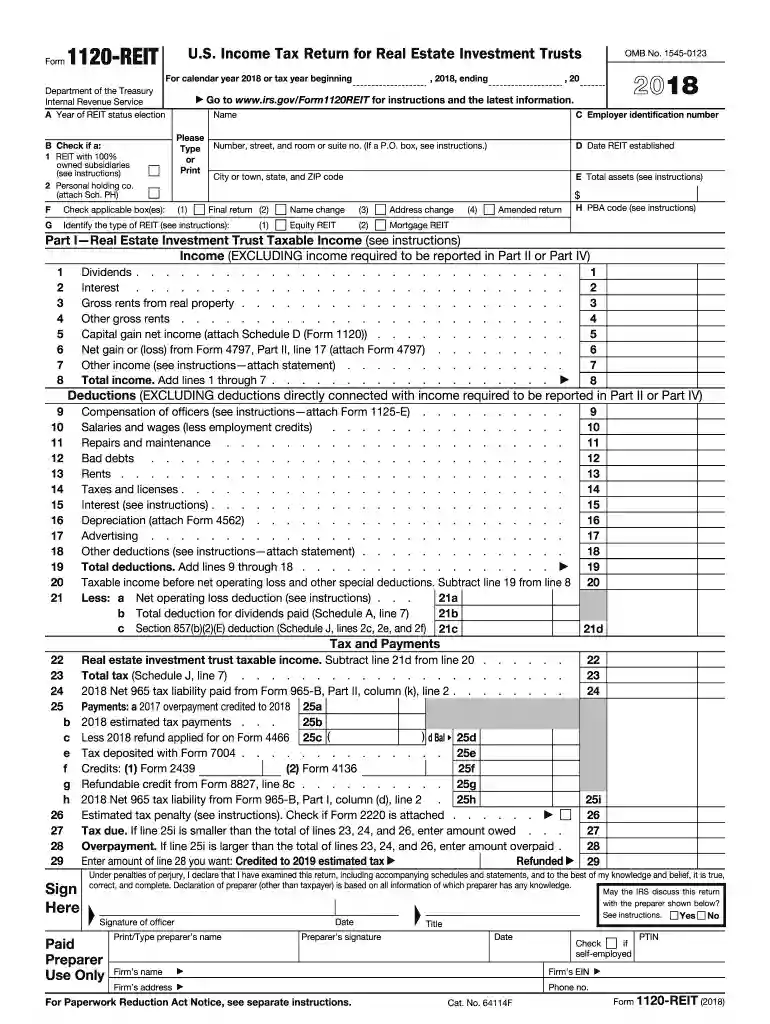
Form 1120-REIT is the U.S. Income Tax Return specifically for Real Estate Investment Trusts (REITs). This tax form is used to report the taxable income, deductions, and taxes related to real estate investment activities for the tax year 2018. It is essential for documenting the financial operations of a REIT, including information about assets, income sources, and distributions to shareholders.
Gather Required Documents: Before starting, collect all necessary financial statements, records of income, and details of expenses and deductions.
Complete General Information: Fill in the basic information about the REIT, including its name, address, and employer identification number.
Report Income: Input data regarding the REIT's total income from real estate sales, rental income, and any other revenue sources.
Calculate Deductions: Identify and subtract applicable deductions such as management fees, operational expenses, and interest on loans.
Determine Tax Liability: Use the form to compute the taxable income after deductions and apply the appropriate tax rates to find the total tax due.
Record Dividends: Include information on dividends paid out to shareholders, as this affects the calculation of taxable income.
Review & Submit: Check the form for accuracy before submission via mail or electronically to the IRS.
Income Section: Captures all income earned by the REIT, including rental income and gains from property sales.
Deductions Section: Detailed listing of deductible expenses such as depreciation, interest paid, and administrative expenses.
Tax Computation: Involves calculating the taxable income and determining the tax owed based on current IRS tax rates for REITs.
Dividends Paid Deduction: Critical for determining the REIT’s taxable income since distributions affect the modified taxable income.
Compliance Checkboxes: Includes various statements to ensure adherence to specific tax requirements and conditions.
REIT: A corporation that invests in real estate through property and mortgages, qualifying for specific tax advantages.
Dividends-Received Deduction: Allows REITs to deduct dividends distributed to shareholders, impacting the taxable income.
Undistributed Income: Income not distributed to shareholders, increasing the REIT's taxable income and potential tax liability.
REITs must adhere to the IRS guidelines for reporting income and deductions accurately. This includes meeting specific criteria for qualification as a REIT, such as asset and income tests, and ensuring compliance with dividend distribution requirements, which must be satisfied to maintain tax-favored status.
The deadline for filing the 2018 Form 1120-REIT is typically the 15th day of the fourth month following the end of the REIT’s tax year. For those using a calendar year, this generally falls on April 15. Extensions may be available, but the request must be filed before the due date.
To complete Form 1120-REIT accurately, REITs need the following:
REITs can submit Form 1120-REIT through various methods:
Online Submission: Via the IRS e-file system for secure electronic filing.
Mail: Mailing the completed form to the designated IRS address depending on the location or specific instructions for REITs.
Authorized IRS e-file Providers: Using third-party providers who are authorized by the IRS to submit forms electronically.
Failure to file Form 1120-REIT on time, or errors in the submission, can lead to penalties. These may include fines for late filing, failure to pay taxes, or inaccuracies within the report. It’s critical for REITs to ensure accurate completion and timely submission to avoid these punitive measures.
We've got more versions of the 1120 reit form. Select the right 1120 reit version from the list and start editing it straight away!
| Versions | Form popularity | Fillable & printable |
|---|---|---|
| 2025 | 4.5 Satisfied (52 Votes) | |
| 2024 | 4.4 Satisfied (24 Votes) | |
| 2023 | 4.6 Satisfied (20 Votes) | |
| 2022 | 4.1 Satisfied (57 Votes) | |
| 2021 | 4.8 Satisfied (246 Votes) | |
| 2020 | 4.3 Satisfied (199 Votes) | |
| 2019 | 4.3 Satisfied (223 Votes) | |
| 2018 | 4.4 Satisfied (117 Votes) | |
| 2017 | 4.3 Satisfied (50 Votes) | |
| 2016 | 4.4 Satisfied (280 Votes) | |
| 2015 | 4.3 Satisfied (163 Votes) |
At DocHub, your data security is our priority. We follow HIPAA, SOC2, GDPR, and other standards, so you can work on your documents with confidence.
Instructions for Form 1120-REIT, U.S. income tax return for real estate investment trusts. Author / Creator: United States. Internal Revenue Service. AvailableRead more
Part IReal Estate Investment Trust Taxable Income (see instructions). Income (EXCLUDING income required to be reported in Part II or Part IV).Read more


