




01. Edit your form online
Type text, add images, blackout confidential details, add comments, highlights and more.

Type text, add images, blackout confidential details, add comments, highlights and more.

Draw your signature, type it, upload its image, or use your mobile device as a signature pad.

Send it via email, link, or fax. You can also download it, export it or print it out.
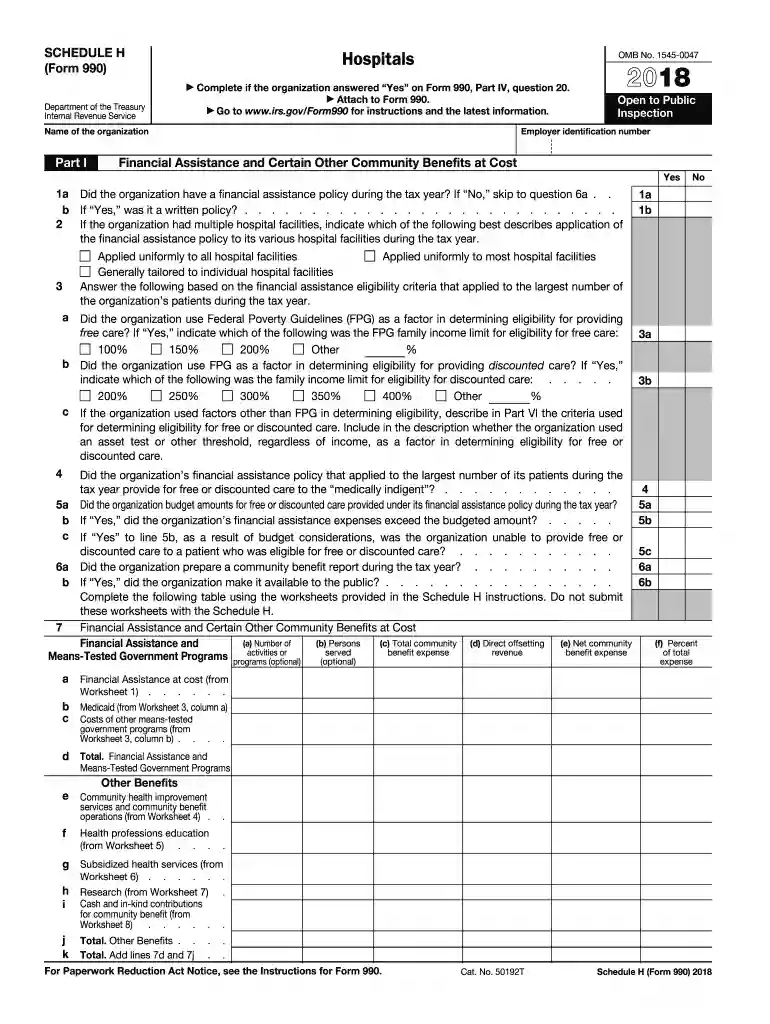
IRS Form Schedule H for 2017 is specifically used by private organizations to report information related to hospitals. It is part of the Form 990, commonly filed by tax-exempt or nonprofit organizations, to disclose details on hospital financial assistance, community health needs assessments, billing and collection practices, and community benefits. Its main aim is to provide transparency about how hospitals address the needs of local communities, particularly underserved populations.
The form requires hospitals to describe their financial assistance policies, specifically how they determine eligibility and what types of financial relief are provided to patients. Key elements include:
Hospitals must report on their assessments of community health needs and outline any strategy developed to handle identified issues. The details should encompass:
Hospitals and relevant organizations can download IRS Form Schedule H 2017 from the official IRS website. Additionally, it can be accessed via taxation software platforms like TurboTax or QuickBooks, which facilitate easier downloading, completion, and submission.
Gather Necessary Information:
Complete Financial Assistance Sections:
Community Health Reporting:
Review and Submit:
The form is primarily used by tax-exempt hospitals in the United States. These include:
Organizations must ensure that all disclosed information in Form Schedule H is accurate and truthful. The requirements state that:
The IRS mandates that Form Schedule H is filed annually alongside Form 990. Important dates include:
For a comprehensive and accurate reporting on Form Schedule H, hospitals need:
Failure to file IRS Form Schedule H, or filing with inaccuracies, can lead to penalties:
Through careful organization, accurate completion, and timely submission, hospitals can leverage IRS Form Schedule H to effectively demonstrate their dedication to the health and wellness of the communities they serve.
We've got more versions of the irs form schedule h 2017 form. Select the right irs form schedule h 2017 version from the list and start editing it straight away!
| Versions | Form popularity | Fillable & printable |
|---|---|---|
| 2025 | 4.8 Satisfied (58 Votes) | |
| 2024 | 4.8 Satisfied (52 Votes) | |
| 2023 | 4.9 Satisfied (53 Votes) | |
| 2022 | 4.5 Satisfied (58 Votes) | |
| 2021 | 4.8 Satisfied (213 Votes) | |
| 2020 | 4.2 Satisfied (42 Votes) | |
| 2019 | 3.8 Satisfied (41 Votes) | |
| 2018 | 4.3 Satisfied (47 Votes) | |
| 2017 | 4.4 Satisfied (112 Votes) | |
| 2016 | 4.4 Satisfied (458 Votes) | |
| 2012 | 4 Satisfied (49 Votes) |
At DocHub, your data security is our priority. We follow HIPAA, SOC2, GDPR, and other standards, so you can work on your documents with confidence.
May 2, 2017 or Schedule H (Form 1040) filed with the IRS, you will be contacted to resolve the discrepancies. To help reduce discrepancies on Forms W-2:.Read more
Calendar year taxpayers having no household employees in 2017 dont have to complete this form for 2017. A Did you pay any one household employee cash wages ofRead more


