




01. Edit your form online
Type text, add images, blackout confidential details, add comments, highlights and more.

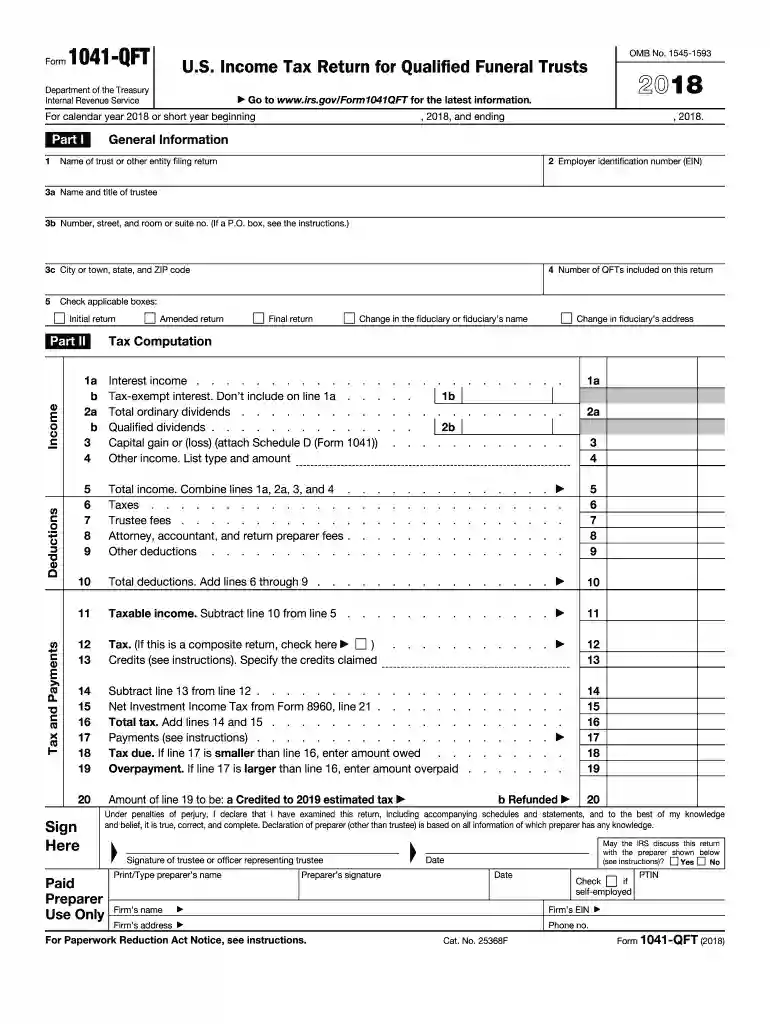
Type text, add images, blackout confidential details, add comments, highlights and more.

Draw your signature, type it, upload its image, or use your mobile device as a signature pad.

Send it via email, link, or fax. You can also download it, export it or print it out.
The Form 1041-QFT is a U.S. Income Tax Return specifically created for Qualified Funeral Trusts (QFTs). A QFT is a type of trust that enables individuals to set aside funds to cover future funeral expenses. The form ensures that all income generated from these trusts is reported correctly to the IRS. Understanding the nuances of Form 1041-QFT is essential for trustees managing these accounts, as it addresses various tax obligations associated with QFTs, including reporting of income, deductions, and liabilities.
To properly use the 1041-QFT, trustees must follow IRS guidelines which outline how the form should be completed and submitted. The form's structure is designed to capture all necessary financial details surrouding the trust. Every field must be filled with precise information based on the trust's earnings and disbursements within the tax year. This ensures accurate tax computation and compliance with federal regulations. Familiarity with specific terminologies and sections of the form enhances the accuracy and reliability of the submission.
The 1041-QFT form must be filed annually, typically by the 15th day of the fourth month following the end of the trust's tax year (April 15 for calendar year trusts). It's crucial for trustees to adhere to this deadline to avoid penalties. Extensions are possible, but the request must be submitted before the original due date. Keeping track of these important dates ensures adherence to IRS requirements and helps maintain good standing.
Preparing the 1041-QFT involves assembling several critical documents, including:
Failing to file the 1041-QFT on time or submitting an inaccurate form can lead to significant penalties. These penalties may include a percentage of the tax due, a fixed amount for late filing, or interest on overdue taxes. It's vital for trustees to submit accurate information and pay any taxes due by the deadline to avoid these financial repercussions. Understanding these consequences highlights the importance of timely and precise tax filings.
The IRS provides explicit guidelines on completing and submitting Form 1041-QFT. These guidelines outline the procedures for accurately reporting income, maintaining records, and calculating deductions. Trustees should consult these resources to ensure compliance. Detailed instructions are available within the form itself and on the IRS website, offering additional clarity on specific tax rules and expectations. Familiarity with these guidelines helps trustees submit accurate returns and mitigate potential issues.
We've got more versions of the 1041 qft form. Select the right 1041 qft version from the list and start editing it straight away!
| Versions | Form popularity | Fillable & printable |
|---|---|---|
| 2025 | 4.1 Satisfied (23 Votes) | |
| 2024 | 4.3 Satisfied (33 Votes) | |
| 2023 | 4.4 Satisfied (58 Votes) | |
| 2022 | 4.9 Satisfied (38 Votes) | |
| 2021 | 4.8 Satisfied (59 Votes) | |
| 2020 | 4.2 Satisfied (44 Votes) | |
| 2019 | 4.1 Satisfied (69 Votes) | |
| 2018 | 4.2 Satisfied (79 Votes) | |
| 2017 | 4.2 Satisfied (95 Votes) | |
| 2016 | 4.4 Satisfied (573 Votes) | |
| 2015 | 4.1 Satisfied (74 Votes) | |
| 2014 | 4 Satisfied (27 Votes) | |
| 2013 | 4 Satisfied (23 Votes) | |
| 2012 | 4.3 Satisfied (43 Votes) | |
| 2011 | 4 Satisfied (34 Votes) |
At DocHub, your data security is our priority. We follow HIPAA, SOC2, GDPR, and other standards, so you can work on your documents with confidence.
Form 1041-QFT, U.S. income tax return for qualified funeral trusts. Journal/Periodical. See availability. Description. Language: English. Imprint: [Washington
Mar 30, 2026 The trustee of a trust that has elected to be taxed as a qualified funeral trust (QFT) files Form 1041-QFT to report the income, deductions,Read more


