2014 ia schedule a-2026

Get Form
2014 ia schedule a Preview on Page 1

Here's how it works

01. Edit your form online
Type text, add images, blackout confidential details, add comments, highlights and more.

02. Sign it in a few clicks
Draw your signature, type it, upload its image, or use your mobile device as a signature pad.

03. Share your form with others
Send it via email, link, or fax. You can also download it, export it or print it out.

How to use or fill out 2014 IA Schedule A with our platform

Form edit decoration
9.5
Ease of Setup
DocHub User Ratings on G2
9.0
Ease of Use
DocHub User Ratings on G2
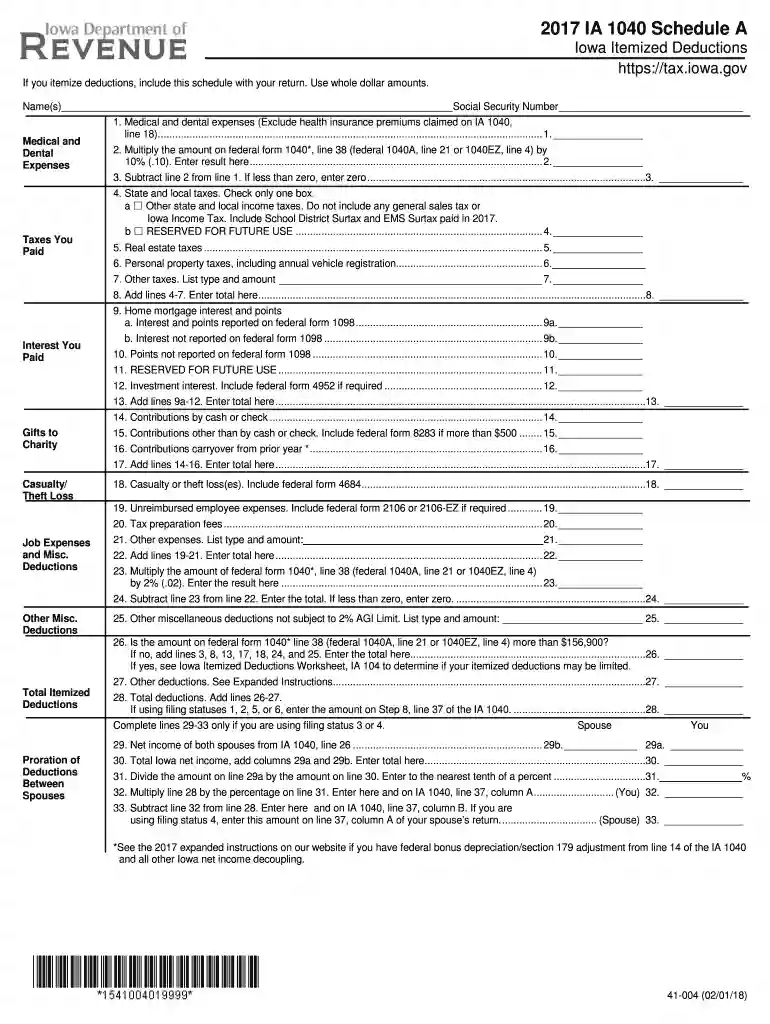
  1. Click ‘Get Form’ to open the 2014 IA Schedule A in the editor.
  2. Begin by entering your name(s) and Social Security Number at the top of the form.
  3. In the 'Medical and Dental Expenses' section, input your total medical expenses on line 1. Remember to exclude health insurance premiums claimed elsewhere.
  4. Calculate 10% of your federal income (line 38 from your federal return) and enter this amount on line 2. Subtract line 2 from line 1 and enter the result on line 3.
  5. For 'Taxes You Paid', check one box for state and local taxes on line 4, then fill in real estate taxes on line 5 and personal property taxes on line 6.
  6. Continue filling out sections for interest paid, gifts to charity, job expenses, and other deductions as applicable, ensuring you follow the prompts for each section.
  7. Finally, add up all relevant lines to determine your total itemized deductions and ensure accuracy before submission.

Start using our platform today for free to simplify your form completion process!

See more 2014 ia schedule a versions

We've got more versions of the 2014 ia schedule a form. Select the right 2014 ia schedule a version from the list and start editing it straight away!
Versions Form popularity Fillable & printable
2022 4.7 Satisfied (38 Votes)
2021 4.8 Satisfied (27 Votes)
2020 4.4 Satisfied (73 Votes)
2019 4.3 Satisfied (169 Votes)
2018 4.3 Satisfied (110 Votes)
2018 4.3 Satisfied (156 Votes)
2014 4.4 Satisfied (491 Votes)
2013 4 Satisfied (46 Votes)
be ready to get more

Complete this form in 5 minutes or less

Get form

Got questions?

We have answers to the most popular questions from our customers. If you can't find an answer to your question, please contact us.
Contact us
Most income is taxable unless its specifically exempted by law. Income can be money, property, goods or services. Even if you dont receive a form reporting income, you should report it on your tax return. Income is taxable when you receive it, even if you dont cash it or use it right away.
Beginning in tax year 2025, Iowa will transition to a flat tax of 3.8%. While that flat tax shift will eventually simplify the states tax system, current-year taxpayers may still need help understanding their responsibilities.
You also must file an Iowa return IF: For information about military spouses, see Military Spouses Residency Relief Act. You were subject to Iowa lump-sum tax. You were a nonresident or part-year resident and your net income from Iowa sources was $1,000 or more, unless below the income thresholds above.
You must list all forms of income, including any self-employment earnings, tips or business income, and then check your eligibility for tax deductions or credits.
Tax season officially begins the same day as Federal return processing (January 27, 2025) and tax Iowa tax returns are due April 30.

Security and compliance

At DocHub, your data security is our priority. We follow HIPAA, SOC2, GDPR, and other standards, so you can work on your documents with confidence.

Learn more
ccpa2
pci-dss
gdpr-compliance
hipaa
soc-compliance

People also ask

A filer also needs to report wages, salary, taxable interest, capital gains, pensions, Social Security benefits, and other types of income. Taxpayers may need to file supplemental tax 1040 forms depending on their situation.
Taxpayers must include personal information on Form 1040, such as name, address, Social Security number, and the number of dependents. A filer also needs to report wages, salary, taxable interest, capital gains, pensions, Social Security benefits, and other types of income.
Key Takeaways. Income received as wages, salaries, commissions, rental income, royalty payments, stock options, dividends and interest, and self-employment income are taxable. Unemployment compensation generally is taxable.

Related links