EXCESS NET PASSIVE INCOME TAX 2026

Get Form
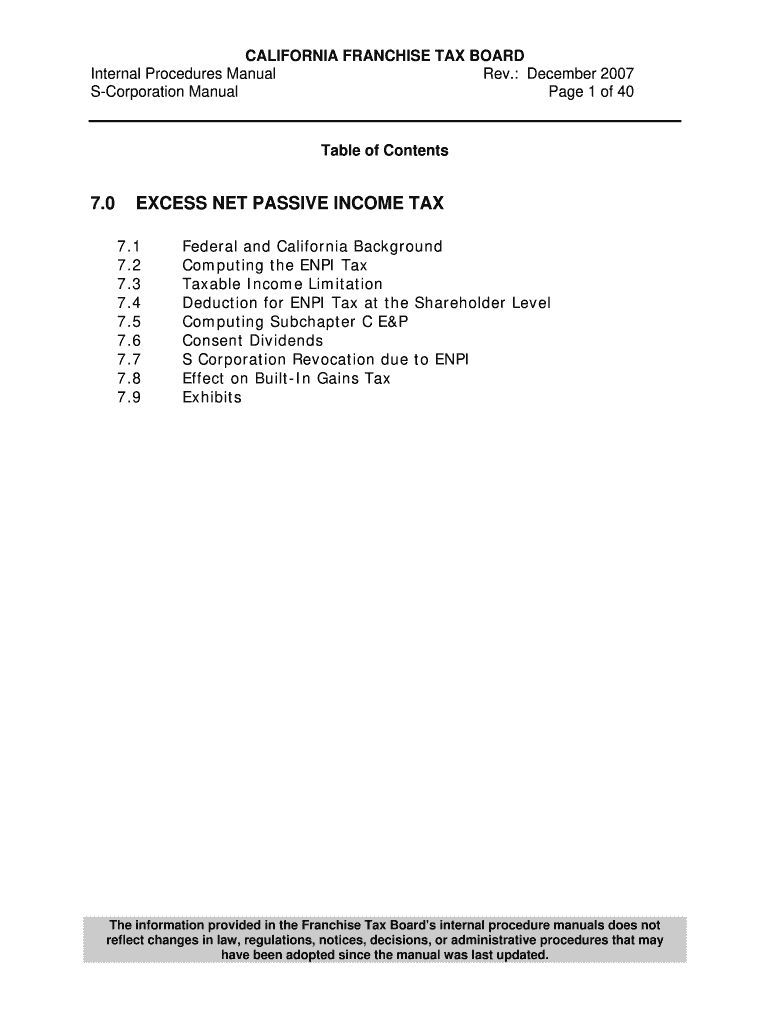
excess net passive income tax Preview on Page 1

Here's how it works

01. Edit your excess net passive income tax online
Type text, add images, blackout confidential details, add comments, highlights and more.
02. Sign it in a few clicks
Draw your signature, type it, upload its image, or use your mobile device as a signature pad.
03. Share your form with others
Send it via email, link, or fax. You can also download it, export it or print it out.

How to use or fill out EXCESS NET PASSIVE INCOME TAX with our platform

Form edit decoration
9.5
Ease of Setup
DocHub User Ratings on G2
9.0
Ease of Use
DocHub User Ratings on G2
  1. Click ‘Get Form’ to open the EXCESS NET PASSIVE INCOME TAX document in the editor.
  2. Begin by reviewing the Federal and California Background section. This will provide context on how ENPI is calculated and its implications for S Corporations.
  3. Proceed to compute your ENPI tax. Fill in your passive investment income, gross receipts, and any deductions directly connected to this income.
  4. Ensure you understand the Taxable Income Limitation. Input your taxable income as if you were a C corporation, excluding certain deductions as specified.
  5. Review the Deduction for ENPI Tax at the Shareholder Level section. Make sure to adjust each item of passive investment income proportionately based on the ENPI tax paid.
  6. Finally, check all entries for accuracy before saving or exporting your completed form. Utilize our platform's features to sign and distribute your document seamlessly.

Start using our platform today to simplify your EXCESS NET PASSIVE INCOME TAX form completion!

See more EXCESS NET PASSIVE INCOME TAX versions

We've got more versions of the EXCESS NET PASSIVE INCOME TAX form. Select the right EXCESS NET PASSIVE INCOME TAX version from the list and start editing it straight away!
Versions Form popularity Fillable & printable
2018 4.9 Satisfied (36 Votes)
2007 4.3 Satisfied (64 Votes)
be ready to get more

Complete this form in 5 minutes or less

Get form

Got questions?

We have answers to the most popular questions from our customers. If you can't find an answer to your question, please contact us.
Contact us
The NIIT tax rate is 3.8%. It is applied to either your net investment income or the amount by which your modified adjusted gross income (MAGI) exceeds the threshold for your status, whichever is less.
If an S corporation has pre-S corporation earnings and profits at the end of a tax year and its passive investment income is more than 25% of its gross receipts, the S corporation may be subject to a tax on excess net passive income.
An S corporation with accumulated earnings and profits that also has passive investment income totaling more than 25 percent of gross receipts is subject to an income tax computed by multiplying excess net passive income by the highest corporate income tax rate ( Code Sec.
Key takeaways on passive income and taxes Passive income is generally taxed at the taxpayers marginal tax rate, similar to active income. However, those with a modified adjusted gross income above a certain threshold may be subject to the Net Investment Income Tax (NIIT) of 3.8%.
Excess net passive income is computed under a formula in which (1) the passive investment. income in excess of 25% of gross receipts for the taxable year is divided by the. corporations passive investment income for the taxable year; and (2) the net passive.

Security and compliance

At DocHub, your data security is our priority. We follow HIPAA, SOC2, GDPR, and other standards, so you can work on your documents with confidence.

Learn more
ccpa2
pci-dss
gdpr-compliance
hipaa
soc-compliance

People also ask

As an investor, you may owe an additional 3.8% tax called net investment income tax (NIIT). But youll only owe it if you have investment income and your modified adjusted gross income (MAGI) goes over a certain amount.
A corporation must pay the ENPI Tax if all the following apply: Its Accumulated Earnings and Profits (EP) at the close of the tax year. It has Passive Investment Income for the tax year that is in excess of 25% of Gross Receipts.

Related links