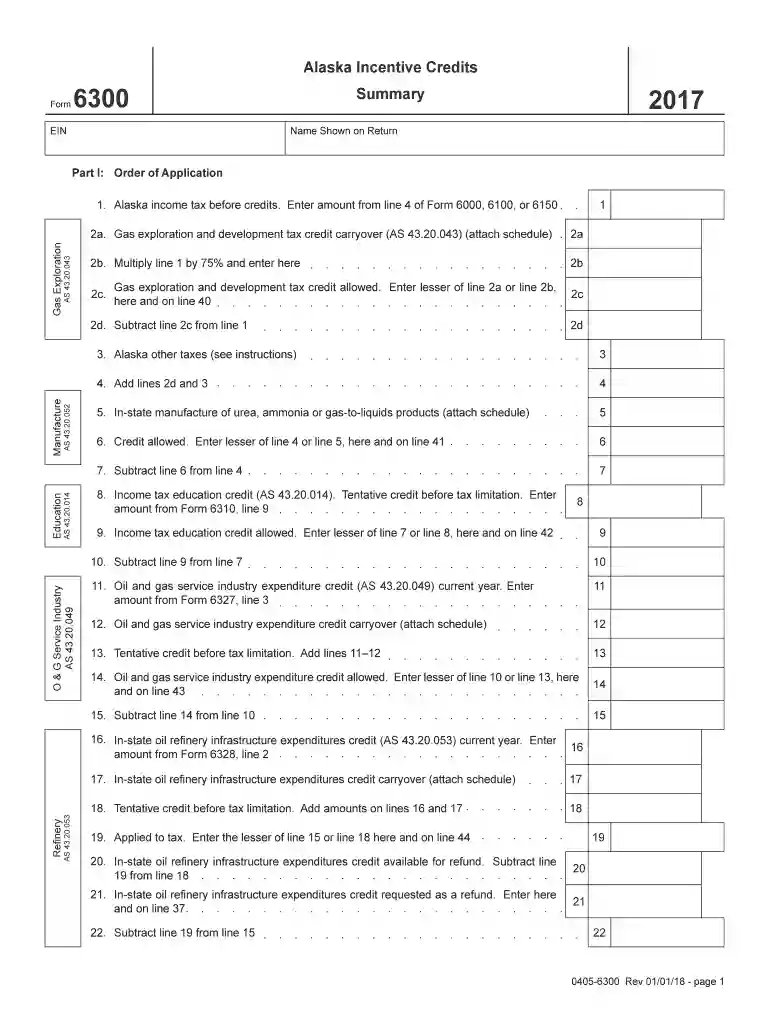
Alaska Incentive Credits Summary 2026

Get Form
Alaska Incentive Credits Summary Preview on Page 1

Here's how it works

01. Edit your form online
Type text, add images, blackout confidential details, add comments, highlights and more.

02. Sign it in a few clicks
Draw your signature, type it, upload its image, or use your mobile device as a signature pad.

03. Share your form with others
Send it via email, link, or fax. You can also download it, export it or print it out.

How to use or fill out Alaska Incentive Credits Summary with our platform

Form edit decoration
9.5
Ease of Setup
DocHub User Ratings on G2
9.0
Ease of Use
DocHub User Ratings on G2
  1. Click ‘Get Form’ to open the Alaska Incentive Credits Summary in the editor.
  2. Begin by entering your EIN and the name shown on your return at the top of the form.
  3. In Part I, start with line 1 by entering the amount from line 4 of Form 6000, 6100, or 6150. This is crucial for calculating your credits.
  4. Proceed to lines 2a through 2d, where you will input various tax credit amounts related to gas exploration. Ensure you attach any required schedules.
  5. Continue filling out subsequent lines, including those for education credits and oil & gas service industry expenditures. Pay attention to instructions for each line to determine if you need to enter lesser amounts.
  6. Finally, review Part III for a summary of all credits applied against tax. Make sure all calculations are accurate before submitting.

Start using our platform today for free and streamline your document editing experience!

See more Alaska Incentive Credits Summary versions

We've got more versions of the Alaska Incentive Credits Summary form. Select the right Alaska Incentive Credits Summary version from the list and start editing it straight away!
Versions Form popularity Fillable & printable
2023 4.7 Satisfied (29 Votes)
2022 4.9 Satisfied (24 Votes)
2021 4.8 Satisfied (60 Votes)
2020 4.3 Satisfied (128 Votes)
2019 4.2 Satisfied (53 Votes)
2018 4.4 Satisfied (91 Votes)
2017 4.2 Satisfied (35 Votes)
2015 4.3 Satisfied (148 Votes)
2013 4.4 Satisfied (331 Votes)
be ready to get more

Complete this form in 5 minutes or less

Get form

Got questions?

We have answers to the most popular questions from our customers. If you can't find an answer to your question, please contact us.
Contact us
If you make $100,000 a year living in the region of Alaska, United States of America, you will be taxed $22,671. That means that your net pay will be $77,329 per year, or $6,444 per month.
Alaska is a tax-friendly state, as it doesnt have an individual income tax. This means that income sources like retirement and pension funds, investment earnings, Social Security benefits, and military pay are not taxed at the state level, giving you a financial advantage if you call Alaska home.
Eight U.S. states impose no state income tax: Alaska, Florida, Nevada, New Hampshire, South Dakota, Tennessee, Texas, and Wyoming do not levy income taxes. Washington does not tax income but does tax capital gains of certain high earners.
The reality is that Alaska truly is unique among all 50 states when it comes to our revenue position. We have no state sales tax, no personal income tax, statutorily balanced budgets, and a huge endowment to fund government for generations to come.
There is no state income tax in Alaska. Likewise, there is no statewide sales tax, although local governments can collect their own sales taxes up to 7.85%. Property tax rates are slightly above the U.S. average. In some municipalities, however, seniors can exempt most or all of their home value from property taxes.

Security and compliance

At DocHub, your data security is our priority. We follow HIPAA, SOC2, GDPR, and other standards, so you can work on your documents with confidence.

Learn more
ccpa2
pci-dss
gdpr-compliance
hipaa
soc-compliance

People also ask

The Alaska Education Tax Credit (ETC) program, administered by the Department of Revenue, gives tax credits (50% of the contribution) to third party entities that make charitable donations (of either cash or equipment) for the purpose of education in the state.
Georgia. Georgia remains the gold standard for U.S. film tax incentives. New Mexico. New Mexico offers a 25% base refundable credit on qualified in-state spending, with opportunities to stack bonuses and docHub up to 40%. Illinois. New York. Louisiana. Other states worth exploring.

Related links