




01. Edit your 941v online
Type text, add images, blackout confidential details, add comments, highlights and more.

Type text, add images, blackout confidential details, add comments, highlights and more.

Draw your signature, type it, upload its image, or use your mobile device as a signature pad.

Send it via email, link, or fax. You can also download it, export it or print it out.
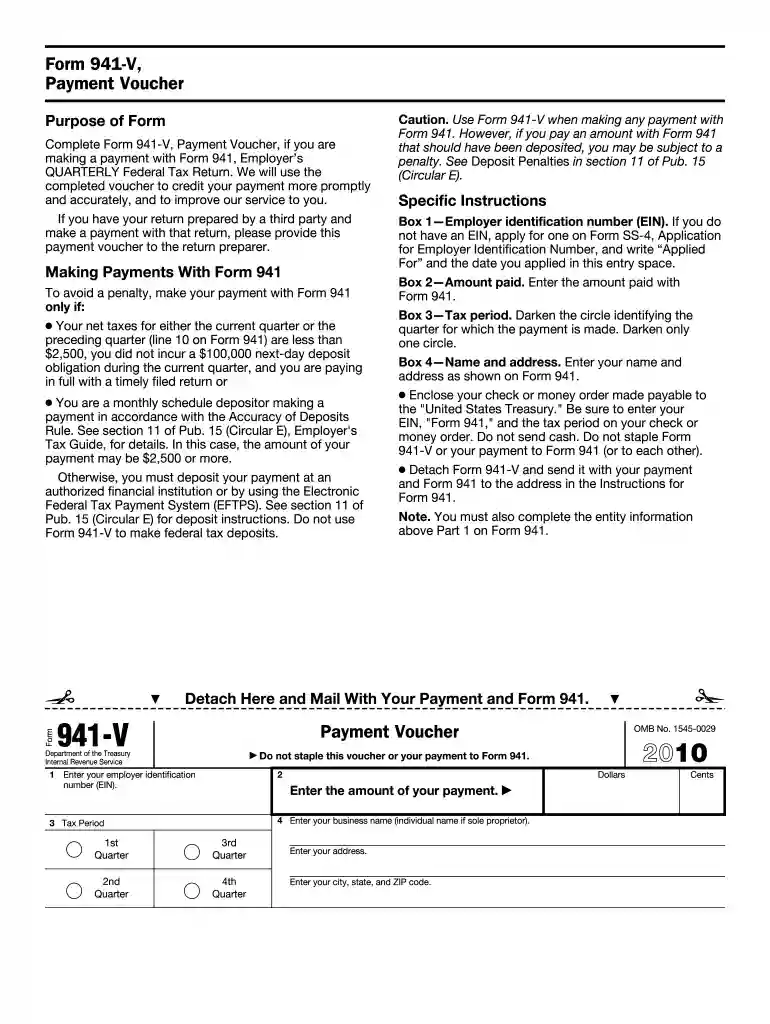
Form 941-V is a Payment Voucher that accompanies Form 941, the Employer's Quarterly Federal Tax Return. Its primary function is to ensure that payments towards the employer's payroll taxes are correctly credited to the right account. Employers are required to submit Form 941 quarterly, which allows them to report their earnings along with Social Security, Medicare, and income taxes withheld from their employees' paychecks. Using the 941-V payment voucher helps streamline the transaction process by clearly associating the payment with the reported period and amount due.
Utilizing Form 941-V correctly involves a few specific steps to ensure that your payment for employer taxes is appropriately processed. First, after completing Form 941, you should fill out Form 941-V with accurate details such as your Employer Identification Number (EIN), the amount being paid, and the relevant tax period. This voucher then accompanies your check or money order payment when submitting to the IRS. It is important to note that while the form provides a physical means to submit payment, the IRS encourages electronic payment methods for faster processing and accounting.
Enter Employer Identification Number (EIN): Ensure that your EIN is entered correctly. It's crucial for correctly associating the payment with your business tax records.
Specify the Amount Being Paid: Accurately fill in the payment amount that corresponds to your Form 941 filing. Double-checking this number helps in preventing errors in crediting payments.
Indicate the Tax Period: Clearly state the tax period that the payment covers. This ensures that the payment applies to the correct quarterly submission.
Provide Personal Information: Include details like your business name and address. This information should match the records associated with your EIN.
Attach Payment: Attach your payment to the voucher, ensuring it’s a check or money order payable to "United States Treasury."
Form 941-V is primarily used by businesses of all sizes across various industries that are required to report payroll taxes. This includes small businesses, large corporations, non-profit organizations, and any entity that employs staff members and withholds federal taxes on their behalf. Employers who prefer to make their tax payments via check or money order rather than electronically would typically use this form to ensure their payments are processed accurately alongside their Form 941 submissions.


The use of Form 941-V is mandated by the IRS for payments accompanying Form 941 submissions via physical mail. To ensure compliance with federal tax laws, businesses must accurately report their tax liabilities and submit payments on time. This form serves as an official record that helps both the taxpayer and the IRS in associating payments with the correct tax periods. Failing to use it correctly or skipping the form entirely when required can result in processing delays or misapplied payments.
Failure to submit Form 941-V with the correct details or missing deadlines can result in penalties imposed by the IRS. Typical penalties might include fines based on the amount of tax due, interest charges on outstanding amounts, and additional penalties for late payment. Employers are encouraged to adhere strictly to submission guidelines to avoid these financial repercussions, which can quickly escalate and impact business finances.
We've got more versions of the 941v form. Select the right 941v version from the list and start editing it straight away!
At DocHub, your data security is our priority. We follow HIPAA, SOC2, GDPR, and other standards, so you can work on your documents with confidence.
Complete Form 941-V, Payment Voucher, if you are making a payment with Form 941, Employers. QUARTERLY Federal Tax Return. We will use the completed voucher toRead more
May 2, 2017 Be sure that the payers name and EIN on Forms W-2 and. W-3 are the same as those used on the Form 941,. Employers QUARTERLY Federal Tax ReturnRead more


