Form m 6 2015-2025

Get Form
form m 6 2015 Preview on Page 1

Here's how it works

01. Edit your form online
Type text, add images, blackout confidential details, add comments, highlights and more.

02. Sign it in a few clicks
Draw your signature, type it, upload its image, or use your mobile device as a signature pad.

03. Share your form with others
Send it via email, link, or fax. You can also download it, export it or print it out.

How to use or fill out form m 6 2015 with our platform

Form edit decoration
9.5
Ease of Setup
DocHub User Ratings on G2
9.0
Ease of Use
DocHub User Ratings on G2
  1. Click ‘Get Form’ to open it in the editor.
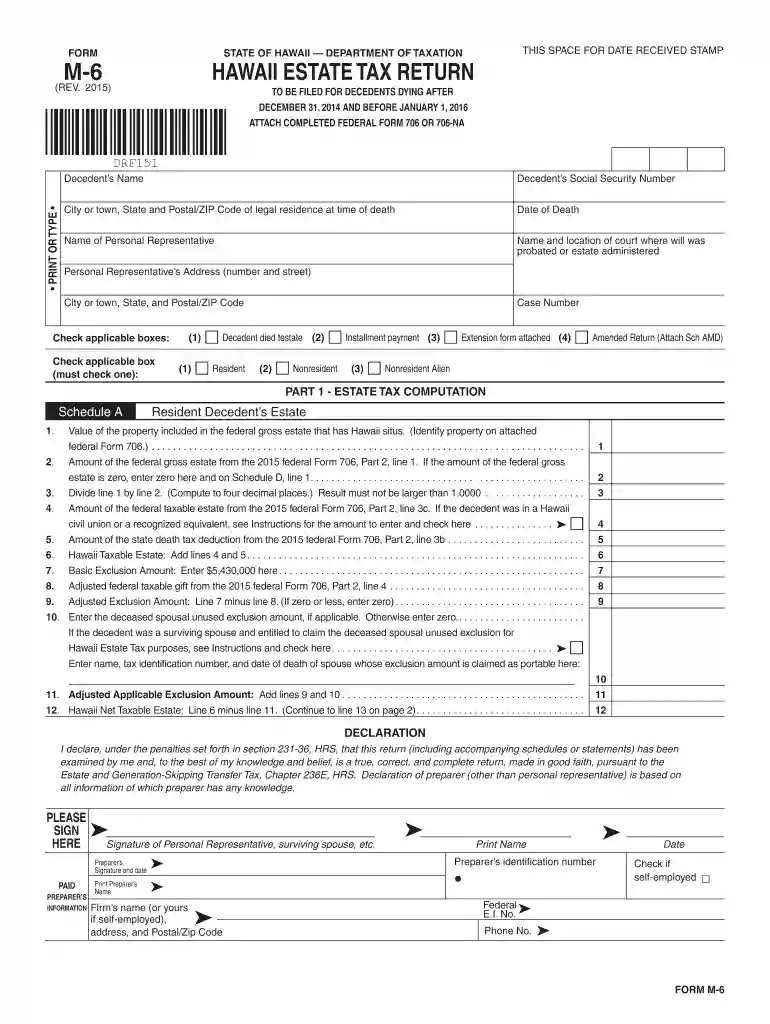
  2. Begin by entering the decedent’s name and Social Security number in the designated fields. Ensure accuracy as this information is crucial for identification.
  3. Fill in the city, state, and postal/ZIP code of the decedent's legal residence at the time of death, followed by the date of death.
  4. Provide details about the personal representative, including their name and address. This section is essential for communication regarding the estate.
  5. Check the applicable boxes indicating whether the decedent died testate or intestate, and specify residency status. This helps determine tax obligations.
  6. Proceed to Part 1 - Estate Tax Computation. Carefully input values from federal Form 706 as instructed, ensuring calculations are accurate.
  7. Complete all relevant schedules (A, B, C) based on residency status and ensure all required attachments are included before submission.

Start using our platform today to fill out your form m 6 2015 easily and for free!

See more form m 6 2015 versions

We've got more versions of the form m 6 2015 form. Select the right form m 6 2015 version from the list and start editing it straight away!
Versions Form popularity Fillable & printable
2022 4.7 Satisfied (44 Votes)
2021 4.8 Satisfied (110 Votes)
2020 4.4 Satisfied (177 Votes)
2019 4.3 Satisfied (68 Votes)
2018 4.3 Satisfied (82 Votes)
2017 4.3 Satisfied (48 Votes)
2016 4 Satisfied (26 Votes)
2015 4.3 Satisfied (141 Votes)
2014 4.4 Satisfied (492 Votes)
2013 4 Satisfied (58 Votes)
2005 4.3 Satisfied (33 Votes)
be ready to get more

Complete this form in 5 minutes or less

Get form

Got questions?

We have answers to the most popular questions from our customers. If you can't find an answer to your question, please contact us.
Contact us
The Federal estate tax applies to the transfer of property at death. Under present law, the estate of a decedent who, at death, owns assets in excess of the estate-tax exemption amount ($5.43 million in 2015) must file a Federal estate-tax return.
If you live in Hawaii and leave behind more than $5.49 million (for deaths occurring in 2025), your estate might have to pay the Hawaii estate tax. The Hawaii estate tax is separate from the federal estate tax, which is imposed only on estates worth more than $13.99 million (for deaths in 2025).
Most relatively simple estates (cash, publicly traded securities, small amounts of other easily valued assets, and no special deductions or elections, or jointly held property) do not require the filing of an estate tax return.
If the estate generates more than $600 in annual gross income, you are required to file Form 1041, U.S. Income Tax Return for Estates and Trusts. An estate may also need to pay quarterly estimated taxes. See Form 1041 instructions for information on when to file quarterly estimated taxes.
A Living Trust can help avoid or reduce estate taxes, gift taxes and income taxes, too. Your tax savings can amount to hundreds of thousands of dollars or more in some circumstances.
be ready to get more

Complete this form in 5 minutes or less

Get form