






Definition & Purpose of the 2019 Virginia Resident Form 760
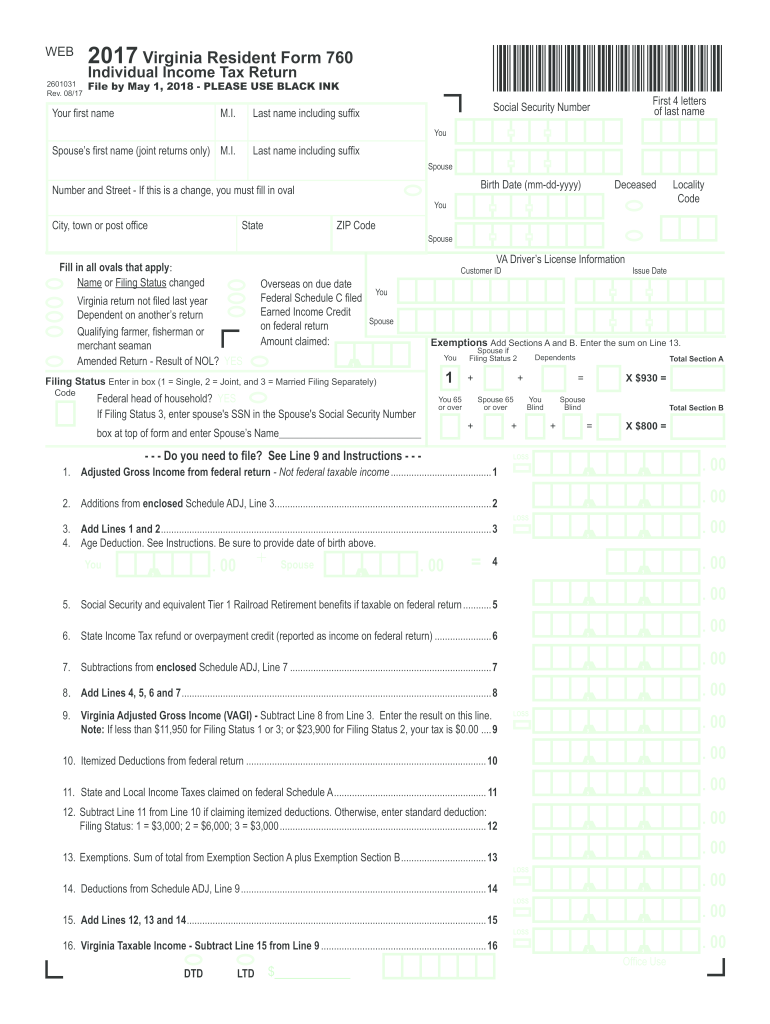
The 2019 Virginia Resident Form 760 serves as an Individual Income Tax Return form required by the state of Virginia. It is used by residents to report their annual income, calculate any taxes owed, and determine the eligibility for refunds. The form includes sections to declare adjusted gross income, exemptions, and deductions. Additionally, it outlines tax credits that can apply to various situations, helping taxpayers ensure compliance with Virginia state tax laws. Completion and submission of this form are mandatory for all Virginia residents with taxable income.
Steps to Complete the 2019 Virginia Resident Form 760
- Gather Required Information: Collect personal data, income documentation, deduction proofs, and previous tax returns to ensure accurate reporting.
- Personal Information Section: Fill in your name, address, and social security number accurately.
- Filing Status: Choose the correct filing status, such as Single, Married Filing Jointly, or Head of Household.
- Income Details: Enter your adjusted gross income using your federal income tax return as a reference.
- Deductions and Exemptions: List eligible deductions, exemptions, and credits to lower taxable income.
- Calculate Tax Owed or Refund: Use the form's instructions to compute earnings against taxes paid. Indicate if there’s a balance due or a refund.
- Sign and Date: Ensure you sign the form as an acknowledgment of the information provided.
- Attach Required Documentation: Include any necessary documentation, such as W-2s, with the form.
How to Obtain the 2019 Virginia Resident Form 760
- Online Access: The form can be downloaded from the Virginia Department of Taxation's official website. Digital copies can be printed or filled out using compatible software.
- Local Tax Offices: Obtain physical copies from local Virginia Department of Taxation offices or certain public libraries.
- Mail Requests: Request a paper copy to be mailed to your address by contacting the Virginia Department of Taxation.
Important Terms and Concepts Related to the 2019 Virginia Resident Form 760
- Adjusted Gross Income (AGI): Income after specific deductions are applied, crucial for tax liability calculation.
- Tax Credits and Deductions: Includes child credits, education deductions, and homeownership-related deductions. These lower the taxable income and potential tax owed.
- Exemptions: Allowances for self, spouse, and dependents, reducing the overall taxable income.
- Filing Status: Determines eligibility for specific exemptions and tax brackets, impacting the total tax computation.
Key Elements of the 2019 Virginia Resident Form 760
- Personal and Filing Status Information: Includes name, address, and social security number, and specifies taxpayer's filing status.
- Income Section: Comprehensive details about wages, salaries, and other forms of income.
- Taxable Income Calculation: Instructions for calculating total taxable income after deductions.
- Tax Payments and Credits: Sections to account for state tax payments already made as well as qualifying credits that reduce tax liability.
- Final Tax Calculation: Determines if additional taxes are owed or if a refund is due.
State-Specific Rules for the 2019 Virginia Resident Form 760
- Domicile and Residency Requirements: Tax laws demand a person meet residency or domicile conditions to file as a Virginia resident.
- State Credits: Virginia offers unique credits, including the Virginia Education Credit and the Virginia Child and Dependent Care Credit.
- Amendments and Extensions: Instructions for those needing to amend the form or apply for an extension beyond the standard filing deadline.
Filing Deadlines and Penalties for the 2019 Virginia Resident Form 760
- Standard Deadline: Typically, the deadline is May 1st of the year following the tax year. For the 2019 tax year, the deadline was May 1, 2020.
- Late Filing Penalties: Charges apply if the form is filed after the deadline without an approved extension. Penalties include interest on owed amounts and potential fines for substantial delays.
- Extension Requests: File for an extension if you cannot meet the May deadline to avoid penalties.
Form Submission Methods: Online, Mail, or In-Person
- Online Filing: Facilitated through the Virginia state tax website, providing a streamlined and efficient submission process.
- Mail-In Options: Send completed forms with the necessary attachments to the Virginia Department of Taxation’s address. Ensure postmark by the deadline.
- In-Person: Some tax services or offices offer the possibility of submitting forms directly, ideal for those needing immediate assistance or verification.
Taxpayer Scenarios for Utilizing the 2019 Virginia Resident Form 760
- Self-Employed Individuals: Must consider additional tax schedules to report business income accurately.
- Retirees with Pensions: Apply specific deductions for retirement income exemptions.
- Students or Young Professionals: May qualify for unique educational tax credits and student loan interest deductions.


Legal Considerations and Compliance for the 2019 Virginia Resident Form 760
- Signature Requirement: Both paper and electronic submissions require legally-binding signatures, ensuring authenticity.
- Documentation Records: Retain copies of submitted forms and any supporting documentation for at least three years for potential audits.
- Amendments: If necessary to amend, follow Virginia’s specific process and guidelines for amending to ensure compliance and accuracy.