




Here's how it works
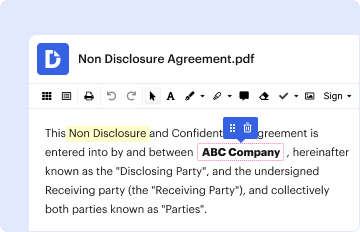
01. Edit your form online
Type text, add images, blackout confidential details, add comments, highlights and more.
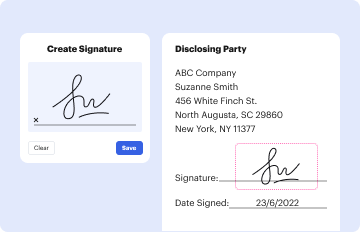
02. Sign it in a few clicks
Draw your signature, type it, upload its image, or use your mobile device as a signature pad.
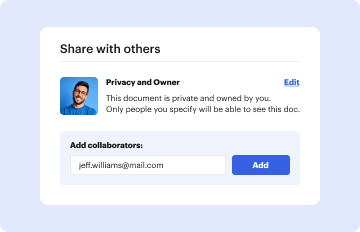
03. Share your form with others
Send it via email, link, or fax. You can also download it, export it or print it out.
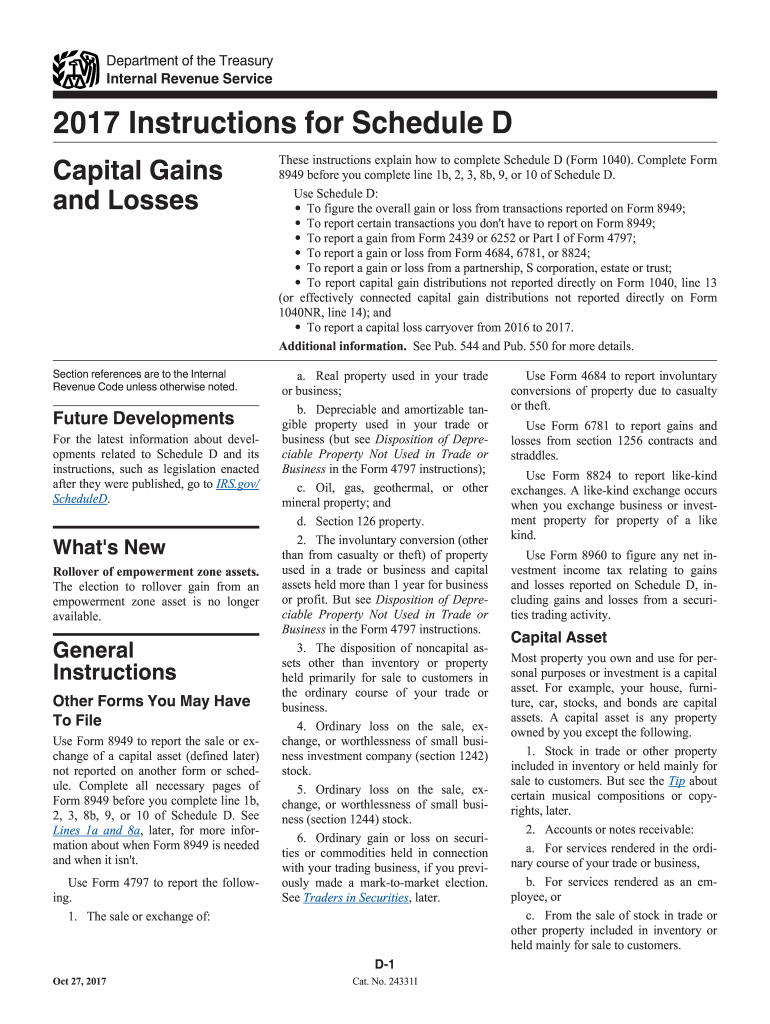
How to use or fill out d instructions 2017 form with our platform

- Click ‘Get Form’ to open the d instructions 2017 form in the editor.
- Begin by reviewing the general instructions provided at the top of the form. This section outlines essential information about completing Schedule D and its relationship with Form 8949.
- Fill out your personal information in the designated fields, ensuring accuracy to avoid processing delays.
- Proceed to Part I for short-term capital gains and losses. Enter each transaction's details as required, including dates, proceeds, and cost basis.
- Move to Part II for long-term capital gains and losses. Similar to Part I, input all relevant transaction data accurately.
- If applicable, complete any additional sections regarding capital loss carryovers or special treatments as outlined in the instructions.
- Review all entries for completeness and correctness before saving your work. Utilize our platform’s features to easily edit or adjust any fields as necessary.
Start using our platform today for free to streamline your document editing and form completion!
Fill out d instructions 2017 form online
It's free
It's free
See more d instructions 2017 form versions
We've got more versions of the d instructions 2017 form form. Select the right d instructions 2017 form version from the list and start editing it straight away!
| Versions | Form popularity | Fillable & printable |
|---|---|---|
| 2025 | 4.3 Satisfied (42 Votes) | |
| 2023 | 4.4 Satisfied (44 Votes) | |
| 2022 | 4.7 Satisfied (25 Votes) | |
| 2021 | 4.8 Satisfied (90 Votes) | |
| 2020 | 4.3 Satisfied (164 Votes) | |
| 2019 | 4.3 Satisfied (103 Votes) | |
| 2018 | 4.1 Satisfied (69 Votes) | |
| 2017 | 4.3 Satisfied (49 Votes) | |
| 2016 | 4.3 Satisfied (80 Votes) | |
| 2015 | 4.4 Satisfied (138 Votes) | |
| 2014 | 4.8 Satisfied (39 Votes) | |
| 2011 | 4.4 Satisfied (322 Votes) |
Got questions?
We have answers to the most popular questions from our customers. If you can't find an answer to your question, please contact us.
Contact us
What is the $3000 capital loss rule?
The capital loss tax deduction allows taxpayers to offset investment losses against their gains, reducing their taxable income. If capital losses exceed gains, individuals can use up to $3,000 per year to offset other income, with any remaining losses carried forward to future years.
Do I have to list every transaction on Schedule D?
You and your spouse may list your transactions on separate forms or you may combine them. However, you must include on your Schedule D the totals from all Forms 8949 for both you and your spouse. Corporations and partnerships.
What form do I use to file 2017 taxes?
Download individual federal tax forms Form (click to download)Title 1040 Individual Income Tax Return 1040-X Amended U.S. Individual Income Tax Return 1040V Payment Voucher Schedule 8812 Additional Child Tax Credit63 more rows
What is form Schedule D?
Schedule D is a tax form reporting the sale of capital assetspersonal property, like a home, car, collectibles, stocks, and bonds, typically bought as an investment.
What is the tax rate for Schedule D?
Whats the difference between short and long-term capital gains and losses tax? Filing Status0%15% Single Up to $47,025 $47,026 $518,900 Head of household Up to $63,000 $63,001 $551,350 Married filing jointly Up to $94,050 $94,051 $583,750 Married filing separately Up to $47,025 $47,026 $291,850 Jan 21, 2025
Security and compliance
At DocHub, your data security is our priority. We follow HIPAA, SOC2, GDPR, and other standards, so you can work on your documents with confidence.
Learn more


Related forms

Swimming pool report
The document is a monthly operation report for public swimming pools issued by the Michigan Department of Environment, G ...

CITY OF DELTONA - Deltona Self Service
The document is a lien search request form from the City of Deltona, Florida. It provides instructions for submitting a ...

DocHub form-library257726Authorization Of Administration For Udca Form - US Legal Forms
The document outlines the procedures and authorizations for administering diabetes management and care services to stude ...

Online and Mobile Banking DisclosureAllSouth Federal
The document is a Commercial Development & Services Application form for CPS Energy, outlining the process for submittin ...

How to Move to Set Aside Entry of Default
The document provides a guide for defendants in the Central District of California on how to file a Motion to Set Aside ...

This form must be filled out in black ink
The document is a legal affidavit related to the Servicemembers Civil Relief Act (SCRA), which requires the plaintiff to ...

Daily Attendance Record Sample Form
The document is a sample form for a Daily Attendance Record (ES-1604) used to track the attendance of a child throughout ...
SYNCHRONIZATION LICENSE
The document is a Synchronization and Master Use License agreement between a Producer and an Owner, outlining the terms ...
People also ask
What is the Schedule D used for?
Youll use Schedule D to report capital gains and losses from selling or trading certain assets during the year. Capital assets include personal items like stocks, bonds, homes, cars, artwork, collectibles, and cryptocurrency.
What does D mean on taxes?
DElective deferral under a Section 401(k) cash or arrangement plan. This includes a SIMPLE 401(k) arrangement. You may be able to claim the Savers Credit on Form 1040 Schedule 3, line 4. See Form 1040 Instructions for details.