Form st 131 2015-2026

Get Form
form st 131 2015 Preview on Page 1

Here's how it works

01. Edit your form online
Type text, add images, blackout confidential details, add comments, highlights and more.

02. Sign it in a few clicks
Draw your signature, type it, upload its image, or use your mobile device as a signature pad.

03. Share your form with others
Send it via email, link, or fax. You can also download it, export it or print it out.

How to use or fill out form st 131 2015 with our platform

Form edit decoration
9.5
Ease of Setup
DocHub User Ratings on G2
9.0
Ease of Use
DocHub User Ratings on G2
  1. Click ‘Get Form’ to open it in the editor.
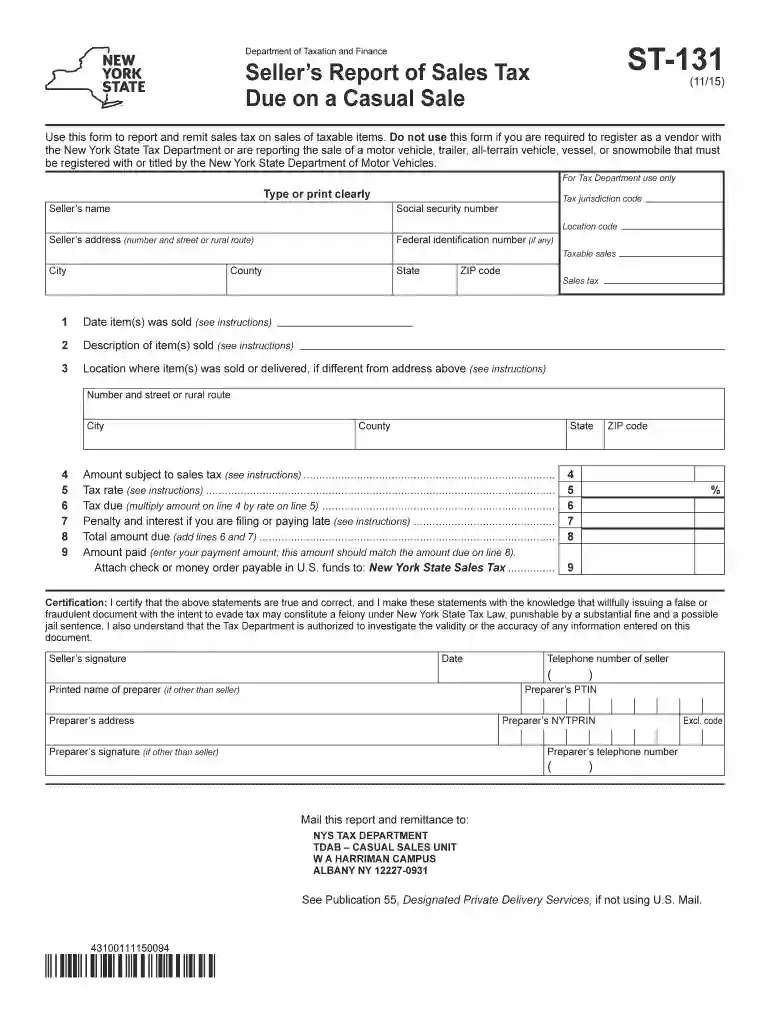
  2. Begin by entering the seller’s name and address clearly in the designated fields. Ensure that you include the tax jurisdiction code and social security number for accurate processing.
  3. In section 1, input the date when the item(s) were sold. Follow this by providing a detailed description of the item(s) sold in section 2.
  4. If applicable, specify the location where the item(s) were sold or delivered in section 3. This should be different from your address if necessary.
  5. Calculate the amount subject to sales tax and enter it in line 4. Then, determine the tax rate and input it on line 5.
  6. Multiply the amount on line 4 by the rate on line 5 to find your tax due, which should be entered on line 6.
  7. If filing late, calculate any penalties or interest as instructed and add this to your total amount due on line 8.
  8. Finally, enter your payment amount on line 9, ensuring it matches what is due on line 8 before signing and dating at the bottom of the form.

Start filling out your form st 131 2015 online for free today!

See more form st 131 2015 versions

We've got more versions of the form st 131 2015 form. Select the right form st 131 2015 version from the list and start editing it straight away!
Versions Form popularity Fillable & printable
2018 4.8 Satisfied (168 Votes)
2015 4.2 Satisfied (95 Votes)
2015 4 Satisfied (27 Votes)
2014 4 Satisfied (42 Votes)
2013 4 Satisfied (64 Votes)
2011 4.1 Satisfied (59 Votes)
be ready to get more

Complete this form in 5 minutes or less

Get form

Got questions?

We have answers to the most popular questions from our customers. If you can't find an answer to your question, please contact us.
Contact us
In short, it depends on what the invoice represents. The general rule of thumb is that: If the invoice is for the sale of a product, you likely will need to apply sales tax. If the invoice is for the sale of a service, you likely wont need to apply sales tax.
Whether a product is taxable will vary based on the jurisdiction and the type of product being sold. Factors include whether your state collects sales taxes based on origin or destination, whether youre selling a product or a service, and if your state requires that the product or service be taxed.
Heres a list of some of the exemptions on sales tax in New York: Services are generally exempt, unless specifically taxable. Certain groceries. Menstrual hygiene products. Newspapers and periodicals. College textbooks. Over-the-counter and prescription drugs and medicines.
A casual sale is an occasional or isolated taxable sale by a person who is not in the business of selling taxable property or services. People who make casual sales from their homes and have no intention of making sales on a regular basis as a business do not have to register for sales tax purposes.
Vendors selling taxable goods and services must register Sales of tangible personal property are subject to New York sales tax unless they are specifically exempt. Sales of services are generally exempt from New York sales tax unless they are specifically taxable.

Security and compliance

At DocHub, your data security is our priority. We follow HIPAA, SOC2, GDPR, and other standards, so you can work on your documents with confidence.

Learn more
ccpa2
pci-dss
gdpr-compliance
hipaa
soc-compliance

People also ask

Sales tax applies to retail sales of certain tangible personal property and services. Use tax applies if you buy tangible personal property and services outside the state and use it within New York State.

Related links