




01. Edit your 6765 online
Type text, add images, blackout confidential details, add comments, highlights and more.

Type text, add images, blackout confidential details, add comments, highlights and more.

Draw your signature, type it, upload its image, or use your mobile device as a signature pad.

Send form 6765 via email, link, or fax. You can also download it, export it or print it out.
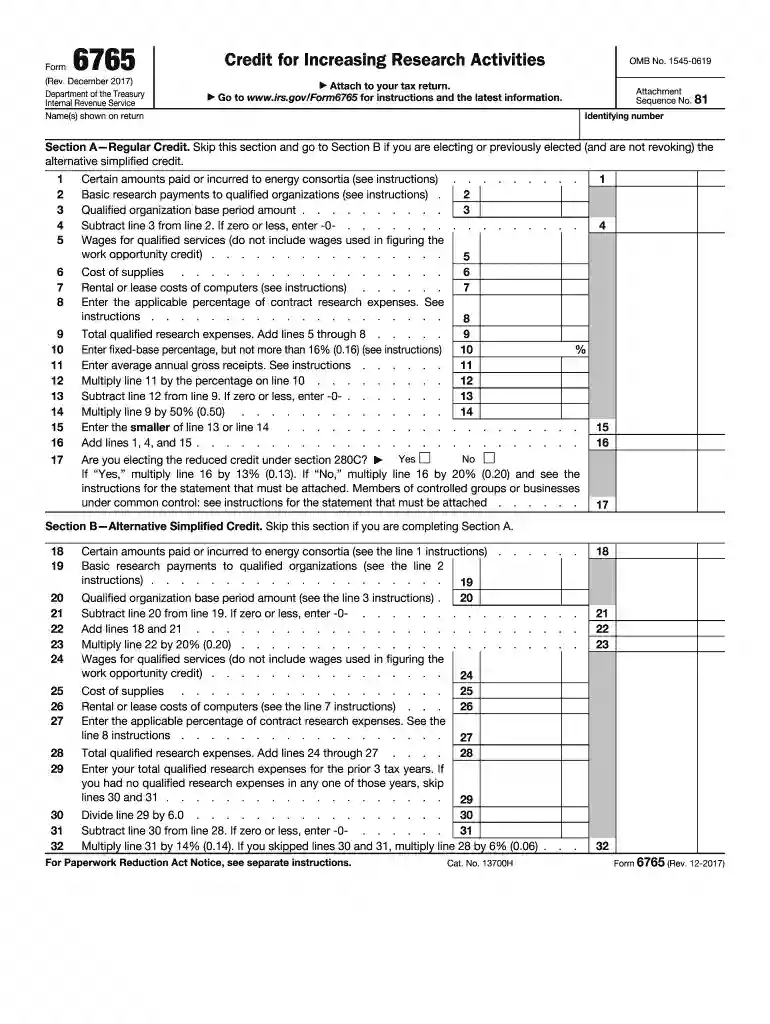
Form 6765, officially known as the "Credit for Increasing Research Activities," is a tax form used by businesses in the United States to claim tax credits for eligible research and development (R&D) expenses. This incentive is designed to encourage businesses to invest in research and innovation. The form allows companies to calculate their allowable credit by providing detailed sections for Regular and Alternative Simplified Credits based on qualifying expenses.
Obtaining Form 6765 is a straightforward process. For the 2017 tax year, businesses can access the form through several channels:
Completing Form 6765 involves a structured approach to accurately report eligible R&D expenses and calculate the credit. Follow these steps:
Form 6765 is mainly used by businesses engaged in qualifying research activities, ranging from small startups to large corporations. Specific industries that commonly utilize the form include:
Understanding key terms is crucial when dealing with Form 6765:
Legal compliance is essential when filing Form 6765 to avoid penalties or disallowance of claimed credits. Guidelines include:
Adhering to deadlines is critical to ensure eligibility for claiming credits via Form 6765:
Determining eligibility is the first step towards claiming the research tax credit:


By adhering to the above guidelines, businesses can fully maximize the benefits offered by Form 6765 while maintaining compliance and accuracy throughout the filing process.
We've got more versions of the 6765 form. Select the right 6765 version from the list and start editing it straight away!
| Versions | Form popularity | Fillable & printable |
|---|---|---|
| 2025 | 4.5 Satisfied (52 Votes) | |
| 2023 | 4.3 Satisfied (20 Votes) | |
| 2020 | 4.8 Satisfied (102 Votes) | |
| 2019 | 4.4 Satisfied (270 Votes) | |
| 2018 | 4.3 Satisfied (127 Votes) | |
| 2017 | 4.4 Satisfied (233 Votes) | |
| 2016 | 4.4 Satisfied (608 Votes) | |
| 2015 | 4.3 Satisfied (33 Votes) | |
| 2014 | 4 Satisfied (38 Votes) | |
| 2013 | 4 Satisfied (44 Votes) | |
| 2012 | 4.2 Satisfied (59 Votes) | |
| 2011 | 4 Satisfied (45 Votes) | |
| 2008 | 4.4 Satisfied (52 Votes) |
Of course, electronically drawing your signature is acceptable, but only if you use a tool that complies with industry regulations and policies. Consider DocHub, which guarantees eSignature validity under ESIGN and UETA requirements. All you need to approve your form 6765 2017 electronically is an account with DocHub and an internet connection. After you open your document in our editor, click Sign and choose the Draw tool.
Document editing with DocHub is equally convenient on desktop and mobile devices. You just need an internet browser to revise your form 6765 2017 on Android. Open our site and sign in to access the instruments you require. Add your document and introduce your intended changes. Next, you can keep your form in your document storage or send it out immediately.
At DocHub, your data security is our priority. We follow HIPAA, SOC2, GDPR, and other standards, so you can work on your documents with confidence.
Dec 31, 2017 Use Form 6765 to figure and claim the credit for increasing research activities (research credit), to elect the reduced credit under sectionRead more
by SY Sun 2018 Example: Corp A filed its 2016 federal tax return Form 1120 on March 30, 2017 and attached a. Form 6765 to the return to reflect the payroll taxRead more
Abstract. Osteoarthritis (OA) and obesity are prevalent health problems in todays society. Obesity increases the risk of OA in both weight-bearing joints,Read more


