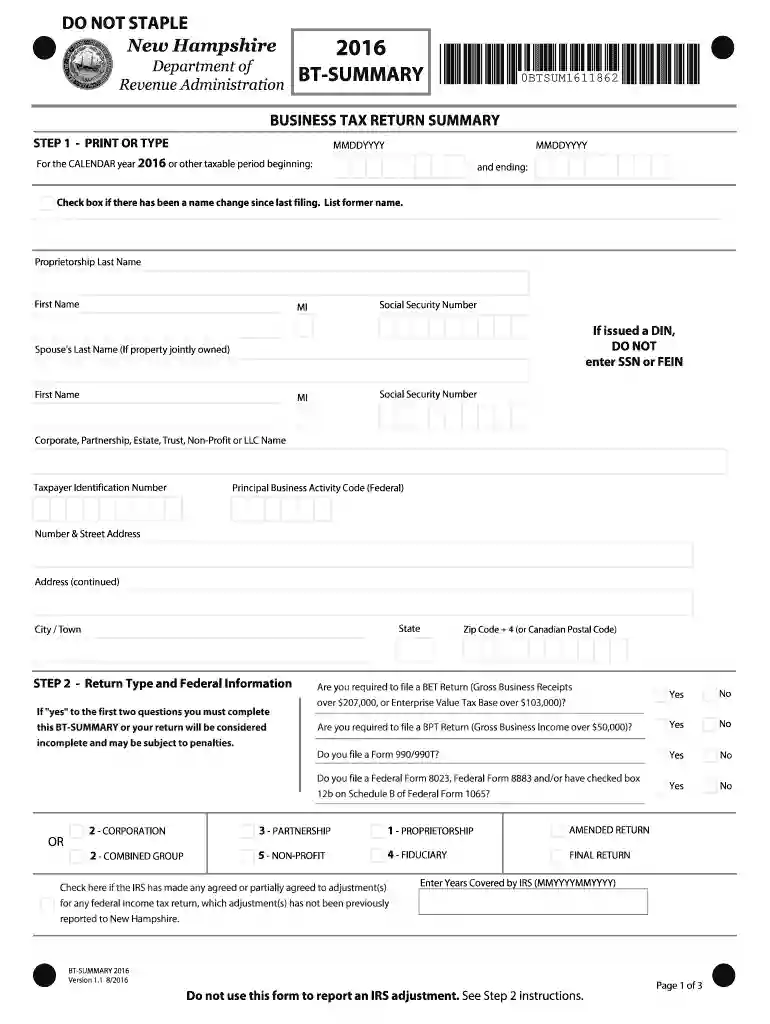
Bt summary 2016 form-2026

Get Form
bt form Preview on Page 1

Here's how it works

01. Edit your bt form online
Type text, add images, blackout confidential details, add comments, highlights and more.

02. Sign it in a few clicks
Draw your signature, type it, upload its image, or use your mobile device as a signature pad.

03. Share your form with others
Send bt fill form via email, link, or fax. You can also download it, export it or print it out.

How to use or fill out bt summary 2016 form with our platform

Form edit decoration
9.5
Ease of Setup
DocHub User Ratings on G2
9.0
Ease of Use
DocHub User Ratings on G2
  1. Click ‘Get Form’ to open the bt summary 2016 form in the editor.
  2. Begin by entering your business information in the designated fields, including your name, address, and tax identification number. Ensure all details are accurate to avoid processing delays.
  3. Next, navigate to the income section. Here, you will input your total revenue figures for the year. Be sure to double-check your calculations for accuracy.
  4. Proceed to the deductions section. Fill in any applicable deductions that apply to your business operations. This may include expenses related to cost of goods sold or operational costs.
  5. Finally, review all sections for completeness and accuracy. Once satisfied, utilize our platform’s signature feature to sign the document electronically before submission.

Start using our platform today for free and streamline your bt summary 2016 form completion!

See more bt summary 2016 form versions

We've got more versions of the bt summary 2016 form form. Select the right bt summary 2016 form version from the list and start editing it straight away!
Versions Form popularity Fillable & printable
2022 4.7 Satisfied (37 Votes)
2021 4.8 Satisfied (129 Votes)
2020 4.1 Satisfied (37 Votes)
2019 4.4 Satisfied (170 Votes)
2018 4.3 Satisfied (111 Votes)
2017 4.3 Satisfied (167 Votes)
2016 4 Satisfied (50 Votes)
2010 4.4 Satisfied (444 Votes)
2009 4 Satisfied (20 Votes)
2008 4.3 Satisfied (71 Votes)
be ready to get more

Complete this form in 5 minutes or less

Get form

Got questions?

We have answers to the most popular questions from our customers. If you can't find an answer to your question, please contact us.
Contact us
The C corporation is the standard (or default) corporation under IRS rules. The S corporation is a corporation that has elected a special tax status with the IRS and thereby gains some tax advantages. Both business structures get their names from the parts of the Internal Revenue Code that they are taxed under.
These advantages are typically unavailable to sole proprietorships and general partnerships. Protected assets. Pass-through taxation. Tax-favorable characterization of income. Straightforward transfer of ownership. Cash method of accounting. Heightened credibility.
Even if a corporation had no income for the year, filing the form is still required to comply with IRS regulations.
Schedule UTP (Form 1120) asks for information about tax positions that affect the U.S. federal income tax liabilities of certain corporations that issue or are included in audited financial statements and have assets that equal or exceed $10 million.
Use Form 1120-S to report the income, gains, losses, deductions, credits, and other information of a domestic. corporation or other entity for any tax year covered by an election. to be an S corporation.

Security and compliance

At DocHub, your data security is our priority. We follow HIPAA, SOC2, GDPR, and other standards, so you can work on your documents with confidence.

Learn more
ccpa2
pci-dss
gdpr-compliance
hipaa
soc-compliance

People also ask

Use Form 1120-S to report the income, gains, losses, deductions, credits, etc., of a domestic corporation or other entity for any tax year covered by an election to be an S corporation.
In Summary. Remember, Form 1120-S is for the corporate entity (your S Corp), while Form 1040 is for your personal taxes. To file your personal taxes, you need to first complete your S Corp tax return. You must file your business and personal returns separately.

Related links