






Definition & Meaning
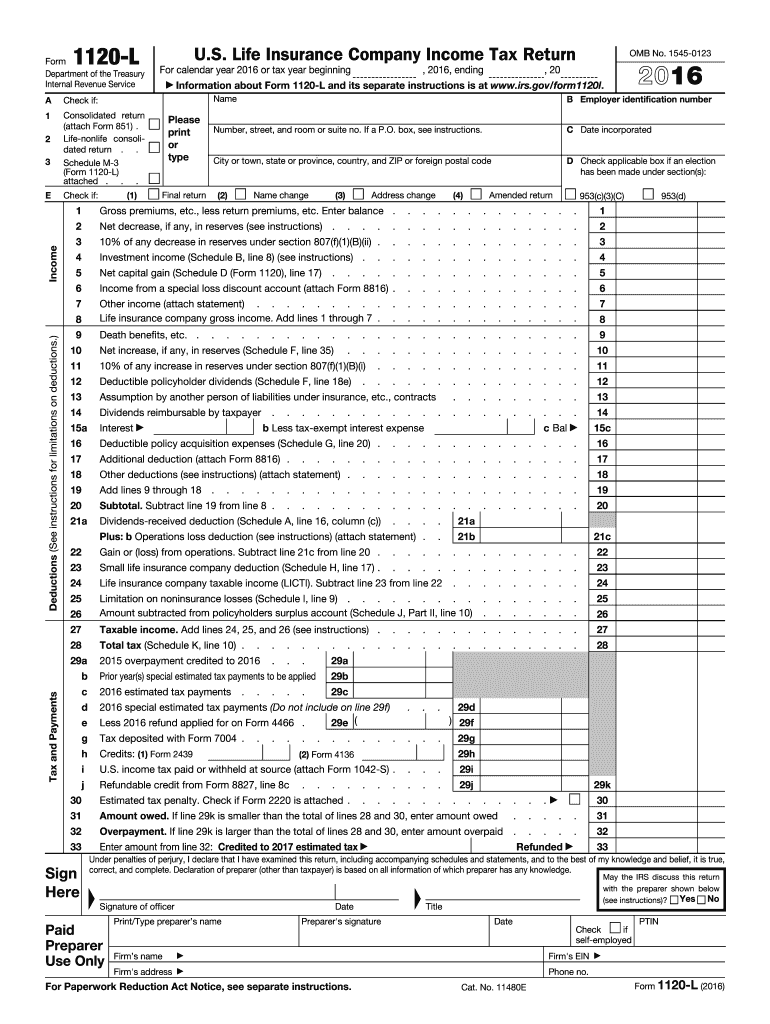
The 2016 Form 1120-L is the U.S. Life Insurance Company Income Tax Return used by life insurance companies to report their financial activities for the calendar year 2016. This form is essential for calculating tax liabilities and includes various sections and schedules specific to life insurance companies. It forms the basis for determining the company’s gross income, deductions, and taxable income.
Component Breakdown
- Gross Income Reporting: Details all income sources, including premiums and investment income.
- Deductions and Credits: Lists applicable deductions such as reserves and policy acquisition expenses.
- Taxable Income Calculation: Provides a framework for determining the net taxable amount after considering all deductions.
Steps to Complete the 2016 Form 1120-L
Filing the 2016 Form 1120-L requires meticulous attention to detail to ensure accuracy. Here are the steps to fill out the form effectively:
- Gather Required Information: Collect all financial documents, including income statements, reserve calculations, and policy acquisition expenses.
- Complete Income Sections: Start with gross income from premiums and investments.
- Calculate Deductions: Include all allowable expenses under IRS guidelines.
- Determine Taxable Income: Subtract deductions from total income.
- Attach Schedules: Provide additional forms for dividends, reserves, and other items as required.
- Review and File: Double-check for errors and submit either electronically or through mail by the due date.
Example: Reserve Calculation
- Reserve calculations must comply with IRS guidelines to ensure they are deductible. The complexity arises from the need to consider both mandatory and discretionary reserves.
IRS Guidelines
Understanding IRS guidelines is crucial for accurately completing Form 1120-L.
Key Guidelines Include:
- Compliance with Insurance Specifics: All income and deductions must adhere to the specifics governing life insurance entities.
- Schedules and Attachments: All relevant schedules (e.g., Schedule J or M-3) must be properly attached to supplement the main form.
- Recordkeeping: Maintain all related documents and supporting evidence for three years in case of audit.
Practical Tip
Insurance companies must keep abreast of any IRS changes yearly as these could impact requirements related to Form 1120-L.
Filing Deadlines / Important Dates
Ensuring timely filing of the 2016 Form 1120-L is essential to avoid penalties.
- Standard Deadline: Typically, Form 1120-L is due on the 15th day of the third month after the end of the company's tax year.
- Extension Options: Extensions are possible, usually granting an additional six months, provided a request is filed before the original deadline.
Consequences of Late Filing
- Late submissions may incur penalties; thus, understanding extension protocols can be beneficial for companies dealing with complex financials.
Required Documents
Filing Form 1120-L requires submission of numerous supporting documents ensuring compliance.
- Income Statements and Balance Sheets: Detail revenue and expenses.
- Schedule Fillings: Dividends received, reserves, and acquisition expenses must be correctly scheduled.
- Certifications: Internal audits confirming data accuracy improve credibility.
Helpful Hint
Having these documents prepared in advance allows for smoother filing and fewer errors.
Key Elements of the 2016 Form 1120-L
A deep dive into key elements ensures the company meets all reporting obligations:
- Income and Deductions: Every entry must be backed by documented facts.
- Policyholder Obligations: Accurately reflect the company's obligations to policyholders.
- Tax Payments: Report any credits or estimated tax payments already made.
Real-World Scenario
For an insurance firm with diverse investments, keeping track of income from various sources is necessary for accurate declaration under key elements.
Penalties for Non-Compliance
Non-compliance with the requirements of Form 1120-L can lead to significant consequences.
Types of Penalties
- Late Filing Penalties: Calculated based on the unpaid tax amount as of the due date.
- Reporting Errors: Negligence or false information can result in additional penalties.
Example: Impact of Errors
An incorrect deduction entry could lead to an underestimated tax liability, resulting in substantial fines once discovered.
Form Submission Methods
Companies have multiple methods for submitting Form 1120-L, catering to different preferences and resources.
Online Submission
- Using authorized IRS e-file systems provides faster processing and confirmation.
Mail Options
- Mailing the physical form remains an option, especially for entities requiring a traditional paper trail.
In-Person Submission
- Direct submission to IRS offices is uncommon but available for businesses preferring face-to-face interactions.
Business Types That Most Benefit
Life insurance companies of varied structures find this form beneficial, from sole proprietorships in insurance to large corporate entities.
Entity Types
- C Corporations: Often use detailed reporting for tax optimization.
- Mutual Companies: Require specific attention to policyholder liabilities.
Common Use Cases
Businesses, particularly those expanding their product offerings, benefit from understanding how their diverse income streams are taxed under Form 1120-L.