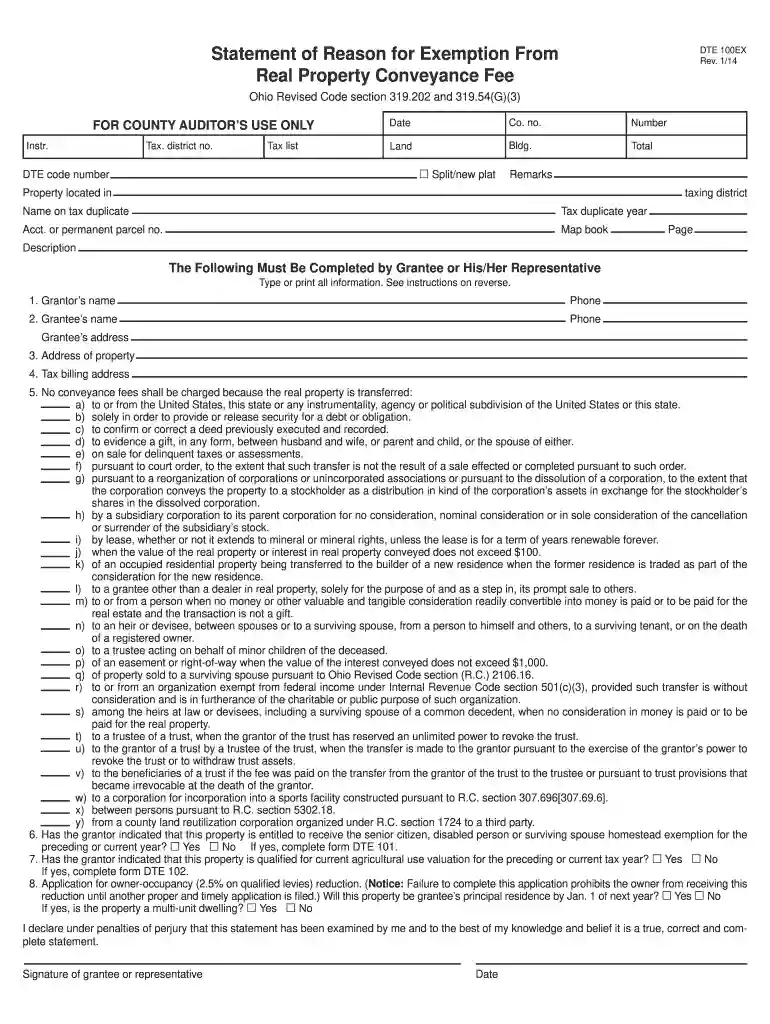
Exemption conveyance fee 2014 form-2026

Get Form
exemption conveyance fee 2014 form Preview on Page 1

Here's how it works

01. Edit your form online
Type text, add images, blackout confidential details, add comments, highlights and more.

02. Sign it in a few clicks
Draw your signature, type it, upload its image, or use your mobile device as a signature pad.

03. Share your form with others
Send it via email, link, or fax. You can also download it, export it or print it out.

How to use or fill out exemption conveyance fee 2014 form with our platform

Form edit decoration
9.5
Ease of Setup
DocHub User Ratings on G2
9.0
Ease of Use
DocHub User Ratings on G2
  1. Click ‘Get Form’ to open the exemption conveyance fee 2014 form in the editor.
  2. Begin by filling in the grantor’s name and phone number in Line 1. Ensure accuracy as this information is crucial for identification.
  3. In Line 2, enter the grantee’s name and phone number, followed by their address. This ensures that all parties are correctly identified.
  4. For Line 3, provide the complete address of the property being conveyed. This should include street number and name for clarity.
  5. Line 4 requires you to specify the tax billing address where future tax bills should be sent. Accuracy here is essential to avoid missed payments.
  6. In Line 5, select one of the exemptions (a)-(y) that applies to your situation. Be prepared to provide additional documentation if requested by the county auditor.
  7. Complete Lines 6 through 8 as applicable, ensuring all questions are answered truthfully to comply with Ohio Revised Code requirements.
  8. Finally, sign and date the form at the bottom, confirming that all information provided is accurate and complete.

Start using our platform today for free to streamline your document editing and signing process!

See more exemption conveyance fee 2014 form versions

We've got more versions of the exemption conveyance fee 2014 form form. Select the right exemption conveyance fee 2014 form version from the list and start editing it straight away!
Versions Form popularity Fillable & printable
2016 4.8 Satisfied (160 Votes)
2014 4.3 Satisfied (124 Votes)
2012 4.4 Satisfied (407 Votes)
1998 4 Satisfied (33 Votes)
be ready to get more

Complete this form in 5 minutes or less

Get form

Got questions?

We have answers to the most popular questions from our customers. If you can't find an answer to your question, please contact us.
Contact us
Major Exemptions The tax does not apply: to sales or transfers to or from the U.S. government or its agencies, or to or from the state of Ohio or any of its political subdivisions. to gifts from one spouse to another, or to children and their spouses. to surviving spouses or to a survivorship tenant.
These are taxes paid to the Town and State on the sale of real estate. They are generally paid by the seller from the closing and given to the town clerk when the transaction is recorded.
When a warranty deed lists Exceptions to conveyance and warranty such as prior easements, those easements remain with the grantor or previous holders. Minerals under these easements are typically retained by the grantor unless explicitly conveyed.
Conveyance tax is imposed on the transfer of real property at the state, county, or municipal level. The conveyance tax is also known as a real estate transfer tax. This tax is generally calculated as a percentage of the sale price.
The term conveyance refers to the act of transferring property from one party to another. The term is commonly used in real estate transactions when buyers and sellers transfer ownership of land and/or a home. This is done using an instrument of conveyancea legal document such as a contract, lease, title, or deed.

Security and compliance

At DocHub, your data security is our priority. We follow HIPAA, SOC2, GDPR, and other standards, so you can work on your documents with confidence.

Learn more
ccpa2
pci-dss
gdpr-compliance
hipaa
soc-compliance

People also ask

The conveyance tax is also known as a real estate transfer tax. This tax is generally calculated as a percentage of the sale price. If the property is sold for a very low amount or is transferred for free, such as between family members, it may be exempt from conveyance tax but may still be subject to estate tax.
transfer fees are charged when a new owner purchases a property and are influence by the county, the school district and the local industry in the area. conveyance taxes are based on the purchase price of a property and are imposed on real property transfers at the state, county or municipal level.

Related links