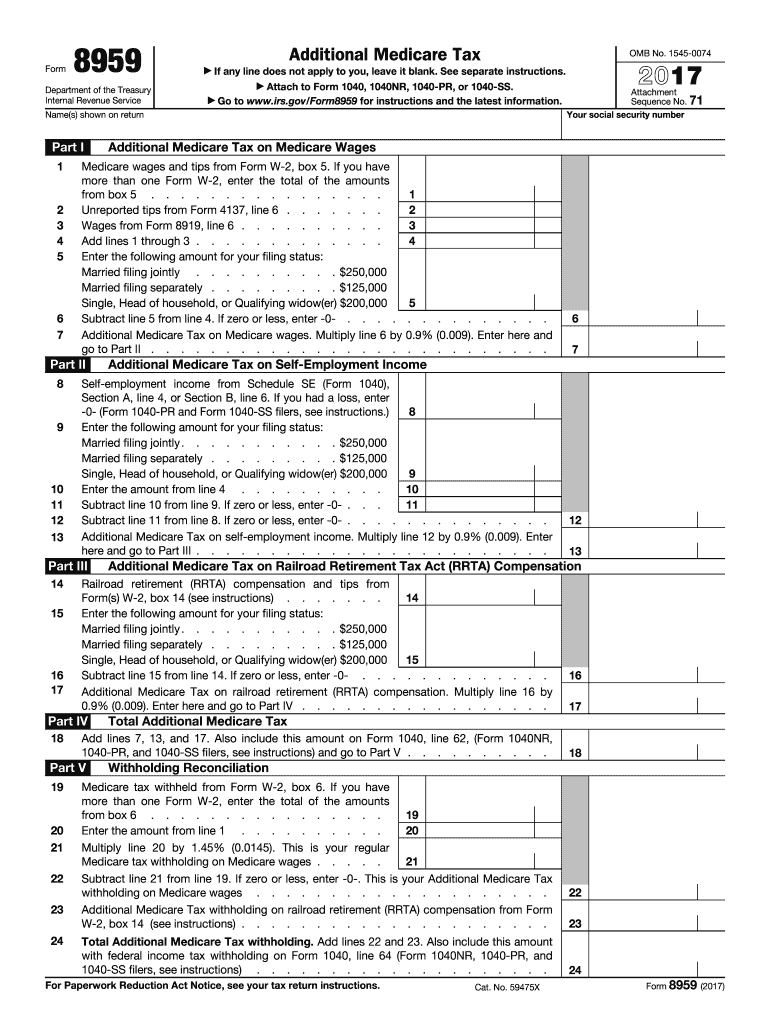
2016 8959 form-2026

Get Form
2016 8959 form Preview on Page 1

Here's how it works

01. Edit your form online
Type text, add images, blackout confidential details, add comments, highlights and more.
02. Sign it in a few clicks
Draw your signature, type it, upload its image, or use your mobile device as a signature pad.
03. Share your form with others
Send it via email, link, or fax. You can also download it, export it or print it out.

How to use or fill out 2016 8959 form with our platform

Form edit decoration
9.5
Ease of Setup
DocHub User Ratings on G2
9.0
Ease of Use
DocHub User Ratings on G2
  1. Click ‘Get Form’ to open the 2016 8959 form in the editor.
  2. Begin by entering your name(s) as shown on your tax return at the top of the form.
  3. In Part I, report any unreported tips from Form 4137 and wages from Form 8919. Add these amounts together in line 3.
  4. Refer to the filing status section and enter the appropriate threshold amount based on your status (e.g., $250,000 for married filing jointly).
  5. Subtract line 5 from line 4. If this results in zero or less, enter -0-. This will help determine your Additional Medicare Tax.
  6. Continue through Parts II to V, ensuring you accurately calculate and report Medicare taxes based on your income sources as instructed.

Start using our platform today for free to complete your 2016 8959 form effortlessly!

See more 2016 8959 form versions

We've got more versions of the 2016 8959 form form. Select the right 2016 8959 form version from the list and start editing it straight away!
Versions Form popularity Fillable & printable
2023 4.4 Satisfied (46 Votes)
2022 4.2 Satisfied (35 Votes)
2021 4.8 Satisfied (103 Votes)
2020 4.2 Satisfied (66 Votes)
2019 4.4 Satisfied (109 Votes)
2018 4.3 Satisfied (129 Votes)
2017 4.4 Satisfied (36 Votes)
2016 4.2 Satisfied (108 Votes)
2014 4.4 Satisfied (312 Votes)
2013 4.2 Satisfied (64 Votes)
be ready to get more

Complete this form in 5 minutes or less

Get form

Got questions?

We have answers to the most popular questions from our customers. If you can't find an answer to your question, please contact us.
Contact us
An employer must begin withholding Additional Medicare tax in the pay period in which the wages or railroad retirement (RRTA) compensation paid to an employee for the year exceeds $200,000. The employer then continues to withhold it each pay period until the end of the calendar year.
You should file form 8959 if one or more conditions are met as follows: Medicare wages and tips are greater than $200,000. Retirement income (RRTA) compensation is greater than $200,000. Medicare wages, tips, and self-employment income are greater than threshold amount for your filing status (see table below).
A 0.9% Additional Medicare tax applies to Medicare wages, self-employment income, and railroad retirement (RRTA) compensation that exceed the following threshold amounts based on filing status: $250,000 for married filing jointly; $125,000 for married filing separately; and.
The short answer is no, you cannot opt out of paying the Medicare tax (or the Social Security tax), Paying both the Medicare tax and the Social Security tax is mandatory for workers in the United States.
The Additional Medicare Tax is an additional (0.9%) tax to wages, compensation, and self-employment income, if an individuals income exceeds the threshold amount for their individual filing status.

Security and compliance

At DocHub, your data security is our priority. We follow HIPAA, SOC2, GDPR, and other standards, so you can work on your documents with confidence.

Learn more
ccpa2
pci-dss
gdpr-compliance
hipaa
soc-compliance
be ready to get more

Complete this form in 5 minutes or less

Get form

People also ask

For many taxpayers who are involved in a business on only a limited basis the easiest way to avoid the 3.8% tax may be reliance on what was originally intended to be a gotcha rule (referred to as the SIPPA rule) in the passive activity loss regulations designed to prevent taxpayers from converting nonpassive income
Use Form 8919 to figure and report your share of the uncollected social security and Medicare taxes due on your compensation if you were an employee but were treated as an independent contractor by your employer. By filing this form, your social security earnings will be credited to your social security record.

Related links