




01. Edit your 1099 q form online
Type text, add images, blackout confidential details, add comments, highlights and more.

Type text, add images, blackout confidential details, add comments, highlights and more.

Draw your signature, type it, upload its image, or use your mobile device as a signature pad.

Send what is 1099q via email, link, or fax. You can also download it, export it or print it out.
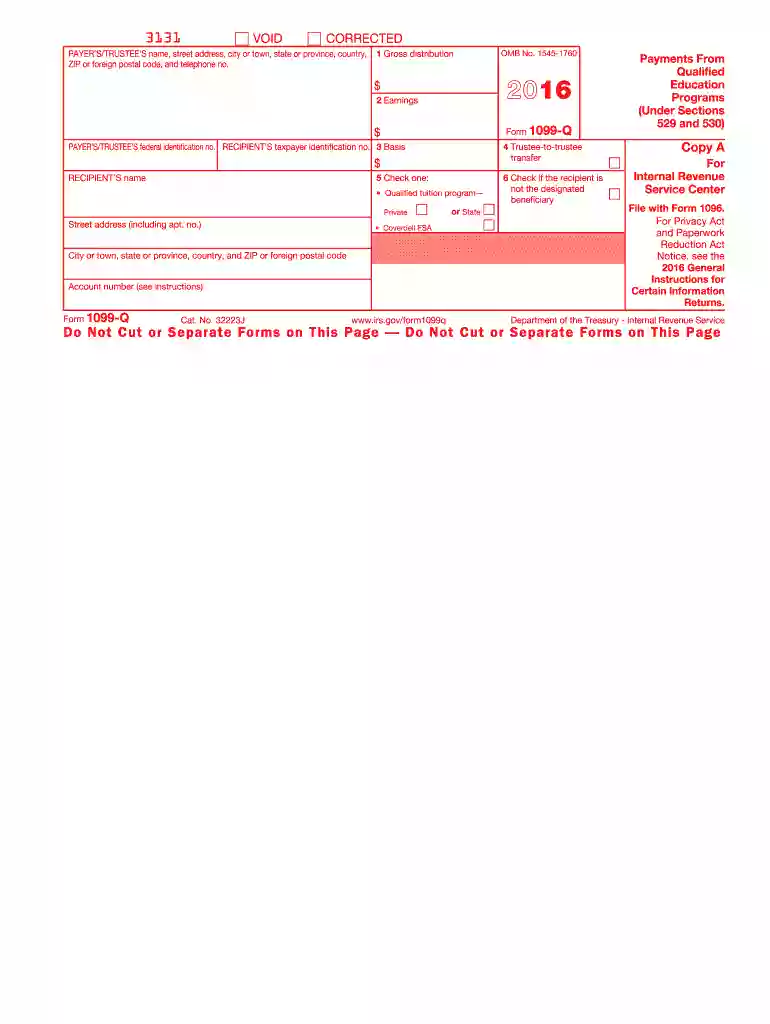
Form 1099-Q is an IRS tax form used to report distributions from qualified education programs, specifically under Sections 529 and 530. These programs are designed to help taxpayers save for education expenses. The form is issued by payers, such as financial institutions, to individuals who have received distributions from these education savings accounts. The purpose of the form is to ensure that recipients and the IRS are aware of amounts withdrawn and to assess any associated tax implications.
To obtain Form 1099-Q for the year 2016, you should first contact the financial institution or payer that manages your qualified education savings account. These entities are responsible for generating and distributing the form to account holders. They typically send the form by January 31 of the following year. If you do not receive it, verify your address on file and request a duplicate or electronic version through your online account if available. You can also check the IRS website for reference copies or additional guidance.
Completing Form 1099-Q is generally straightforward, as it is largely information provided by the issuer. However, understanding how to interpret the data is crucial. The form includes multiple boxes, such as:
Ensure the information aligns with your records and report it accurately when filing your taxes. If discrepancies are found, contacting the issuer promptly is essential to rectify the issue and avoid tax complications.
Key elements of Form 1099-Q include identifying and financial details that need careful review:
Understanding these elements helps avoid errors in tax reporting and ensures compliance with IRS requirements.
The IRS provides specific guidelines for Form 1099-Q usage and reporting:
Consult the IRS guidelines or a tax advisor when uncertain about potential tax liabilities associated with your distributions.
The filing deadline for recipient copies of Form 1099-Q is January 31, while issuers have until February 28 (or March 31 if filing electronically) to submit forms to the IRS. These deadlines are crucial for ensuring timely and accurate reporting, avoiding penalties, and preparing recipients to file their tax returns. Ensure that all forms are reviewed promptly upon receipt to address any errors or discrepancies well in advance of tax-filing deadlines.
Failure to comply with Form 1099-Q filing and reporting requirements can result in significant penalties. Payers who do not provide forms to recipients or the IRS on time may face fines. Recipients who fail to report distributions accurately could incur additional taxes, penalties on earnings taxed as income, and a 10% federal penalty if the funds were not used for qualified education expenses. Understanding and adhering to regulations mitigates these risks effectively.
Form 1099-Q uniquely impacts taxpayers who are students or designated beneficiaries of educational savings accounts. Students who use distributions for qualified education expenses benefit from tax advantages, whereas those who withdraw funds for nonqualified purposes may face tax consequences. Common scenarios include:
By tailoring education savings allocations to qualified expenses, recipients can maximize tax efficiency.


We've got more versions of the 1099 q form form. Select the right 1099 q form version from the list and start editing it straight away!
| Versions | Form popularity | Fillable & printable |
|---|---|---|
| 2025 | 4.1 Satisfied (59 Votes) | |
| 2019 | 4.8 Satisfied (25 Votes) | |
| 2018 | 4.2 Satisfied (109 Votes) | |
| 2017 | 4.4 Satisfied (145 Votes) | |
| 2016 | 4.4 Satisfied (338 Votes) | |
| 2015 | 4.1 Satisfied (48 Votes) | |
| 2014 | 4 Satisfied (49 Votes) | |
| 2013 | 4 Satisfied (59 Votes) | |
| 2012 | 4.4 Satisfied (63 Votes) | |
| 2011 | 4.2 Satisfied (57 Votes) | |
| 2010 | 4.4 Satisfied (53 Votes) |
At DocHub, your data security is our priority. We follow HIPAA, SOC2, GDPR, and other standards, so you can work on your documents with confidence.
May 2, 2017 Employers must report the compensation paid and any backup withholding on Forms 1099-MISC and Form 945, Annual Return of. Withheld FederalRead more
Information about Form 1099-Q, Payments from Qualified Education Programs, including recent updates, related forms, and instructions on how to file.
Q. What is a Form MA 1099-HC? The MA 1099-HC form is a Massachusetts document which serves as proof of health insurance.Read more


