




01. Edit your form online
Type text, add images, blackout confidential details, add comments, highlights and more.

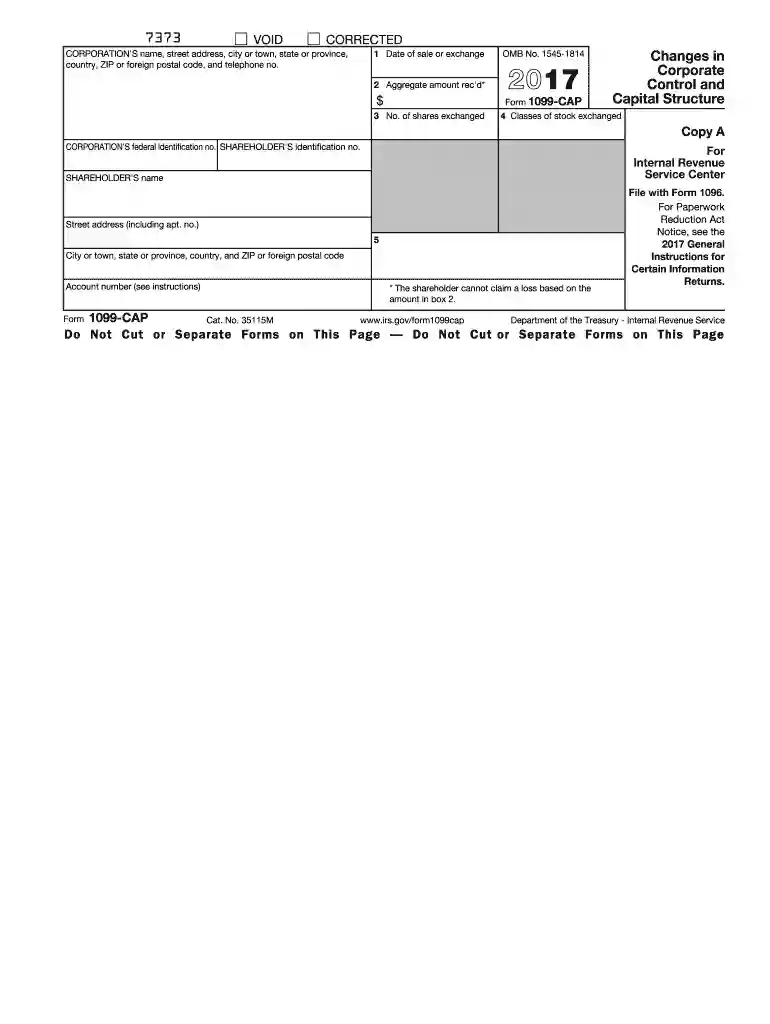
Type text, add images, blackout confidential details, add comments, highlights and more.

Draw your signature, type it, upload its image, or use your mobile device as a signature pad.

Send it via email, link, or fax. You can also download it, export it or print it out.
The 2017 Form 1099-CAP, issued by the Internal Revenue Service (IRS), is a tax form used to report specific transactions involving changes in corporate control and capital structure. Its primary purpose is to notify shareholders and the IRS about gains resulting from exchanges of stock or ownership interests due to corporate actions, such as mergers or acquisitions. The form includes detailed reporting on the number of shares exchanged, the date of sale or exchange, aggregate cash received, and classes of stock involved in the transaction.
Using the 2-CAP form requires understanding its layout and the information necessary for accurate completion. Shareholders receive this form when there are significant changes in corporate control or capital structure. Upon receiving a 1099-CAP, recipients should:
Typically, corporations are responsible for issuing the 2-CAP form to affected shareholders. Shareholders do not normally need to obtain this form themselves, as companies will distribute it directly to individuals involved in applicable transactions. If a shareholder anticipates a 1099-CAP but has not received it, they should contact the corporation directly to request a copy or report a non-issuance.
While shareholders do not complete this form, understanding its completion process provides clarity on its contents:
Critical components of the 2-CAP help ensure comprehensive reporting:
The form is primarily utilized by shareholders involved in transactions that alter corporate governance or capital structures, such as:


Parties involved with the 2-CAP form should adhere to IRS-imposed deadlines to mitigate penalties:
Legal adherence in using the 1099-CAP form is crucial to ensure regulatory compliance:
The IRS provides guidance for completing and submitting the 2-CAP:
Failure to comply with Form 1099-CAP regulations can lead to significant penalties:
This structure provides comprehensive, in-depth coverage of the 2-CAP form and serves as a resourceful guide for addressing a wide range of associated scenarios.
We've got more versions of the 2017 1099 cap form form. Select the right 2017 1099 cap form version from the list and start editing it straight away!
At DocHub, your data security is our priority. We follow HIPAA, SOC2, GDPR, and other standards, so you can work on your documents with confidence.
Aug 24, 2016 Form 1099-CAP is furnished to shareholders who receive cash, stock, or other property from an acquisition of control or a substantial change inRead more
Sep 16, 2013 Accordingly,. Employers two-year credit period is 2016 and 2017. Example 2. (i) Facts. Same facts as Example 1, but Employer files Form 8941Read more
for 2017 distributed to depository libraries with: Notice 1427: Information 1099-C, cancellation of debt. Related to : Form 1099-C, cancellation ofRead more


