




01. Edit your 1099s 2016 form online
Type text, add images, blackout confidential details, add comments, highlights and more.

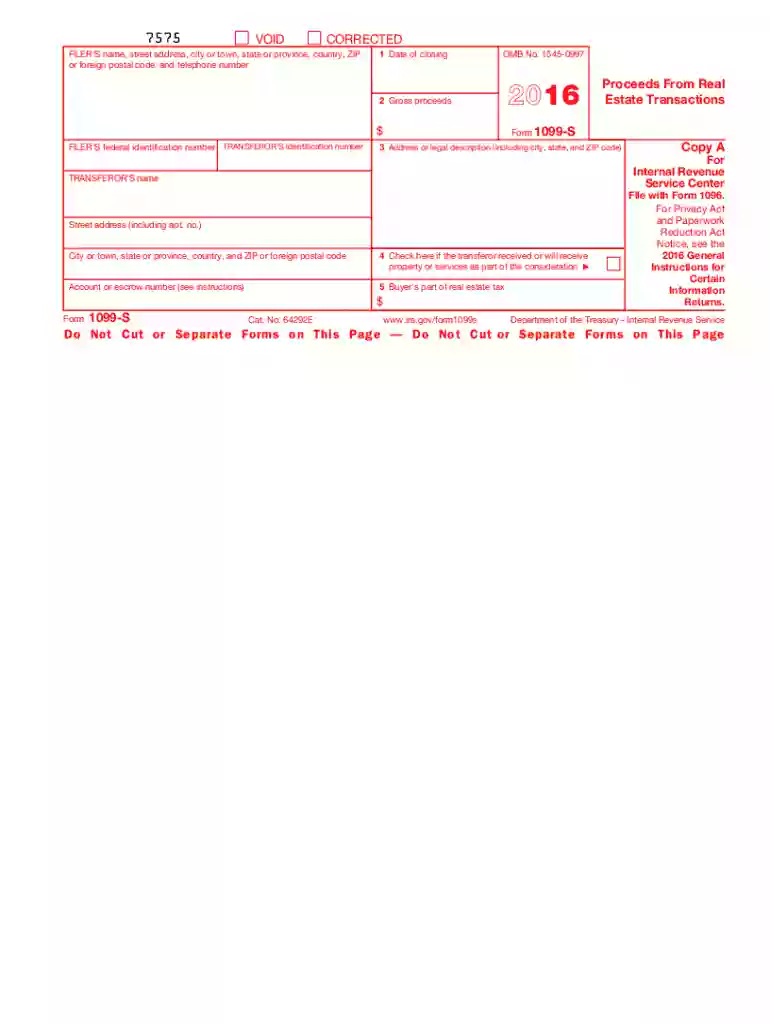
Type text, add images, blackout confidential details, add comments, highlights and more.

Draw your signature, type it, upload its image, or use your mobile device as a signature pad.

Send fillable 1099 2016 via email, link, or fax. You can also download it, export it or print it out.
Form 1099-S is a tax document used to report proceeds from real estate transactions. It is filed with the IRS to ensure the correct reporting of income, specifically from the sale or exchange of real estate, including land, permanent structures or a home. The form is instrumental in providing transparency and ensuring all parties accurately report the income earned from such transactions.
When using Form 1099-S, individuals need to accurately fill in all required fields to ensure the IRS receives correct information. Here's how you typically use the form:
For example, if you are a real estate agent managing a client's property sale, you would gather this information to report the transaction accurately on Form 1099-S.
To obtain the 2016 version of Form 1099-S, follow these steps:
Completing the 1099-S form requires careful attention to detail to ensure all information is correct. Here is a step-by-step breakdown:
The importance of Form 1099-S extends beyond mere compliance, playing a critical role in:
Typically, the users of Form 1099-S include:


The IRS has specific guidelines for filing Form 1099-S:
Failing to comply with the requirements for filing Form 1099-S invites penalties, impacting both entities and individuals involved in the transaction. The IRS imposes fines for:
By adhering to these guidelines and fully understanding Form 1099-S, individuals and organizations can ensure accurate reporting of real estate transaction proceeds, thus complying with federal tax laws and avoiding unnecessary penalties.
We've got more versions of the 1099s 2016 form form. Select the right 1099s 2016 form version from the list and start editing it straight away!
| Versions | Form popularity | Fillable & printable |
|---|---|---|
| 2022 | 4.4 Satisfied (24 Votes) | |
| 2021 | 4.8 Satisfied (46 Votes) | |
| 2020 | 4.2 Satisfied (86 Votes) | |
| 2019 | 4.4 Satisfied (442 Votes) | |
| 2018 | 4.4 Satisfied (213 Votes) | |
| 2017 | 4.4 Satisfied (740 Votes) | |
| 2016 | 4.4 Satisfied (529 Votes) | |
| 2015 | 4.1 Satisfied (36 Votes) | |
| 2014 | 4.1 Satisfied (68 Votes) | |
| 2013 | 4 Satisfied (31 Votes) | |
| 2012 | 4 Satisfied (60 Votes) | |
| 2011 | 4.4 Satisfied (65 Votes) | |
| 2010 | 4 Satisfied (26 Votes) | |
| 1999 | 4.7 Satisfied (28 Votes) |
At DocHub, your data security is our priority. We follow HIPAA, SOC2, GDPR, and other standards, so you can work on your documents with confidence.
1099-MISC OR 1042-S FORMS FOR TAX PURPOSES. PER IRS REGULATIONS must be marked as tax reportable on the payment processing form submitted for payment (PIR, etc.)Read more
Mar 1, 2017 The federal income tax is a pay-as-you-go tax. You must pay the tax as you earn or receive in- come during the year. There are two ways to.Read more
To complete Form 1099-S, use: the 2016 General Instructions for Certain Information. Returns, and. the 2016 Instructions for Form 1099-S. To order theseRead more


