




01. Edit your 2013 form 1065 online
Type text, add images, blackout confidential details, add comments, highlights and more.

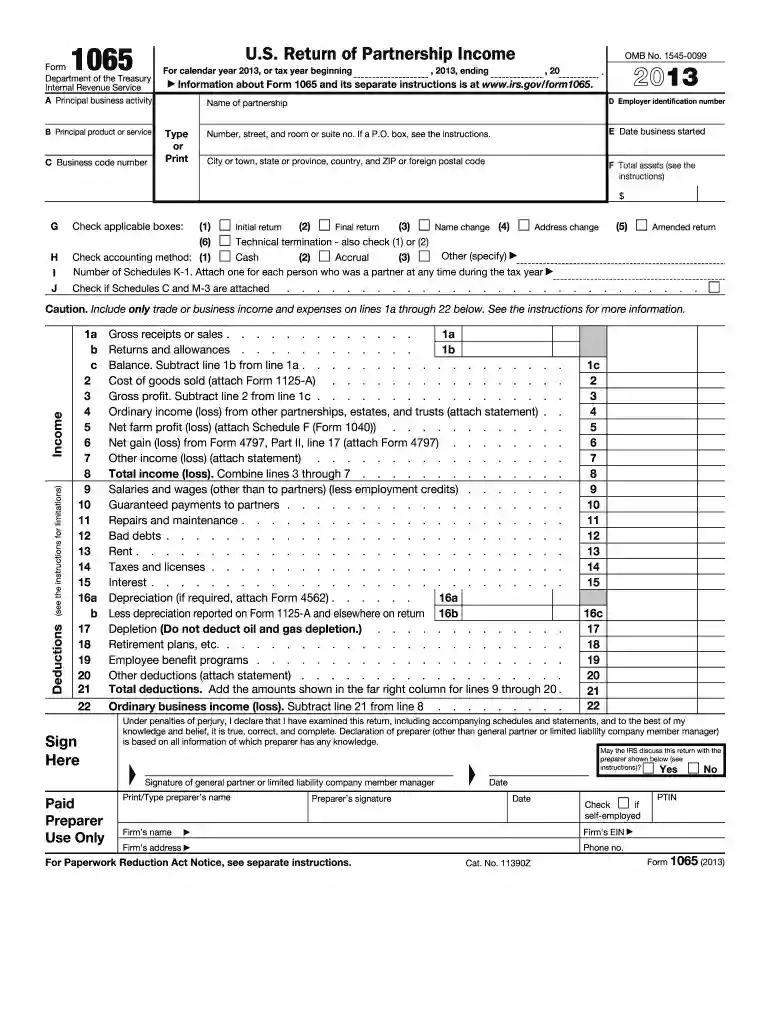
Type text, add images, blackout confidential details, add comments, highlights and more.

Draw your signature, type it, upload its image, or use your mobile device as a signature pad.

Send it via email, link, or fax. You can also download it, export it or print it out.
The 2013 Form 1065, titled U.S. Return of Partnership Income, serves as a federal tax form used by partnerships to report their financial information to the IRS. It details the annual income, deductions, gains, losses, and other pertinent tax-related activities of the partnership. The form ensures transparency in the financial aspects and tax liabilities of the partnership, helping the IRS assess the correct tax amount owed. Partnerships, as pass-through entities, don't pay income tax directly; instead, the tax responsibilities are distributed to individual partners based on their share of the business.
Understanding how to properly complete and file the 2013 Form 1065 is essential for partnerships. This form should be filled with meticulous attention to detail, accurately reflecting the partnership's income, deductions, and distributions. Partnerships need to compile all relevant financial records, including sales records, expense reports, and partners’ contributions. The form is complemented by Schedule K-1 for detailing each partner's share of the partnership's income. Ensure all sections are accurately completed to avoid complications with the IRS.
IRS guidelines for the 2013 Form 1065 provide a roadmap for accurately completing and filing the form. The IRS mandates that partnerships follow specific instructions regarding how income, expenses, and deductions should be reported. Stay informed about all applicable regulations to ensure compliance. Partners need to adhere to IRS deadlines and keep records supporting all claims made on the form.
The 2013 Form 1065 is due on the 15th day of the third month following the close of the partnership's tax year, typically March 15th, unless an extension is filed. For partnerships on a calendar year, this filing deadline is crucial for avoiding penalties. Extensions should be requested before this date using Form 7004 for automatic adjustment.
Failure to file the 2013 Form 1065 on time, or inaccuracies in the reported information, can lead to significant penalties. The IRS imposes penalties per month that the form is late, which can accumulate quickly. Additionally, failing to provide Schedule K-1 to each partner can result in separate penalties. Proper documentation and timely filing are essential to avoid these financial repercussions.
We've got more versions of the 2013 form 1065 form. Select the right 2013 form 1065 version from the list and start editing it straight away!
| Versions | Form popularity | Fillable & printable |
|---|---|---|
| 2025 | 4.6 Satisfied (56 Votes) | |
| 2024 | 4.3 Satisfied (48 Votes) | |
| 2023 | 4.4 Satisfied (52 Votes) | |
| 2022 | 4.9 Satisfied (24 Votes) | |
| 2021 | 4.8 Satisfied (81 Votes) | |
| 2020 | 4.3 Satisfied (145 Votes) | |
| 2019 | 4.4 Satisfied (171 Votes) | |
| 2018 | 4.3 Satisfied (138 Votes) | |
| 2017 | 4.3 Satisfied (233 Votes) | |
| 2016 | 4.4 Satisfied (678 Votes) | |
| 2015 | 4.2 Satisfied (57 Votes) | |
| 2014 | 4.1 Satisfied (30 Votes) | |
| 2013 | 4.3 Satisfied (36 Votes) | |
| 2012 | 4.2 Satisfied (30 Votes) | |
| 2011 | 4 Satisfied (42 Votes) |
At DocHub, your data security is our priority. We follow HIPAA, SOC2, GDPR, and other standards, so you can work on your documents with confidence.




Nov 5, 2013 Use Schedule F (Form 1040) to report farm income and expenses. File it with Form. 1040, 1040NR, 1041, 1065, or 1065-B.Read more
Filing Status 6. Single Dependent taxpayers, regardless of whether income is earned or unearned, are not required to file a Maryland income tax return unlessRead more
A new law allows you to choose to deduct certain charitable contributions of money on your 2013 tax return instead of your 2014 return. The.Read more


