




01. Edit your form online
Type text, add images, blackout confidential details, add comments, highlights and more.

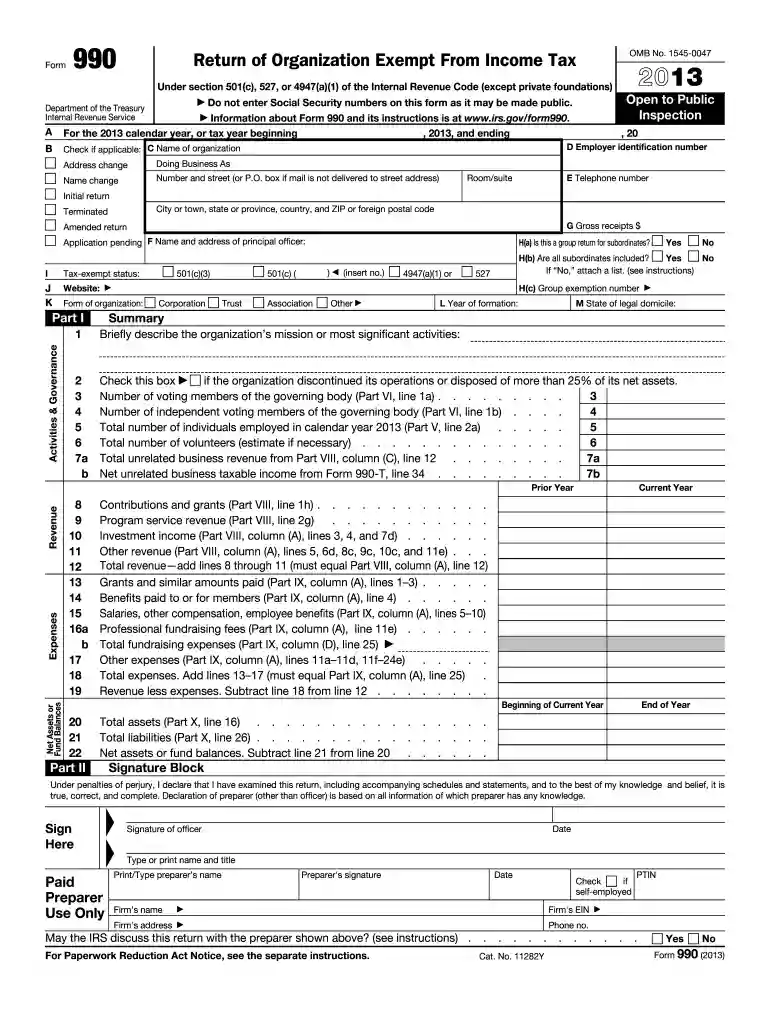
Type text, add images, blackout confidential details, add comments, highlights and more.

Draw your signature, type it, upload its image, or use your mobile device as a signature pad.

Send it via email, link, or fax. You can also download it, export it or print it out.
Form 990 for 2013 is an informational tax return used by organizations exempt from income tax under sections 501(c), 527, or 4947(a)(1) of the Internal Revenue Code in the United States. It is critical for providing transparency regarding the financial activities, governance policies, and compliance of these tax-exempt entities. This form is a public document that provides insight into an organization's operations, including revenue, expenses, and executive compensation.
Completing Form 990 for 2013 involves a systematic approach, covering multiple parts and schedules that must be accurately filled in:
Organizations must file the 2013 version of Form 990 by the 15th day of the 5th month after the close of their fiscal year. For example, if the fiscal year ends on December 31, 2013, the form is due by May 15, 2014.
To ensure compliance and validity, organizations must adhere to specific instructions outlined by the IRS:
Failure to file Form 990 timely and accurately can lead to significant penalties:
Various types of organizations are required to file this form, primarily those exempt under section 501(c):
Understanding essential terminology related to Form 990 is important for filing accuracy:
Understanding the critical components included in the Form 990 for 2013 is vital in ensuring accurate and compliant reporting:
Each element contributes to an overarching transparency goal, supporting public trust and compliance with federal requirements.
We've got more versions of the form 990 2013 form. Select the right form 990 2013 version from the list and start editing it straight away!
| Versions | Form popularity | Fillable & printable |
|---|---|---|
| 2025 | 4.6 Satisfied (50 Votes) | |
| 2024 | 4.6 Satisfied (53 Votes) | |
| 2023 | 3.4 Satisfied (37 Votes) | |
| 2022 | 4.3 Satisfied (30 Votes) | |
| 2021 | 4.8 Satisfied (102 Votes) | |
| 2020 | 4.4 Satisfied (60 Votes) | |
| 2019 | 4.3 Satisfied (102 Votes) | |
| 2018 | 4.3 Satisfied (128 Votes) | |
| 2017 | 4.3 Satisfied (133 Votes) | |
| 2016 | 4.4 Satisfied (565 Votes) | |
| 2015 | 4 Satisfied (61 Votes) | |
| 2015 | 4.5 Satisfied (22 Votes) | |
| 2014 | 4 Satisfied (49 Votes) | |
| 2013 | 4.1 Satisfied (45 Votes) | |
| 2012 | 4 Satisfied (27 Votes) |
At DocHub, your data security is our priority. We follow HIPAA, SOC2, GDPR, and other standards, so you can work on your documents with confidence.


1. Contributions, gifts, grants, etc., received (attach schedule). 2. Check ▷ if the foundation is not required to attach Sch. B.Read more
by AWM File Cited by 3 December 31, 2013 (not on or after December 31, 2013), it may use either 2012 Form 990 or 2013 Form 990 to file for the short year. A short period returnRead more
11. Totals. 990-T. Form 990-T (2013). Page. (see instructions). Add totals of columns 2(a) and 2(b). Enter here and on page 1, Part I, line 6, column (A)Read more


