
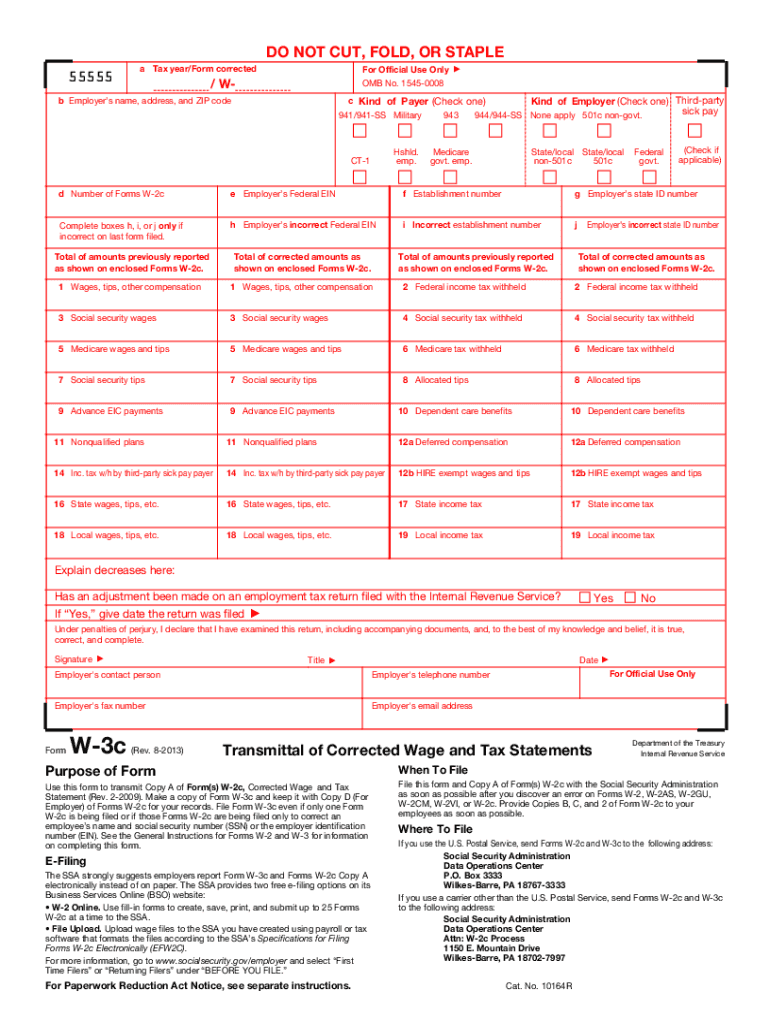







Definition & Meaning
The "2013 W-3c Form" is essential for correcting employment tax records for businesses. It serves as a transmittal document for Form W-2c, which reports corrected wage and tax information for employees. Issued by the Internal Revenue Service (IRS), the W-3c Form ensures that amendments to W-2 information are accurately communicated to the Social Security Administration (SSA). This form is particularly significant because it ensures that employees' Social Security and Medicare wages and taxes are correctly recorded, essential for future benefits and compliance with federal regulations.
How to Use the 2013 W-3c Form
To effectively use the 2013 W-3c Form, first identify the changes needed for employee wage and tax data. Begin by compiling the original data from the Form W-2 that needs correction. Next, complete Form W-2c to reflect these corrections. Subsequently, fill out the W-3c Form to serve as a summary document that transmits the corrected W-2 data to the SSA. Ensure that you accurately enter all required information in the designated fields, as errors may result in misunderstandings or penalties. Clear instructions are provided on the IRS website to guide users through each step of the process.
Steps to Complete the 2013 W-3c Form
- Gather Corrected Data: Before filling out the W-3c Form, ensure that you have the correct details regarding employees' wage and tax adjustments.
- Fill Out Employee Information: Include employee details such as name, Social Security number, and any corrections to previously reported data in the appropriate sections of Form W-2c.
- Complete the W-3c Form: Use the W-3c Form to summarize the corrections made. Accurate transcriptions of amounts and details from W-2c to W-3c are crucial.
- Verify Information: Double-check all the information for accuracy, ensuring no discrepancies between the W-2c and W-3c forms.
- Send to SSA: Submit both the corrected W-2c and the W-3c to the Social Security Administration following the specified submission methods.
Filing Deadlines / Important Dates
Timely filing of the W-3c Form is critical. Typically, employers should submit corrections, along with Form W-2c, as soon as any error is discovered. Although specific deadlines for submitting corrections can vary, completing and filing corrections before the SSA processes the original year's returns is advisable. It's crucial to check IRS guidelines annually for any updates to these deadlines and ensure adherence to prevent penalties.
Penalties for Non-Compliance
Failing to submit the 2013 W-3c Form within required timelines or providing incorrect information can result in fines. Penalties vary based on the severity of the error, the delay in correction, and the size of the business. For minor discrepancies corrected promptly, penalties might be waived. However, significant lapses can incur substantial fines. Employers must maintain accurate records and promptly address any identified mistakes to avoid these financial repercussions.
Required Documents
To complete the W-3c Form accurately, you need the original Form W-2 for both the individual employee records and company summaries. Additionally, have access to related tax return documentation and any payroll records that detail the necessary corrections. These documents help ensure precise data entry and support the reliable completion of both W-2c and W-3c forms.
Form Submission Methods (Online / Mail / In-Person)
The IRS and SSA provide multiple submission methods for corrected forms. Online submission is the most efficient, with the Business Services Online (BSO) portal providing a secure method for electronic filing. Alternatively, businesses can mail physical copies of the W-3c and W-2c forms directly to the relevant SSA office. In-person submissions are less common but possible through SSA offices equipped to handle employer filings. Each submission method has specific procedures, so verifying the IRS guidelines each tax year is recommended.
Examples of Using the 2013 W-3c Form
Consider a scenario where an employer discovers an employee's incorrect Social Security number on the original W-2 form. The employer would complete a W-2c to correct this information and then use the W-3c to transmit this change. Another example involves correcting payroll amounts where, upon review, underreported wages were found. In both cases, the corrected information ensures accurate reporting for both the employee's future benefits and compliance with tax regulations.




