Az instructions income tax 2026

Get Form
arizona income tax Preview on Page 1

Here's how it works

01. Edit your arizona income tax online
Type text, add images, blackout confidential details, add comments, highlights and more.

02. Sign it in a few clicks
Draw your signature, type it, upload its image, or use your mobile device as a signature pad.

03. Share your form with others
Send az income tax via email, link, or fax. You can also download it, export it or print it out.

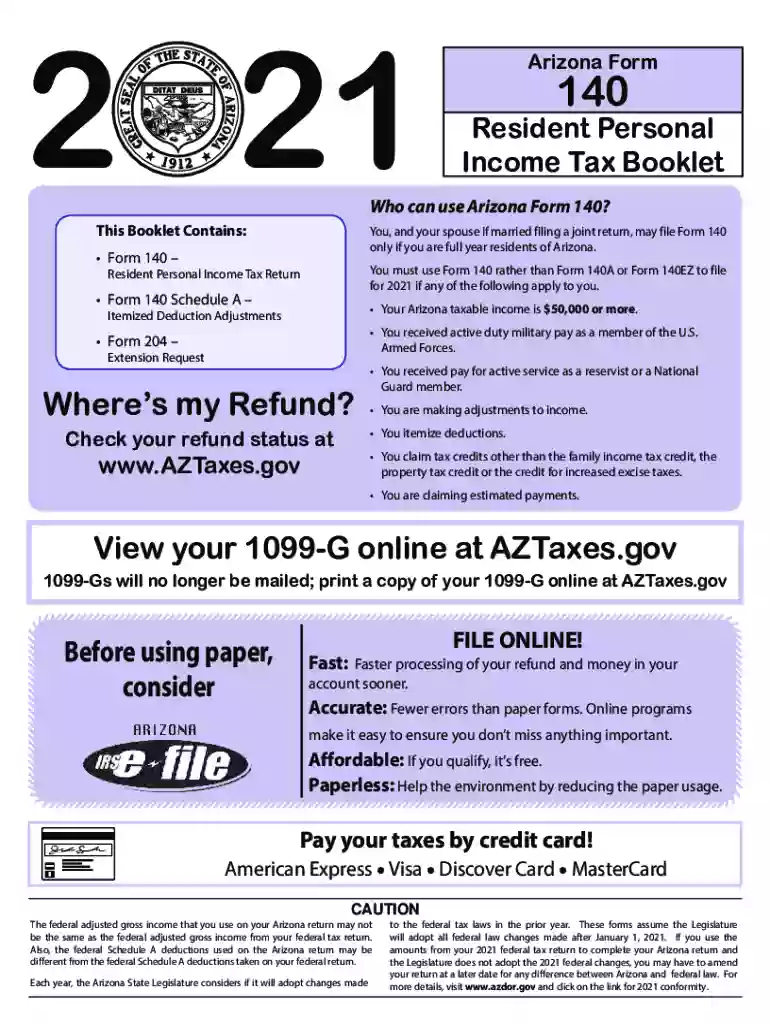
Definition & Purpose of Arizona Form 140

Arizona Form 140 is specifically designed for residents to report their personal income tax. The form is part of the Arizona Department of Revenue's suite of documents that enable residents to file their state taxes. This document plays a crucial role in helping taxpayers identify their tax liabilities or refunds after accounting for deductions, credits, and any income adjustments.

Form 140 is applicable to those with taxable income in Arizona, offering residents a clear framework for documenting earnings and deductions. It's available for both paper and e-filing, making it accessible to a wide range of users. The form also offers the opportunity for taxpayers to declare various state-specific tax credits and considerations, especially those pertinent to special groups such as military personnel and small business owners.

Steps to Complete the Arizona Form 140

  1. Gather Necessary Documents: Begin by collecting all relevant financial documentation, including W-2 forms, 1099 forms, records of additional income, and receipts for deductions.
  2. Download the Form: Access the Arizona Department of Revenue website or DocHub to download Form 140.
  3. Personal Information: Fill in your basic identification details, including your name, Social Security Number, and filing status.
  4. Report Income: Input all income sources, each documented accurately to ensure proper calculation.
  5. Calculate Deductions and Credits: Identify all applicable state deductions and credits. Arizona offers potential tax credits for military service and other state-specific deductions.
  6. Review Deductions and Adjustments: Follow instructions for state household deductions or credits related to senior living, military service, or dependents.
  7. Submit the Form: Choose between online submission for quicker processing or mailing the paper form. Ensure to include all supporting documents.

Important Terms Related to Arizona Form 140

  • Adjusted Gross Income (AGI): Total gross income minus specific deductions.
  • Tax Credits: Non-refundable credits offered by the state of Arizona, including credits for contributions to public schools and renewable energy.
  • Taxable Income: The portion of income that is subject to state income tax after deductions.
  • Exemption: A specific amount deducted from taxable income for the primary taxpayer, spouse, and dependents.
  • Filing Status: Defined categories based on marital status, determining tax rates and deductions.

Legal Use and Compliance with Arizona Form 140

Completing Form 140 fulfills the legal obligation for residents to report their annual income to the state. Non-compliance can result in penalties, including accrual of interest on unpaid taxes and potential legal action. Accurately filing this form not only ensures compliance but also maximizes potential refunds or minimizes tax liabilities by efficiently applying state-specific credits and deductions.

In particular, legal citation of earnings and expenditures as outlined in state regulations is critical. Misrepresentation or omission of important financial details can lead to audits and penalties. Ethical and complete tax reporting aligns not only with personal interests but also complies with state laws, promoting financial integrity.

Filing Deadlines and Important Dates for Arizona Form 140

The deadline for submitting Arizona Form 140 aligns with the federal tax deadline, generally on April 15 of each year. In instances where this date falls on a weekend or holiday, the deadline may extend to the next business day. Taxpayers should also be aware of deadlines specific for extensions.

For taxpayers requiring additional time, Arizona offers a six-month filing extension, provided that at least 90% of the tax liability is paid by the original due date. It's critical for taxpayers to ensure they meet these deadlines to avoid penalties and interest on unpaid taxes.

Required Documents for Completing Arizona Form 140

  • W-2 Forms: Documenting income earned from employers.
  • 1099 Forms: Reporting other applicable income types like dividends and interest.
  • Receipts for Deductions: Including medical expenses, property taxes, and charitable contributions.
  • Proof of Credit Eligibility: Residency documents, investment in public school programs, or renewable energy system installation evidence.
  • Proof of Dependents: Birth certificates or adoption papers for deductions and exemptions related to dependents.

Taxpayer Scenarios: Who Typically Uses Arizona Form 140

Arizona residents across various circumstances use Form 140 based on their income and filing status. This includes:

  • Salaried Employees: Individuals earning wages from employer-reported via W-2.
  • Self-Employed Individuals: Business owners reporting income and expenses on Schedules C or SE.
  • Retired Persons: Those drawing pensions and social security benefits.
  • Students and Part-time Workers: Reporting part-time income.

Unique situations like part-year residents or those with multistate income might require additional forms or schedules for accurate reporting.


decoration image ratings of Dochub

State-Specific Rules and Variants of Arizona Form 140

Form 140 is tailored for full-year Arizona residents. There are variants, such as Form 140PY, for part-year residents, and Form 140NR, for non-residents with income from Arizona sources. These variations ensure that all types of residents meet their filing requirements properly. The Arizona tax code frequently updates, affecting how credits or deductions apply—particularly those related to new legislation impacting income levels or exemption amounts.

Understanding these details ensures compliance and optimizes financial outcomes through structured legal avenues specific to Arizona's guidelines.

See more az instructions income tax versions

We've got more versions of the az instructions income tax form. Select the right az instructions income tax version from the list and start editing it straight away!
Versions Form popularity Fillable & printable
2023 4.5 Satisfied (58 Votes)
2022 4.8 Satisfied (58 Votes)
2021 4.8 Satisfied (85 Votes)
2020 4.3 Satisfied (231 Votes)
2018 4.4 Satisfied (207 Votes)
2017 4.5 Satisfied (52 Votes)
be ready to get more

Complete this form in 5 minutes or less

Get form

Got questions?

We have answers to the most popular questions from our customers. If you can't find an answer to your question, please contact us.
Contact us
The Tax Cuts and Jobs Act (TCJA) increased the standard deduction (set at $14,600 for single filers and $29,200 for joint filers in 2024) while suspending the personal exemption by reducing it to $0 through 2025.
Who must file a Arizona tax return? Single AND gross income is more than $13,850. MFJ AND gross income is more than $27,700. MFS AND gross income is more than $13,850. Head of Household AND gross income more than $20,800.
To make a payment on individual Arizona income tax owed, taxpayers can either do so electronically or by mail. Taxpayers who file electronically can authorize an electronic funds withdrawal (direct debit) from a checking or savings account.
If your 2024 earnings are similar to 2023, youll want your federal paycheck withholdings at roughly last years effective tax rate, Loyd said. For example, if your gross paycheck is $1,000 and last years effective tax rate was 12%, youll want about $120 withheld in federal taxes, he said.
The flat Arizona income tax rate of 2.5% applies to taxable income earned in 2023, which is reported on your 2024 state tax return. The due dates for your state income tax return generally follow the federal tax deadline.

Security and compliance

At DocHub, your data security is our priority. We follow HIPAA, SOC2, GDPR, and other standards, so you can work on your documents with confidence.

Learn more
ccpa2
pci-dss
gdpr-compliance
hipaa
soc-compliance
be ready to get more

Complete this form in 5 minutes or less

Get form

People also ask

For tax year 2023 and beyond, the tax rate for Arizona taxable income is 2.5%.
The Arizona state income tax rate is 2.5%. This rate applies to taxable income earned in 2023, which is reported on state tax returns filed in 2024.
Arizona residents must file income taxes if they earned more than $13,850 individually or $27,700 if married and filing jointly. Residents filing as head of household must file income taxes if they earned more than $20,800.

Related links