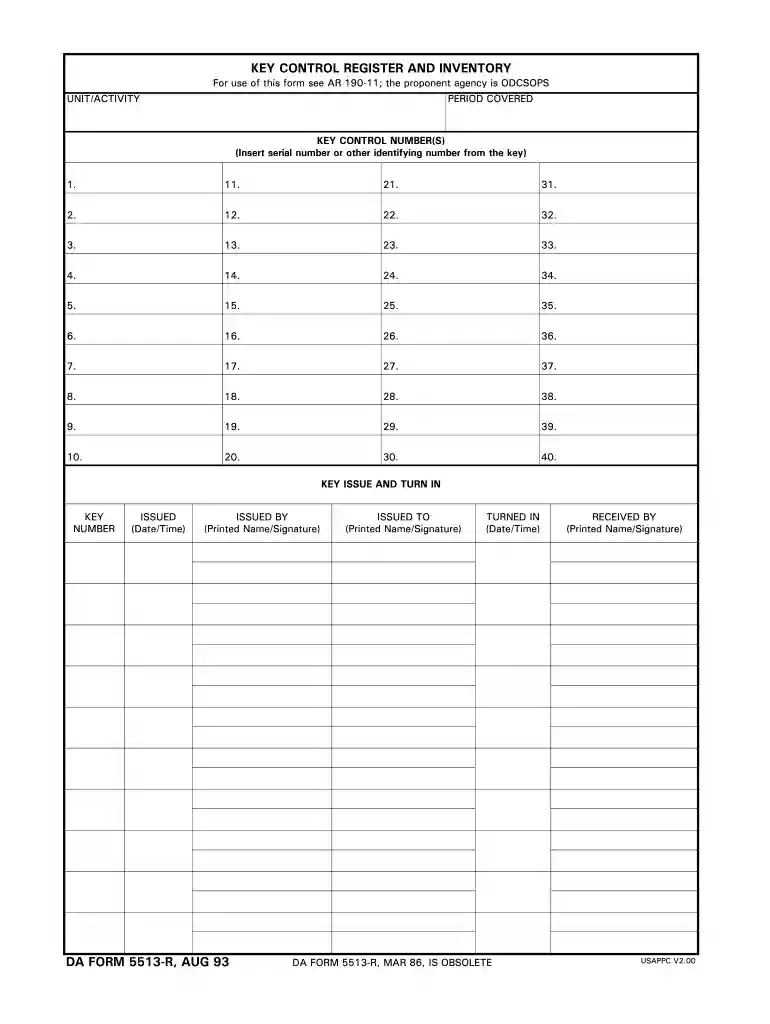
Key inventory log 2026

Get Form
key inventory log Preview on Page 1

Here's how it works

01. Edit your key inventory log online
Type text, add images, blackout confidential details, add comments, highlights and more.

02. Sign it in a few clicks
Draw your signature, type it, upload its image, or use your mobile device as a signature pad.

03. Share your form with others
Send key inventory template via email, link, or fax. You can also download it, export it or print it out.

How to use or fill out key inventory log with our platform

Form edit decoration
9.5
Ease of Setup
DocHub User Ratings on G2
9.0
Ease of Use
DocHub User Ratings on G2
  1. Click ‘Get Form’ to open the key inventory log in the editor.
  2. Begin by entering the 'UNIT/ACTIVITY' and 'PERIOD COVERED' at the top of the form. This information is crucial for tracking your key inventory accurately.
  3. In the 'KEY CONTROL NUMBER(S)' section, input the serial numbers or identifying numbers for each key. Ensure that you fill in all relevant fields from 1 to 40.
  4. For each key issued, complete the 'KEY ISSUE AND TURN IN' section. Enter the 'KEY NUMBER', followed by the 'ISSUED DATE/TIME', and provide your printed name and signature as well as those of the recipient.
  5. When a key is returned, fill in the 'TURNED IN DATE/TIME' and have it signed by both parties in the respective fields.
  6. Finally, for inventories, record dates and signatures in the designated area to maintain accurate records of joint/semiannual inventories.

Start using our platform today to streamline your key inventory management for free!

See more key inventory log versions

We've got more versions of the key inventory log form. Select the right key inventory log version from the list and start editing it straight away!
Versions Form popularity Fillable & printable
2016 4.8 Satisfied (186 Votes)
2006 4.3 Satisfied (74 Votes)
1993 4.4 Satisfied (547 Votes)
be ready to get more

Complete this form in 5 minutes or less

Get form

Got questions?

We have answers to the most popular questions from our customers. If you can't find an answer to your question, please contact us.
Contact us
You should include the following items in your inventory list: the assets. the type or category. the counted quantity. the condition. the current value. the storage location. the time of recording.
Keeping track of your business inventory, whether its stock to sell to customers or key assets for your business, is very important. Using Excel makes this task easier. You can use a free downloadable template or build out your own, helping you save time and stay on top of your inventory.
Use cloud-based inventory management software. Squares software connects directly to your point of sale, so your stock levels are automatically adjusted every time you make a sale. Receive daily stock alert emails so you always know which items are low or out of stock so you can order more in time.
How to write an inventory report Create a column for inventory items. Similar to an inventory sheet template, create a list of items in your inventory using a vertical column. Create a column for descriptions. Assign a price to each item. Create a column for remaining stock. Select a time frame.
Inventory record keeping is an essential aspect of managing any business that involves the buying and selling of goods. It is the process of documenting all inventory-related transactions, including purchases, sales, returns, and adjustments.

Security and compliance

At DocHub, your data security is our priority. We follow HIPAA, SOC2, GDPR, and other standards, so you can work on your documents with confidence.

Learn more
ccpa2
pci-dss
gdpr-compliance
hipaa
soc-compliance
be ready to get more

Complete this form in 5 minutes or less

Get form

People also ask

What to Include on Inventory Lists Name of item: SKU (stock-keeping unit), serial number, and/or barcode: Category and item description: Name of manufacturer or supplier: Unit cost: Sale price: Quantity in stock: Total value:
Inventory logs are used to help track inventory when it is requested and fulfilled in your sites requests. It also tracks: who used the inventory. the quantity fulfilled. the total inventory cost.

the key inventory