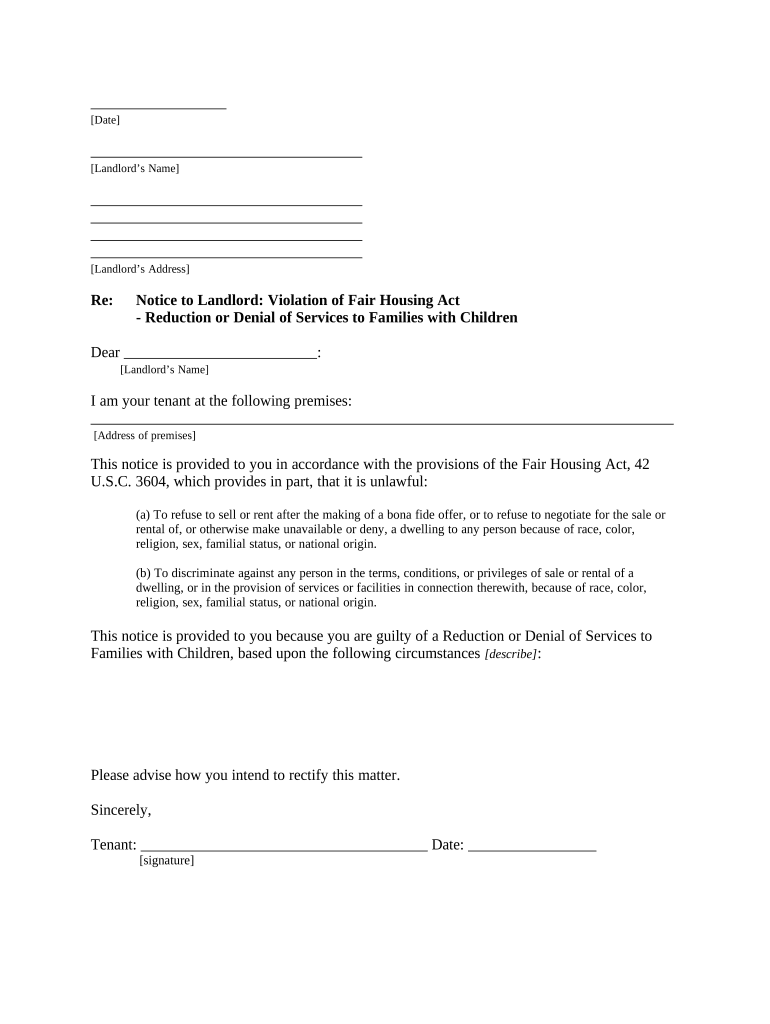
Letter from Tenant to Landlord about Fair Housing Reduction or Denial of services to Family with Children - Maine 2026

Get Form
dfhe Preview on Page 1

Here's how it works

01. Edit your dfhe online
Type text, add images, blackout confidential details, add comments, highlights and more.
02. Sign it in a few clicks
Draw your signature, type it, upload its image, or use your mobile device as a signature pad.
03. Share your form with others
Send equal housing opportunity logo size requirements via email, link, or fax. You can also download it, export it or print it out.

How to use or fill out Letter from Tenant to Landlord about Fair Housing Reduction or Denial of services to Family with Children - Maine

Form edit decoration
9.5
Ease of Setup
DocHub User Ratings on G2
9.0
Ease of Use
DocHub User Ratings on G2
  1. Click ‘Get Form’ to open it in the editor.
  2. Begin by entering the date at the top of the document. This sets a clear timeline for your notice.
  3. Fill in the landlord’s name and address in the designated fields. Ensure accuracy to facilitate proper communication.
  4. In the greeting, address your landlord directly by name, maintaining a professional tone.
  5. Provide your address as the tenant in the specified section. This confirms your identity and residence.
  6. Clearly state the violation of the Fair Housing Act, referencing specific sections that apply to your situation.
  7. Describe the circumstances leading to this notice in detail, ensuring clarity and specificity.
  8. Request a response from your landlord on how they plan to rectify this issue, promoting an open dialogue.
  9. Sign and date at the bottom of the letter, ensuring you have completed all necessary fields before sending.
  10. Select a method for proof of delivery and complete that section accordingly, confirming how you will notify your landlord.

Start using our platform today for free to streamline your document editing and ensure effective communication with your landlord!

be ready to get more

Complete this form in 5 minutes or less

Get form

Got questions?

We have answers to the most popular questions from our customers. If you can't find an answer to your question, please contact us.
Contact us
Discrimination in Housing Based Upon Familial Status In most instances, the amended Fair Housing Act prohibits a housing provider from refusing to rent or sell to families with children. However, some facilities may be designated as Housing for Older Persons (55 years of age).
Direct evidence. Direct evidence often involves a statement from a decision-maker that expresses a discriminatory motive. Direct evidence can also include express or admitted classifications, in which a recipient explicitly distributes benefits or burdens based on race, color, or national origin.
Refusal to sell, rent, or lease rooms, apartments, mobile homes, condos, or houses. Refusal to negotiate for the sale, rental, or lease of housing. Informing someone that an apartment is not available for inspection, sale, or rental when it is in fact available. Denial of a home loan or homeowners insurance.
Federal, state, and local laws prohibit racial and other discrimination in housing. Nonetheless, discrimination persists and can be difficult to prove. Winning a case may require good documentation and patience. Fair housing groups can render assistance.
Examples of direct evidence of discrimination include openly discriminatory statements during a verbal or written exchange between a landlord and a tenant, an advertisement for a rental property stating a discriminatory preference, and discriminatory rules and policies.
be ready to get more

Complete this form in 5 minutes or less

Get form

People also ask

The Federal Fair Housing Act protects several classes from discrimination in housing, including race, color, religion, gender, familial status, and disability. However, employment status is not a protected class under this law. Therefore, the correct answer is D. Employment Status.
There are several ways to file a complaint: You can file a complaint right now, by using our online form. You can call toll-free 1 (800) 669-9777. You can print out a form, complete it, and drop it or mail it to: You can write us a letter with:

fair housing discrimination