School book report form 2026

Get Form
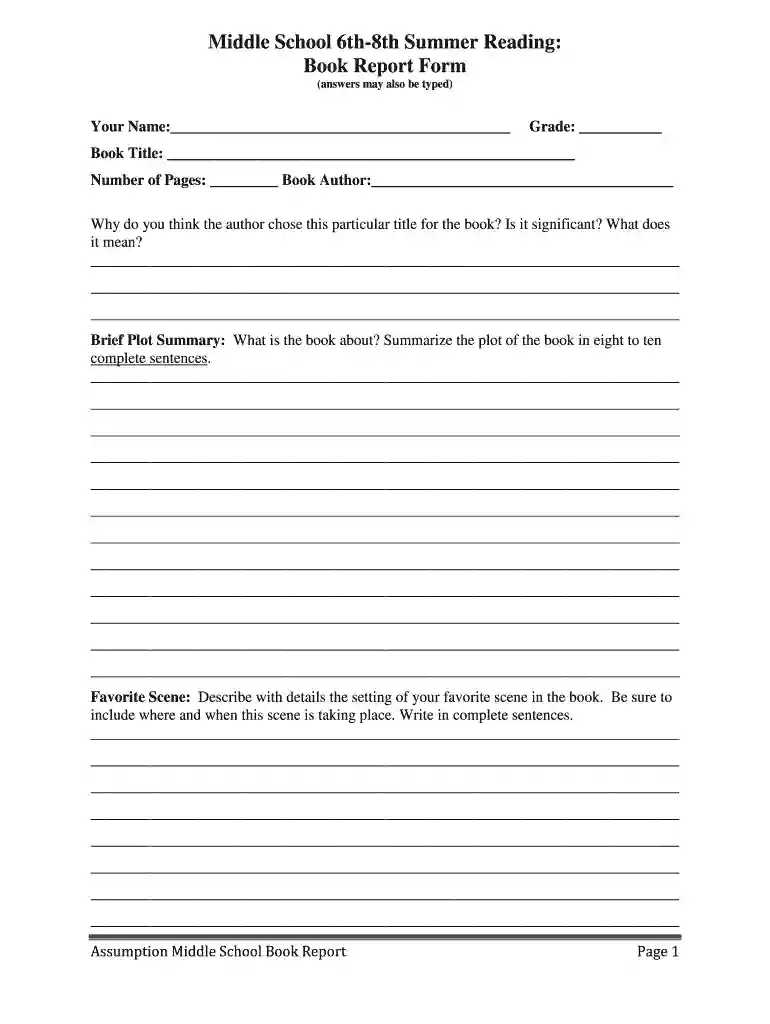
middle school book report template Preview on Page 1

Here's how it works

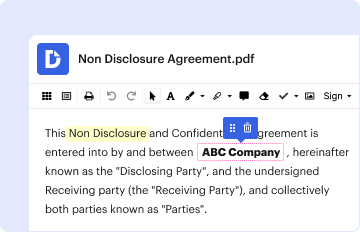
01. Edit your middle school book report template online
Type text, add images, blackout confidential details, add comments, highlights and more.

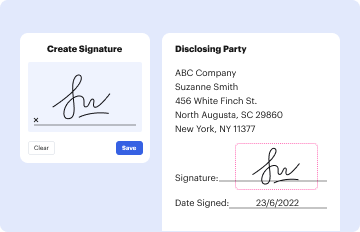
02. Sign it in a few clicks
Draw your signature, type it, upload its image, or use your mobile device as a signature pad.

03. Share your form with others
Send middle school book report template pdf via email, link, or fax. You can also download it, export it or print it out.

Definition and Meaning of the School Book Report Form

The school book report form serves as a structured template that guides students, particularly in middle school, in summarizing and analyzing books they have read. Typically intended for grades six through eight, it includes sections that require students to provide personal information, details about the book, and their reflections on the text. By using this form, students can effectively engage with literature, fostering critical thinking and encouraging deeper comprehension of reading material.

The main components of a standard school book report form often include:

  • Personal Information: Name, grade, and class details.
  • Book Information: Title, author, genre, and publication details.
  • Plot Summary: A brief overview of the main storyline.
  • Analysis Sections: Favorite scenes, character explorations, and thematic elements.
  • Personal Reflection: Students’ thoughts on the book, its message, and its impact on them.

Utilizing this form helps students in articulating their understanding and personal interpretations of the material, reinforcing essential aspects of literary analysis.

How to Use the School Book Report Form

Using the school book report form involves a straightforward process that can enhance a student’s engagement with their reading assignment. Here are the key steps:

  1. Select a Book: Choose a book that aligns with the reading requirements or one that interests the student.
  2. Read Thoroughly: Encourage the student to read the book carefully, taking notes on significant plot points and character developments.
  3. Complete the Form Sections: Fill out each section of the form as the book is read. This means summarizing the plot, analyzing significant characters, and noting favorite scenes shortly after they are read.
  4. Reflect: In the personal reflection section, the student should articulate their thoughts on the book's themes and overall message, considering how it resonates with them personally.
  5. Proofread: Before submitting the report, review the completed form for clarity, grammar, and completeness to ensure it communicates the student’s understanding effectively.

This method increases retention and comprehension, making reading assignments more rewarding.

Steps to Complete the School Book Report Form

To effectively complete a school book report form, follow these structured steps:

  1. Title and Author Entries: Start by entering the book’s title and the author’s name. Ensure correct spelling and formatting.
  2. Genre Identification: Specify the genre of the book, such as fiction, non-fiction, mystery, or fantasy. This categorization helps in contextualizing the report.
  3. Plot Summary:
    • Write a concise summary capturing essential plot details without revealing any spoilers.
    • Highlight main events, character actions, and pivotal moments.
  4. Character Analysis: Discuss key characters in the book, their traits, motivations, and development throughout the story.
    • Consider including:
      • Main character(s) and their roles.
      • Supporting characters and their significance.
  5. Thematic Exploration: Identify and discuss the major themes presented in the book. How do the themes reflect broader social issues or personal experiences?
  6. Favorite Scenes and their Importance: Choose one or two favorite scenes and explain why they stood out. This could involve emotional impact, humor, or significant character development.
  7. Personal Reflection: Encourage the student to express their thoughts about what they learned, enjoyed, or found challenging about the book.

This framework is essential for crafting a well-rounded and comprehensive book report.

Key Elements of the School Book Report Form

The school book report form encompasses several key elements that are vital for effective completion and educational value:

  • Title and Author: Fundamental details indicating the subject of the report.
  • Plot Summary: A succinct overview that helps encapsulate the book’s main story arc.
  • Character Analysis: Exploration of characters fosters understanding of narrative perspectives and motivations.
  • Theme Identification: Discussing themes enlightens students on deeper meanings and authors' intents.
  • Personal Reflections: Allows students to connect personally with the material, enhancing critical thinking and emotional intelligence.

Each of these components serves a dual purpose: collecting information about the book while also helping students practice writing and analytical skills.

Examples of Using the School Book Report Form

Examples help illustrate the practical application of the school book report form. Common cases include:

  • Summer Reading Assignments: Many schools assign summer reading, asking students to complete a book report form upon return. For instance, a student could read "Harry Potter and the Sorcerer's Stone" and use the form to discuss Harry’s character development and the theme of friendship.
  • Literature Discussions: Teachers might use the form as part of literature circles, where students share and discuss their reports in groups, promoting peer learning.
  • Parental Involvement: Parents can assist younger students in completing the form, discussing story elements together, which can deepen understanding and foster a love for reading.

These examples illustrate the versatility and educational benefits of the school book report form across different contexts and uses.

Important Terms Related to the School Book Report Form

Understanding specific terminology is crucial for successfully navigating and using the school book report form:

  • Plot: The sequence of events in a story, including exposition, rising action, climax, falling action, and resolution.
  • Characterization: The portrayal of characters and their development throughout the book.
  • Theme: The underlying messages or central ideas conveyed in the narrative.
  • Genre: The category of literature that defines various groupings based on style, form, and content, such as fiction, non-fiction, or poetry.
  • Narrative Perspective: Refers to the point of view from which the story is told.

Familiarity with these terms enhances comprehension and execution of the elements needed when completing a school book report form, leading to more insightful and educational submissions.

be ready to get more

Complete this form in 5 minutes or less

Get form

Got questions?

We have answers to the most popular questions from our customers. If you can't find an answer to your question, please contact us.
Contact us
A book report is a written summary of a books content and your analysis of it. It includes an introduction, plot summary, analysis, and conclusion. A book report is typically assigned to students in middle or high school, but it can also be assigned in college. Book reports are typically 250500 words long.
A good book report should include the books author, title, characters, setting, and plot, as well as a personal endorsement, which is your opinion of the book.
An MLA book citation always includes the author(s), title (italicized), publisher, and publication year in the Works Cited entry. If relevant, also include the names of any editors or translators, the edition, and the volume. University Press should be abbreviated to UP in a Works Cited entry.
How to write a book report 1 Read the book. 2 Take notes. 3 Create an outline. 4 Write the introduction. 5 Write the plot summary. 6 Write the analysis. 7 Write the conclusion.
FORMAT YOUR PAPER IN MLA An easily readable font (most professors prefer Times New Roman) 11-13 point size (most professors prefer 12 point font) Double spacing. 1-inch margins. 1/2-inch indent on the first line of each paragraph in the body of your paper. Hanging indent on each Works Cited citation.

People also ask

The basic form for a book citation is: Last Name, First Name. Title of Book. City of Publication, Publisher, Publication Date.
All research papers on literature use MLA format, as it is the universal citation method for the field of literary studies. Whenever you use a primary or secondary source, whether you are quoting or paraphrasing, you will make parenthetical citations in the MLA format [Ex.

middle school book report form