Ms executor 2026

Get Form
ms executor Preview on Page 1

Here's how it works

01. Edit your form online
Type text, add images, blackout confidential details, add comments, highlights and more.
02. Sign it in a few clicks
Draw your signature, type it, upload its image, or use your mobile device as a signature pad.
03. Share your form with others
Send it via email, link, or fax. You can also download it, export it or print it out.

How to use or fill out ms executor with our platform

Form edit decoration
9.5
Ease of Setup
DocHub User Ratings on G2
9.0
Ease of Use
DocHub User Ratings on G2
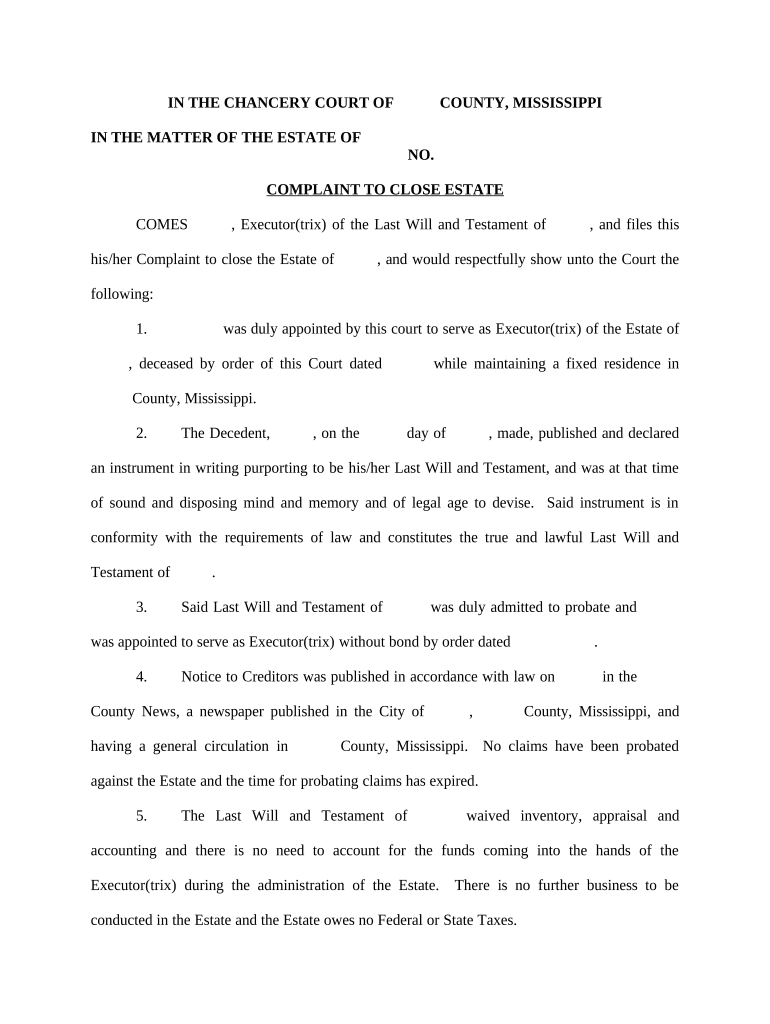
  1. Click ‘Get Form’ to open the ms executor in the editor.
  2. Begin by entering your name as the Executor(trix) in the designated field, ensuring accuracy for legal purposes.
  3. Fill in the details of the decedent, including their full name and date of death, in the appropriate sections.
  4. Provide information regarding the court order appointing you as Executor(trix), including dates and any relevant case numbers.
  5. List all heirs and devisees under the Last Will and Testament, ensuring that each name is clearly stated to avoid confusion.
  6. Review all entries for accuracy before finalizing. Utilize our platform’s editing tools to make any necessary adjustments easily.
  7. Once completed, save your document and proceed to sign it digitally using our platform’s signature feature for a seamless process.

Start filling out your ms executor form today for free on our platform!

be ready to get more

Complete this form in 5 minutes or less

Get form

Got questions?

We have answers to the most popular questions from our customers. If you can't find an answer to your question, please contact us.
Contact us
As an executor, you have the right to collect and secure all assets belonging to the estate. That involves identifying and locating all relevant assets, safeguarding them against loss or damage, and ensuring proper maintenance throughout the administration process.
There are limits on what an executor can and cannot do. If youve been named an executor, a couple basic rules of thumb are that you cant do anything that disregards the provisions in the will, and you cant act against the interests of any of the beneficiaries. Sounds pretty straightforward, right?
Generally speaking, the executor of a will cannot take everything simply based on their status as executor. Executors are bound by the terms of the will and must distribute assets as the will directs. This means that executors cannot ignore the asset distribution in the will and take everything for themselves.
Filing fees: Youll need to pay these fees to open a probate case, typically ranging from $100 to $200, depending on the county. Executor fees: The personal representative gets paid for managing the estate, with fees usually ranging from 1% to 5% of the estates value.
Once the court legally recognizes them as the executor, they have the power to act on behalf of the decedents estate. This means the executor has to fulfill the probate process by administering the estate. The executor has the power to perform duties, such as caring for the decedents property or even pets.
be ready to get more

Complete this form in 5 minutes or less

Get form

People also ask

You can specify in your Last Will if you do not wish that the probate court limits or supervises the executor. Such a person is an independent executor. If you do wish that the probate court limits or supervises them, then your executor will be dependent.
States determine how much an executor gets paid in a variety of different ways. For instance, some states set payment at a percentage of the estate. In those states, the compensation percentage usually diminishes as the value of estate increases5% compensation for the first $100,000, 4% for the next $200,000, etc.
While California law grants executors considerable authority in managing estate assets, the powers of an executor of a will are limited by the fiduciary duties owed to the estate and its beneficiaries. This means that executors are legally required to act in the best interests of the estate and its beneficiaries.

Related links