Type text, add images, blackout confidential details, add comments, highlights and more.
02. Sign it in a few clicks
Draw your signature, type it, upload its image, or use your mobile device as a signature pad.
03. Share your form with others
Send it via email, link, or fax. You can also download it, export it or print it out.
How to use or fill out Mississippi Deed Trust with our platform
Ease of Setup
DocHub User Ratings on G2
Ease of Use
DocHub User Ratings on G2
Click ‘Get Form’ to open the Mississippi Deed Trust in the editor.
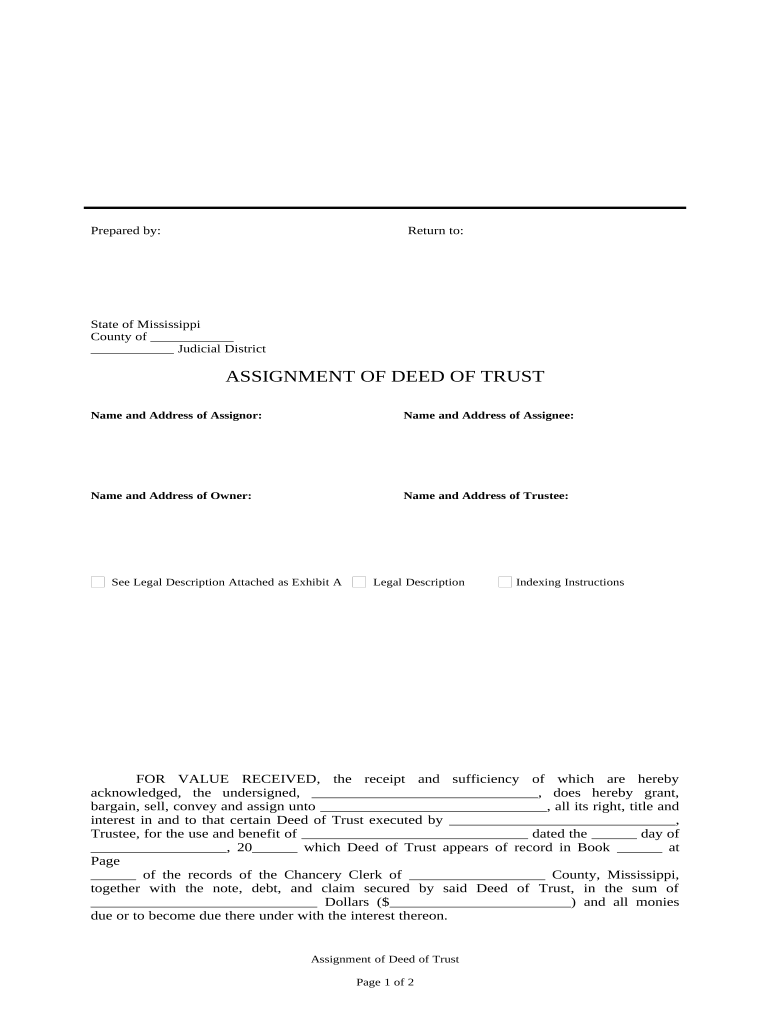
Begin by filling in the 'Name and Address of Assignor' and 'Name and Address of Assignee'. Ensure that all details are accurate to avoid any legal issues.
Next, provide the 'Name and Address of Owner' and 'Name and Address of Trustee'. This information is crucial for identifying all parties involved in the deed trust.
Attach the legal description as Exhibit A. You can easily upload this document using our platform's file upload feature.
In the section labeled 'FOR VALUE RECEIVED', enter the name of the undersigned, along with their acknowledgment of receipt. Fill in the details regarding the Deed of Trust, including dates and record information.
Complete the execution section by signing where indicated. Make sure to include titles and corporate seals if applicable.
Finally, ensure that a notary public witnesses your signature. Fill in their details as required at the bottom of the form.
Start using our platform today to fill out your Mississippi Deed Trust online for free!
What do you need for a deed of trust in Mississippi?
Deeds of trust require the signatures of the grantor and a notary public. The document must be filed with the Chancery Clerks Office for the county where the property is located. Documents must be formatted as follows before being presented for recording: White paper.
Who holds the security in a deed of trust?
An instrument that transfers legal title in real property to a trustee to hold as security for a loan made by a lender to a borrower. The borrower retains equitable title to the real property.
What is the purpose of a deed of trust?
A deed of trust is an agreement between a home buyer and a lender at the closing of real property. The deed of trust, sometimes called a trust deed, states that the home buyer will repay the home loan and the mortgage lender will hold the propertys legal title until the loan is paid in full.
What are the disadvantages of a deed of trust?
What Are the Disadvantages of a Trust? Loss of Control. Setting up the trust necessitates you giving up some amount of control of the assets you place within the trust. Loss of Asset Access. Cost. Recordkeeping Complexity. High Need for Competency.
What is a deed of trust in Mississippi?
In real estate, a deed of trust is a legal document that states a property will be held by a neutral third party until any loan is paid off. In the context of a real estate transaction, a deed of trust is a legal document declaring that a property will be held by a neutral third party until any loan is paid off.
Apr 13, 2023 A deed of trust that pledges the borrowers residence as security for the mortgage loan, and describes the consequences if the borrower fails
Cookie consent notice
This site uses cookies to enhance site navigation and personalize your experience.
By using this site you agree to our use of cookies as described in our Privacy Notice.
You can modify your selections by visiting our Cookie and Advertising Notice.