Disclaimer property interest 2026

Get Form
free inheritance disclaimer form template word Preview on Page 1

Here's how it works

01. Edit your free inheritance disclaimer form template word online
Type text, add images, blackout confidential details, add comments, highlights and more.
02. Sign it in a few clicks
Draw your signature, type it, upload its image, or use your mobile device as a signature pad.
03. Share your form with others
Send disclaimer of inheritance form via email, link, or fax. You can also download it, export it or print it out.

How to use or fill out disclaimer property interest with our platform

Form edit decoration
9.5
Ease of Setup
DocHub User Ratings on G2
9.0
Ease of Use
DocHub User Ratings on G2
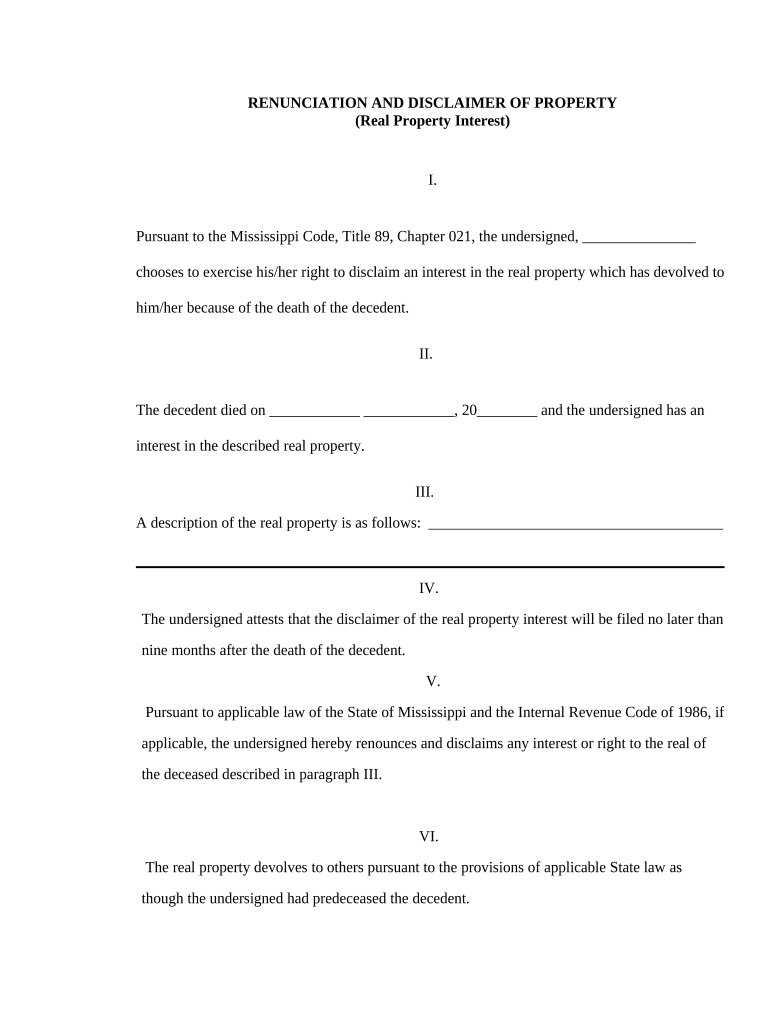
  1. Click ‘Get Form’ to open the disclaimer property interest document in the editor.
  2. In Section I, enter your name where indicated. This identifies you as the individual disclaiming the property interest.
  3. For Section II, input the date of death of the decedent. This is crucial for establishing the timeline for your disclaimer.
  4. In Section III, provide a detailed description of the real property you are disclaiming. Be as specific as possible to avoid any confusion.
  5. Section IV requires you to confirm that your disclaimer will be filed within nine months of the decedent's death. Ensure this date aligns with legal requirements.
  6. Review Sections V and VI carefully, as they outline your legal rights and obligations regarding the renunciation of property interests.
  7. Finally, complete Sections VII and VIII by signing and dating where indicated, ensuring all necessary parties acknowledge receipt.

Start using our platform today to streamline your document editing and signing process for free!

be ready to get more

Complete this form in 5 minutes or less

Get form

Got questions?

We have answers to the most popular questions from our customers. If you can't find an answer to your question, please contact us.
Contact us
Texas law provides a number of rules as to when the disclaimer takes effect. For an interest in property passes because of the death of a decedent , a disclaimer of the interest takes effect as of the time of the decedents death and relates back for all purposes to the time of the decedents death.
In some cases, disclaiming assets can help avoid probate. Probate can be time-consuming, expensive, and public, making it undesirable for many. By disclaiming, the property can pass directly to the deceased joint tenants other beneficiaries, if there are any, bypassing eventual probate.
Heres a general no responsibility disclaimer template to help you get started: The information provided on this website is for general informational purposes only. [Business Name] assumes no responsibility for errors or omissions in the content or for any actions taken based on the information provided.
According to its definition, a disclaimer is a statement that helps businesses and professionals limit their liabilities. Disclaimers are usually used to inform people that the person or organization providing information or service is not liable for any consequences or damages that may come from it.
A disclaimer of interest is, essentially, a written statement to the probate court where someone who stands to inherit property or assets states that they do not wish to exercise that inheritance. They disclaim any right to receive the interest that they otherwise would.

Security and compliance

At DocHub, your data security is our priority. We follow HIPAA, SOC2, GDPR, and other standards, so you can work on your documents with confidence.

Learn more
be ready to get more

Complete this form in 5 minutes or less

Get form

People also ask

For example, if a person doesnt want to take on the responsibilities or liabilities of inheriting a business, contaminated real estate, or other burdensome property, they may choose to disclaim it, allowing it to pass to someone who is willing to accept it.
In the law of inheritance, wills and trusts, a disclaimer of interest (also called a renunciation) is an attempt by a person to renounce their legal right to benefit from an inheritance (either under a will or through intestacy) or through a trust.

Related links