Individual to trust 2026

Get Form
individual to trust Preview on Page 1

Here's how it works

01. Edit your form online
Type text, add images, blackout confidential details, add comments, highlights and more.
02. Sign it in a few clicks
Draw your signature, type it, upload its image, or use your mobile device as a signature pad.
03. Share your form with others
Send it via email, link, or fax. You can also download it, export it or print it out.

How to use or fill out individual to trust with our platform

Form edit decoration
9.5
Ease of Setup
DocHub User Ratings on G2
9.0
Ease of Use
DocHub User Ratings on G2
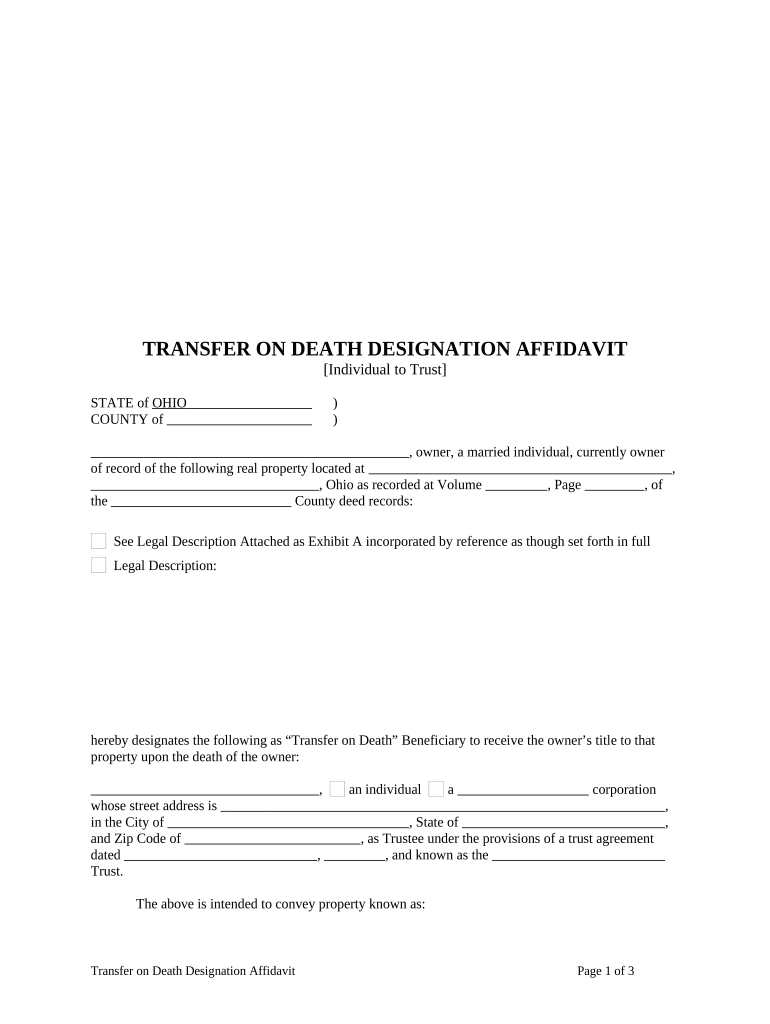
  1. Click ‘Get Form’ to open the Transfer on Death Designation Affidavit in the editor.
  2. Begin by entering your name as the owner of the property in the designated field, ensuring you include your marital status.
  3. Fill in the details of the real property, including its address and legal description. Attach Exhibit A if necessary for additional information.
  4. Designate a beneficiary by entering their name and address in the appropriate fields. This is crucial for transferring ownership upon your passing.
  5. If applicable, indicate whether you are designating an individual or a corporation as trustee under a trust agreement.
  6. Complete any required witness signatures and notary public acknowledgment sections to validate the document.

Start using our platform today to easily complete your Transfer on Death Designation Affidavit for free!

be ready to get more

Complete this form in 5 minutes or less

Get form

Got questions?

We have answers to the most popular questions from our customers. If you can't find an answer to your question, please contact us.
Contact us
Trusts can be broadly categorized into four main types: Living Trusts, Testamentary Trusts, Revocable Trusts, and Irrevocable Trusts. There are many different types of trusts you can choose from, and understanding how they are different can help you pick the right one for your needs.
A trust is a way of managing assets (money, investments, land or buildings) for people. There are different types of trusts and they are taxed differently. Trusts involve: the settlor - the person who puts assets into a trust. the trustee - the person who manages the trust.
A personal trust is a trust that an individual creates, formally naming themselves as the beneficiary. Personal trusts are separate legal entities that have the authority to buy, sell, hold, and manage property for the benefit of their trustors.
How do I transfer the shares I own to my trust? You will need to inform the company issuing the shares that you will be holding them through a trust and also provide your trusts details. This is necessary to ensure the companys internal records reflect this change.
The trusts and designated beneficiaries including in your will are essentially different outlines for different assets and their named beneficiaries. The assets that fall under the trust category include tangible assets, such as physical money, real estate, high-valued possessions such as a car or artwork, and so on.

Security and compliance

At DocHub, your data security is our priority. We follow HIPAA, SOC2, GDPR, and other standards, so you can work on your documents with confidence.

Learn more
ccpa2
pci-dss
gdpr-compliance
hipaa
soc-compliance

People also ask

Disadvantages of Individual Trustee: Personal Liability: Individual trustees bear personal liability for trust obligations, potentially putting their personal assets at risk. Asset Confusion: There can be difficulty distinguishing between personal and trust assets, especially for SMSF individual trustee arrangements.
The trustee(s) (there may be more than one) of a trust may be a person or a company (the latter is known as a corporate trustee). In either case, the trustee must be legally capable of holding trust property in their own right. The trustee holds the trust property for the benefit of the beneficiaries.

Related links