Living Trust for Husband and Wife with One Child - New York 2025

Get Form
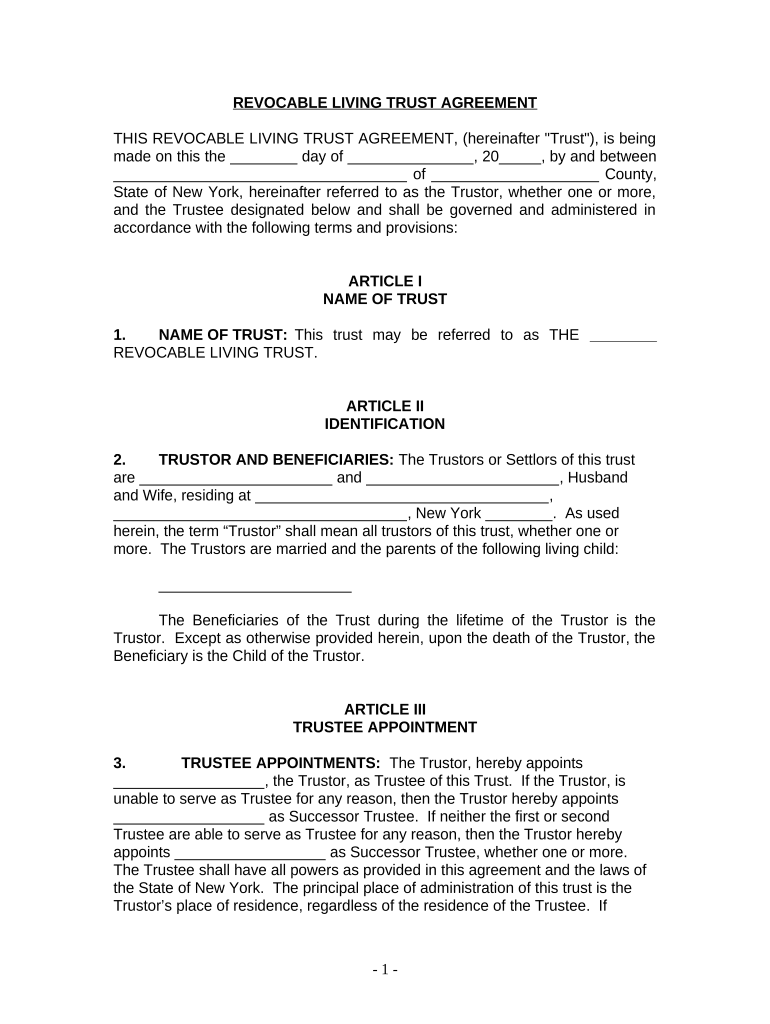
Living Trust for Husband and Wife with One Child - New York Preview on Page 1

Here's how it works

01. Edit your form online
Type text, add images, blackout confidential details, add comments, highlights and more.
02. Sign it in a few clicks
Draw your signature, type it, upload its image, or use your mobile device as a signature pad.
03. Share your form with others
Send it via email, link, or fax. You can also download it, export it or print it out.

How to use or fill out Living Trust for Husband and Wife with One Child - New York

Form edit decoration
9.5
Ease of Setup
DocHub User Ratings on G2
9.0
Ease of Use
DocHub User Ratings on G2
  1. Click ‘Get Form’ to open it in the editor.
  2. Begin by entering the date at the top of the document where indicated. This establishes when the trust is created.
  3. In Article I, specify the name of your trust. This can be a personalized title that reflects your family.
  4. In Article II, fill in the names of both Trustors (husband and wife) along with their address. Ensure accuracy as this identifies you legally.
  5. List your child’s name as the beneficiary under Article II, ensuring clarity on who will inherit.
  6. Proceed to Article III to appoint a Trustee. You can designate one or both Trustors as Trustees, and include successor Trustees if needed.
  7. In Article IV, detail any assets being transferred into the trust. Attach Schedule A listing these assets for clarity.
  8. Review Articles V through XII carefully, ensuring all powers and provisions align with your intentions for asset management and distribution.

Start using our platform today to easily create and manage your Living Trust for free!

be ready to get more

Complete this form in 5 minutes or less

Get form

Got questions?

We have answers to the most popular questions from our customers. If you can't find an answer to your question, please contact us.
Contact us
Benefits of Separate TrustsGreater Asset Protection A spouses trust is generally protected from the other spouses creditors. Also, when one spouse dies, his or her trust becomes irrevocable, making it more difficult for creditors of either spouse to reach the trust assets.
Primarily, the lack of flexibility in a joint trust can be a problem, especially if the two spouses dont agree about who should ultimately be a beneficiary or how much they should receive.
You can put an investment account that brings income into a trust and name yourself as beneficiary while you are alive and then, after you die, have the income go to your spouse, children, and/or other relative, friend, or charity, until the trust ends and the assets are distributed.
A spouses separate trust is generally protected from the other spouses creditors. Also, when one spouse dies, his or her trust becomes irrevocable, making it more difficult for creditors of either spouse to reach the trust assets.
Typically, a revocable living trust would be filed as a separate trust by each spouse, but sometimes a joint trust is a better option. A joint trust may be best if the couple is comfortable owning all assets jointly and with the surviving spouse inheriting all assets.
be ready to get more

Complete this form in 5 minutes or less

Get form

People also ask

If each spouse has distinct assets or complex estate plans, separate trusts might be the better option. On the other hand, if a couples financial life is highly integrated, a joint trust could provide simplicity and ease of management. Its also important to note that this decision isnt set in stone.

Related links