Ny permanent 2026

Get Form
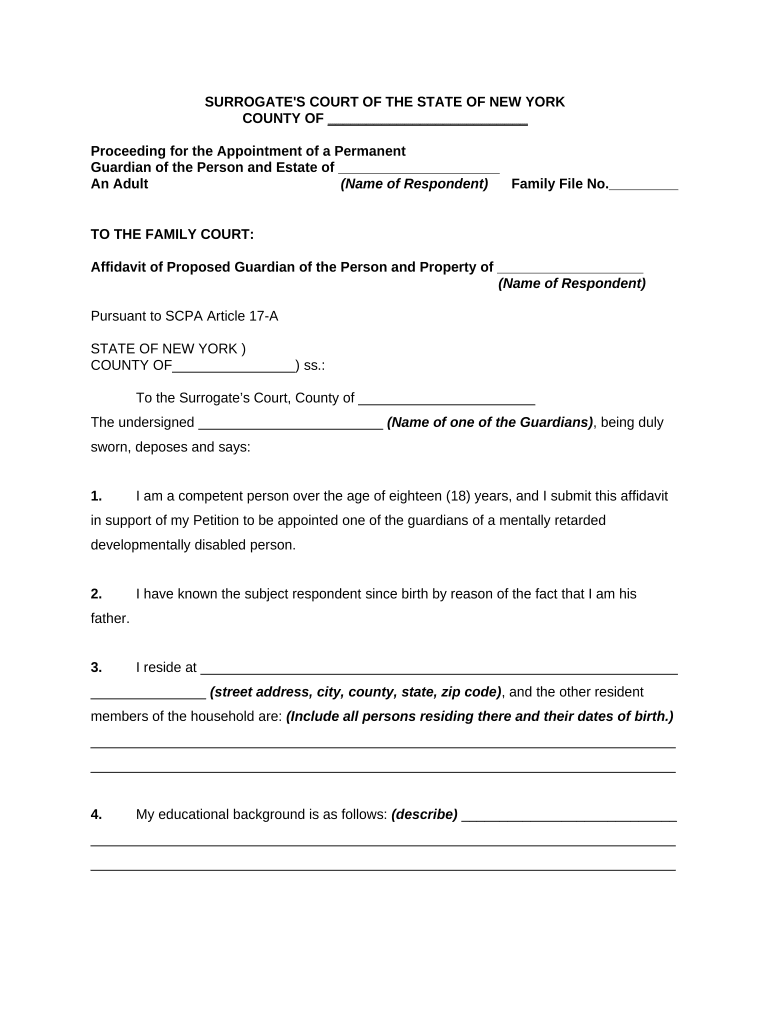
ny permanent Preview on Page 1

Here's how it works

01. Edit your form online
Type text, add images, blackout confidential details, add comments, highlights and more.
02. Sign it in a few clicks
Draw your signature, type it, upload its image, or use your mobile device as a signature pad.
03. Share your form with others
Send it via email, link, or fax. You can also download it, export it or print it out.

How to use or fill out ny permanent with our platform

Form edit decoration
9.5
Ease of Setup
DocHub User Ratings on G2
9.0
Ease of Use
DocHub User Ratings on G2
  1. Click ‘Get Form’ to open it in the editor.
  2. Begin by entering the name of the respondent in the designated field. This is crucial as it identifies the individual for whom guardianship is being sought.
  3. Fill in your personal information, including your name and address. Ensure that all details are accurate to avoid any delays in processing.
  4. Provide a brief description of your educational background. This helps establish your qualifications as a proposed guardian.
  5. Answer questions regarding any past criminal convictions or charges. Transparency is key here; ensure you provide truthful responses.
  6. State your willingness and ability to care for the respondent, emphasizing your commitment to their well-being.
  7. Finally, articulate why you believe your appointment as guardian would be in the best interests of the respondent. This section allows you to express your motivations clearly.

Start filling out your ny permanent form today for free on our platform!

be ready to get more

Complete this form in 5 minutes or less

Get form

Got questions?

We have answers to the most popular questions from our customers. If you can't find an answer to your question, please contact us.
Contact us
Maintaining a permanent place of abode You can be classified as a statutory resident if you maintain a permanent place of abode in New York for more than 10 months of the year. This means having a residence, like a house or apartment, that is suitable for year-round living.
Below are the five preference tiers to obtain a permanent residence visa: Tier 1: Those individuals who have an exceptional talent or ability in the field of the arts, sciences, research, business, education, or athletics. Additionally, specific multi-national executives can fall under this category.
To get a New York green card, you will need to come to the United States with an immigration visa. Immigration visas are typically family-based or employment-based. After arriving in the United States, you can apply for an adjustment of status to obtain lawful permanent resident status.
To qualify as a New York State resident, you must have established legal residence by maintaining a domicile in New York State for a period of at least one year preceding the first day of the semester. A domicile is defined as a fixed permanent home to which you intend to return after being absent for a period of time.
In order to qualify for disability benefits in New York, claimants must prove that their physical or mental conditions will last at least 12 months. The condition or illness does not need to be occupation-related, but it must prevent claimants from performing their normal work duties.
be ready to get more

Complete this form in 5 minutes or less

Get form

People also ask

The 10-month rule in New York City refers to a tax guideline that helps determine whether a person qualifies as a New York City resident for tax purposes. Specifically, it relates to the number of days an individual must spend within the city to be considered a resident for local income tax obligations.
What is the fastest way to get a green card? Immigration through Family Reunification: 9 months to 5 years. Immigration through Marriage to a U.S. Citizen: around 10 months. Immigration of a Political Asylum to the USA: within 1 year. Immigration of Extraordinary Ability Individuals: 1 to 2 years.
There are several ways to become a lawful permanent resident, such as: being sponsored by an immediate relative (spouse, parent, child, or sibling) being sponsored by an employer. being granted refugee or asylum status. winning the diversity visa lottery.

Related links