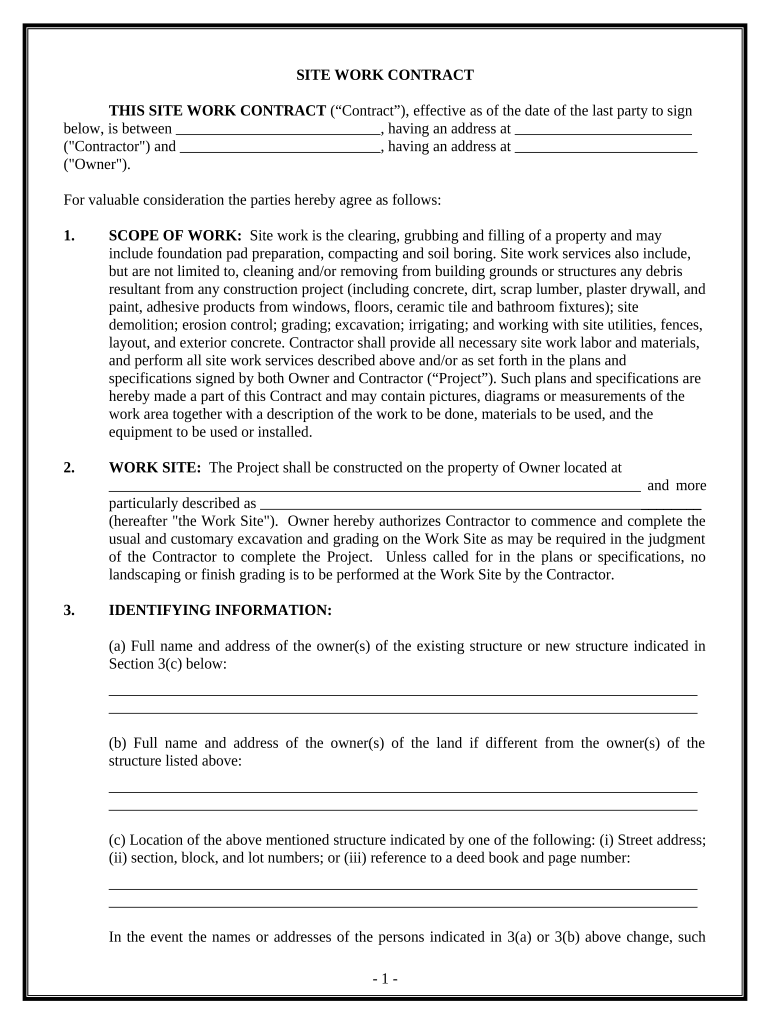
Site Work Contract for Contractor - New York 2026

Get Form
Site Work Contract for Contractor - New York Preview on Page 1

Here's how it works

01. Edit your form online
Type text, add images, blackout confidential details, add comments, highlights and more.
02. Sign it in a few clicks
Draw your signature, type it, upload its image, or use your mobile device as a signature pad.
03. Share your form with others
Send it via email, link, or fax. You can also download it, export it or print it out.

How to use or fill out Site Work Contract for Contractor - New York

Form edit decoration
9.5
Ease of Setup
DocHub User Ratings on G2
9.0
Ease of Use
DocHub User Ratings on G2
  1. Click ‘Get Form’ to open it in the editor.
  2. Begin by filling in the Contractor's name and address at the top of the form. This identifies who will be performing the work.
  3. Next, provide the Owner's name and address. This section is crucial as it establishes who is hiring the Contractor.
  4. In the 'Scope of Work' section, detail all tasks to be performed, including site clearing, grading, and any specific requirements outlined in plans or specifications.
  5. Complete the 'Work Site' section with the exact location of the project. Ensure accuracy to avoid future disputes.
  6. Fill out identifying information for both parties, including full names and addresses as required in Section 3.
  7. Specify timelines for commencement and completion of work in the 'Time of Completion' section. Be clear about deadlines.
  8. Review sections on permits, soil conditions, insurance, and changes to scope carefully to ensure compliance with local regulations.
  9. Finally, sign and date the contract at the bottom. Both parties must do this for it to be legally binding.

Start using our platform today to easily fill out your Site Work Contract for Contractor - New York!

be ready to get more

Complete this form in 5 minutes or less

Get form

Got questions?

We have answers to the most popular questions from our customers. If you can't find an answer to your question, please contact us.
Contact us
Lump sum contracts (also sometimes known as fixed price contracts) are usually considered the most popular type of contract when it comes to building and engineering agreements, however they do have minor differences.
Standard construction contracts should have the following information and clauses: Name of contractor and contact information. Name of homeowner and contact information. Describe property in legal terms. List attachments to the contract. The cost. Failure of homeowner to obtain financing.
Fixed Price Contract With a Fixed Price Contract, the government agrees to pay you a specific pre-determined price for your product or service. This type of contract is more risky for the contractor as you would be responsible for any cost overruns.
All construction contracts should contain certain essential terms. These include a well-defined scope of work, a payment schedule, a project schedule defining certain benchmarks for completion, a procedure for changes in the work, a warranty, indemnification and insurance language, and a dispute resolution procedure.
Best Contract Types for Different Project Owners Government Owners: Lump Sum (Fixed-Price Contract) Private Developers: Cost-Plus with Guaranteed Maximum Price (GMP) Corporate Institutional Owners: Cost-Plus with Incentives. First-Time Owners: Lump Sum or Unit Price.

Security and compliance

At DocHub, your data security is our priority. We follow HIPAA, SOC2, GDPR, and other standards, so you can work on your documents with confidence.

Learn more
ccpa2
pci-dss
gdpr-compliance
hipaa
soc-compliance
be ready to get more

Complete this form in 5 minutes or less

Get form

People also ask

Bilateral contracts are agreements in which both parties exchange mutual promises to perform certain obligations, making this type of contract the most common in business transactions.
A lump sum contract is a suitable if the scope and schedule of the project are sufficiently defined to allow the contractor to fully estimate project costs. In a unit price contract, the work to be performed is broken into various parts, usually by construction trade.

Related links