Notice of Dishonored Check - Civil - Keywords: bad check, bounced check - Nevada 2026

Get Form
bad check letter Preview on Page 1

Here's how it works

01. Edit your bad check letter online
Type text, add images, blackout confidential details, add comments, highlights and more.
02. Sign it in a few clicks
Draw your signature, type it, upload its image, or use your mobile device as a signature pad.
03. Share your form with others
Send bad check letter template via email, link, or fax. You can also download it, export it or print it out.

How to use or fill out Notice of Dishonored Check - Civil - Keywords: bad check, bounced check - Nevada with our platform

Form edit decoration
9.5
Ease of Setup
DocHub User Ratings on G2
9.0
Ease of Use
DocHub User Ratings on G2
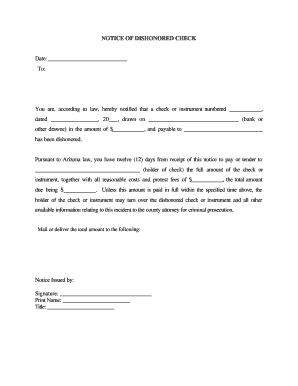
  1. Click ‘Get Form’ to open the Notice of Dishonored Check in the editor.
  2. Fill in the 'Date' field with the current date to indicate when the notice is being issued.
  3. In the 'To' section, enter the name of the individual or entity receiving this notice.
  4. Complete the 'Check No.' field with the specific number of the dishonored check.
  5. Input the date on which the check was issued in the corresponding field.
  6. Enter the amount of the dishonored check in dollars in the designated space.
  7. Specify the bank or financial institution that issued the check in 'drawn upon' section.
  8. Indicate who the check was payable to in that respective field.
  9. State the reason for dishonor in 'reason of' section, such as insufficient funds or account closed.
  10. Fill out your name and title at 'Notice Issued by', and provide your signature for authenticity.

Start using our platform today to easily complete your Notice of Dishonored Check for free!

be ready to get more

Complete this form in 5 minutes or less

Get form

Got questions?

We have answers to the most popular questions from our customers. If you can't find an answer to your question, please contact us.
Contact us
Canceled Checks vs. Checks are canceled after the funds are transferred to the payee. However, when a check is returned, the bank is unable to process the transfer. This typically happens when there are insufficient funds in the account, the account is closed, or theres an error with the check.
Passing a bad check is generally a misdemeanor if the amount is less than $1,200.00. But it can be a felony if the amount is $1,200 or greater.
When a cheque is dishonoured for insufficient funds, the recipient usually sends a notice demanding payment within 15 days. Failure to make this payment can result in legal action, leading to court proceedings where a drawer may face penalties such as fines or imprisonment if found guilty.
Dishonored checks are items deposited at a depository bank and returned due to: Insufficient funds in the accounts the checks are drawn. Other reasons that prevent the bank from honoring the checks.
A bounced check is returned or bounced to its original bank because the money is not in the check writers account to process it. This can lead to several fees and probably some headaches. One so-called rubber check could end up costing $65 or more for overdraft, nonsufficient funds and/or merchant fees.

Security and compliance

At DocHub, your data security is our priority. We follow HIPAA, SOC2, GDPR, and other standards, so you can work on your documents with confidence.

Learn more
ccpa2
pci-dss
gdpr-compliance
hipaa
soc-compliance

People also ask

If a cheque is dishonoured for any reason, the bank on which it is drawn must promptly return the cheque to the depositors (payees) bank, which will ultimately return it to the depositor.
Contact the Check Writer : Reach out to the person who wrote the check to inform them about the bounced check. Request Payment : Politely ask for an alternative form of payment, such as cash or a money order. Keep Records : Document all communications regarding the bounced check, including dates, times
6 reasons why a cheque bounces or dishonoured Insufficient funds. One of the most prevalent reasons for cheque bounce is insufficient funds in the issuers account. Date issues on cheque. Mismatched signature. Inconsistent amount. Damaged cheque. Overwriting.

Related links