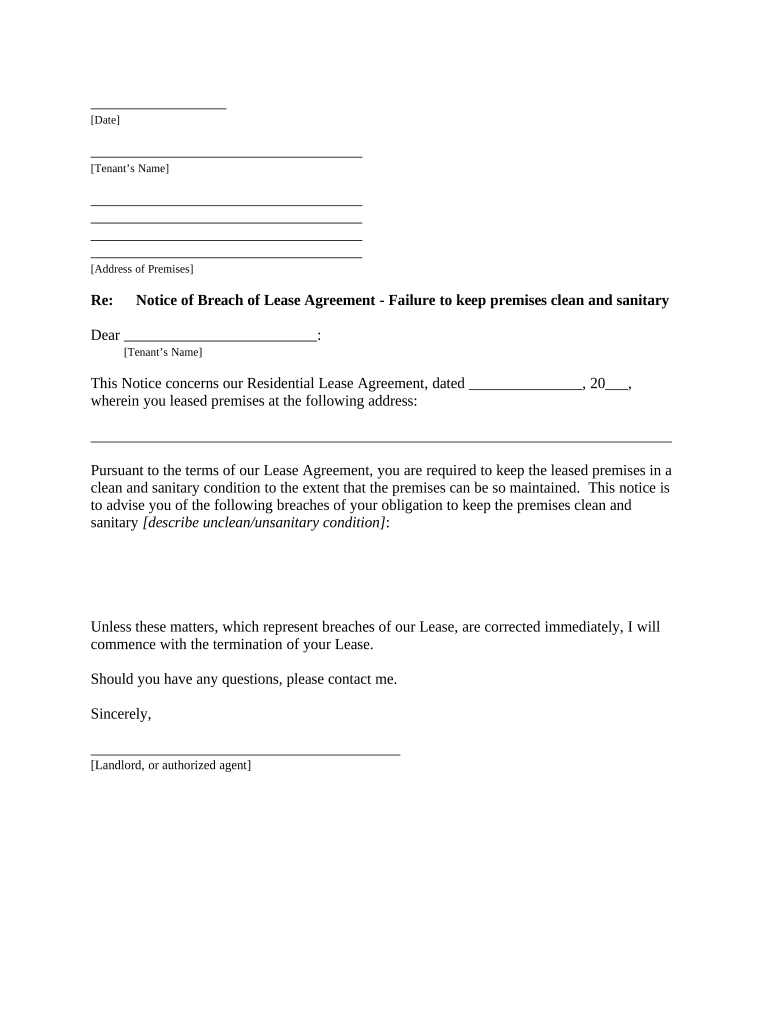
Letter from Landlord to Tenant for Failure to keep premises as clean and safe as condition of premises permits - Remedy or lease terminates - New Jersey 2026

Get Form
Letter from Landlord to Tenant for Failure to keep premises as clean and safe as condition of premises permits - Remedy or lease terminates - New Jersey Preview on Page 1

Here's how it works

01. Edit your form online
Type text, add images, blackout confidential details, add comments, highlights and more.
02. Sign it in a few clicks
Draw your signature, type it, upload its image, or use your mobile device as a signature pad.
03. Share your form with others
Send it via email, link, or fax. You can also download it, export it or print it out.

How to use or fill out Letter from Landlord to Tenant for Failure to keep premises as clean and safe as condition of premises permits - Remedy or lease terminates - New Jersey with our platform

Form edit decoration
9.5
Ease of Setup
DocHub User Ratings on G2
9.0
Ease of Use
DocHub User Ratings on G2
  1. Click ‘Get Form’ to open it in the editor.
  2. Begin by entering the date at the top of the document. This sets the official record for your notice.
  3. Fill in the tenant’s name and address of the premises where indicated. Ensure accuracy to avoid any confusion.
  4. In the body of the letter, specify the breaches of cleanliness and sanitation that have been observed. Be clear and concise in your description.
  5. Indicate a deadline for correction of these issues, emphasizing that failure to comply may lead to lease termination.
  6. Sign off with your name or that of an authorized agent, ensuring you include a signature line for authenticity.
  7. Complete the proof of delivery section by selecting how you delivered this notice (personal delivery, certified mail, etc.) and sign it with the date.

Start using our platform today to streamline your document editing and ensure effective communication with tenants!

be ready to get more

Complete this form in 5 minutes or less

Get form

Got questions?

We have answers to the most popular questions from our customers. If you can't find an answer to your question, please contact us.
Contact us
The law recognizes several reasons a lease agreement can end early, such as: The tenant or a member of the tenants household is a victim of domestic violence. The tenant or a tenants spouse passes away. The tenant or the tenants spouse experiences a disabling illness or accident.
Landlords in New Jersey cannot violate the implied warranty of habitability, discriminate against tenants, unjustly withhold security deposits, evict tenants without proper notice or due process, raise rent without giving proper notice, enter a tenants dwelling without reasonable notice except in emergencies, or
Yes, landlords can raise rent by more than 10% in some New Jersey municipalities with no rent control ordinances. However, landlords in municipalities with local rent control ordinances may only raise rent at an average of 2% to 6% per lease term.
Residential leases carry an implied warranty of habitability. This means that a landlord has a duty to maintain the rental unit and keep it fit for residential purposes throughout the entire term of the lease and that the landlord must repair damage to vital facilities.
What Are the Top 5 Legal Responsibilities of a Landlord in New Jersey? Landlord Responsibilities in Clifton, New Jersey. Comply With Anti-Discrimination Laws. Provide Habitable Housing. Prepare a Rental or Lease Agreement. Make All Necessary Disclosures to Tenants. Respect Privacy of Tenants.

Security and compliance

At DocHub, your data security is our priority. We follow HIPAA, SOC2, GDPR, and other standards, so you can work on your documents with confidence.

Learn more
ccpa2
pci-dss
gdpr-compliance
hipaa
soc-compliance

People also ask

The lease agreement specifies important terms regarding rent payment, security deposits, property maintenance, and proper notice requirements. When landlords violate these terms, they bdocHub the contract, giving tenants legal grounds to seek remedies.
New Jersey is not landlord-friendly because laws favor tenants. Many cities have rent control policies, there are limits on rent increases, and the eviction process can be slow. Read more of our state landlord tenant law guides here.

Related links