Revocation of Living Trust - New Hampshire 2026

Get Form
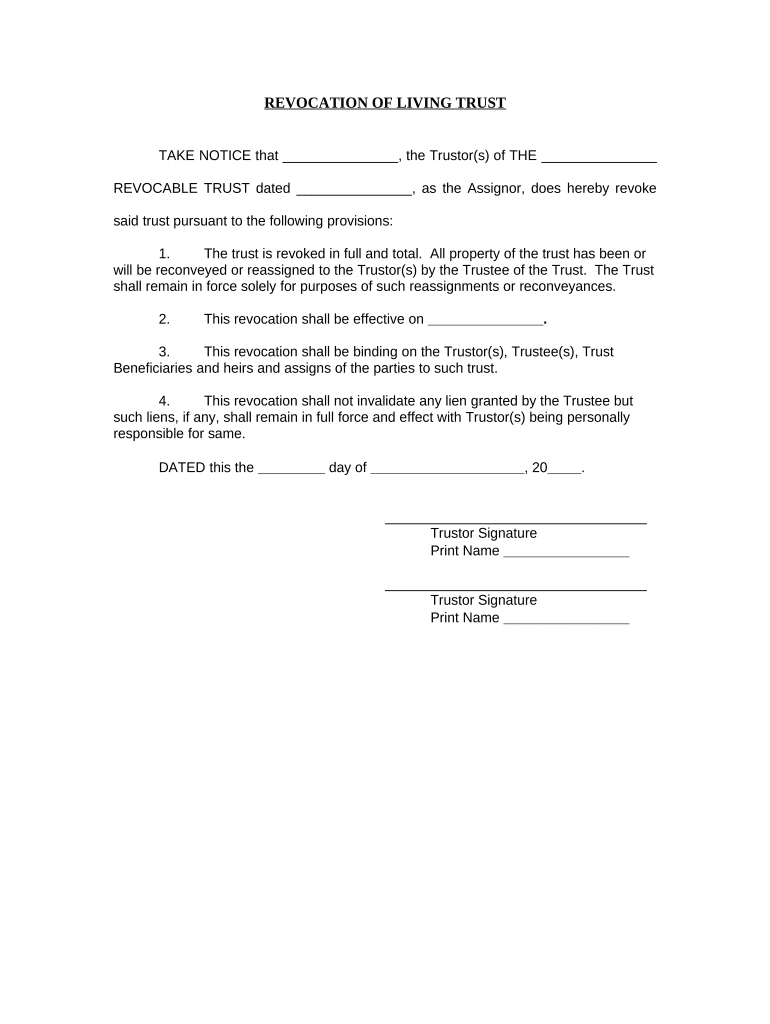
Revocation of Living Trust - New Hampshire Preview on Page 1

Here's how it works

01. Edit your form online
Type text, add images, blackout confidential details, add comments, highlights and more.
02. Sign it in a few clicks
Draw your signature, type it, upload its image, or use your mobile device as a signature pad.
03. Share your form with others
Send it via email, link, or fax. You can also download it, export it or print it out.

How to use or fill out Revocation of Living Trust - New Hampshire with our platform

Form edit decoration
9.5
Ease of Setup
DocHub User Ratings on G2
9.0
Ease of Use
DocHub User Ratings on G2
  1. Click ‘Get Form’ to open the Revocation of Living Trust - New Hampshire in the editor.
  2. Begin by filling in your name as the Trustor(s) in the first blank space. This identifies you as the individual revoking the trust.
  3. Next, enter the name of the trust being revoked in the second blank space. This should match exactly with what is stated in your original trust document.
  4. Indicate the date of the original trust in the third blank space to provide context for this revocation.
  5. In section 2, specify the effective date of this revocation. This is crucial for legal clarity.
  6. Sign and print your name at the bottom of the form where indicated. If there are multiple Trustors, ensure all signatures are included.
  7. Finally, complete the notary section by having a notary public acknowledge your signature on this document.

Start using our platform today to easily complete and manage your Revocation of Living Trust - New Hampshire for free!

be ready to get more

Complete this form in 5 minutes or less

Get form

Got questions?

We have answers to the most popular questions from our customers. If you can't find an answer to your question, please contact us.
Contact us
If you created an individual living trust, you can revoke it at any time. Either grantor can revoke a shared trust, wiping out all terms of the trust. The trust property is returned to each person ing to how they owned it before transferring it to the trust.
A revocable trust allows for flexibility, as you can alter or dissolve it during your lifetime. However, in the context of asset protection from nursing home costs, its effectiveness is limited since the assets in a revocable trust are still considered part of your personal estate.
Some of the most common reasons trusts are invalid include: Legal formalities were not followed when executing the trust instrument. The trust was created or modified through forgery or another type of fraud. The trust maker was not mentally competent when they created or modified the trust.
Changing a revocable trust isnt as simple as verbally telling someone or even writing in changes. There are legal formalities that must be followed to ensure that your trust is changed properly and that your wishes are carried out. You should consult with a lawyer to help you make such changes.
Not Protected from Creditors Revocable living trusts are not protected from creditors, so if you owe money to a company, the IRS, or another entity, this wont shield you from collection efforts.
be ready to get more

Complete this form in 5 minutes or less

Get form

People also ask

Natural Trust Termination Upon the settlors death. Upon another stated event. Upon conclusion of maximum legal term.
In New Hampshire, a settlor can create a purpose trust, which is a trust for a specific non-charitable purpose or a trust that does not have any specific beneficiaries. A purpose trust also may include charitable purposes or charitable beneficiaries. A purpose trust may be perpetual.

Related links