Letter from Tenant to Landlord about Illegal entry by landlord - New Hampshire 2026

Get Form
new hampshire landlord tenant law Preview on Page 1

Here's how it works

01. Edit your new hampshire landlord tenant law online
Type text, add images, blackout confidential details, add comments, highlights and more.
02. Sign it in a few clicks
Draw your signature, type it, upload its image, or use your mobile device as a signature pad.
03. Share your form with others
Send it via email, link, or fax. You can also download it, export it or print it out.

How to use or fill out Letter from Tenant to Landlord about Illegal entry by landlord - New Hampshire with our platform

Form edit decoration
9.5
Ease of Setup
DocHub User Ratings on G2
9.0
Ease of Use
DocHub User Ratings on G2
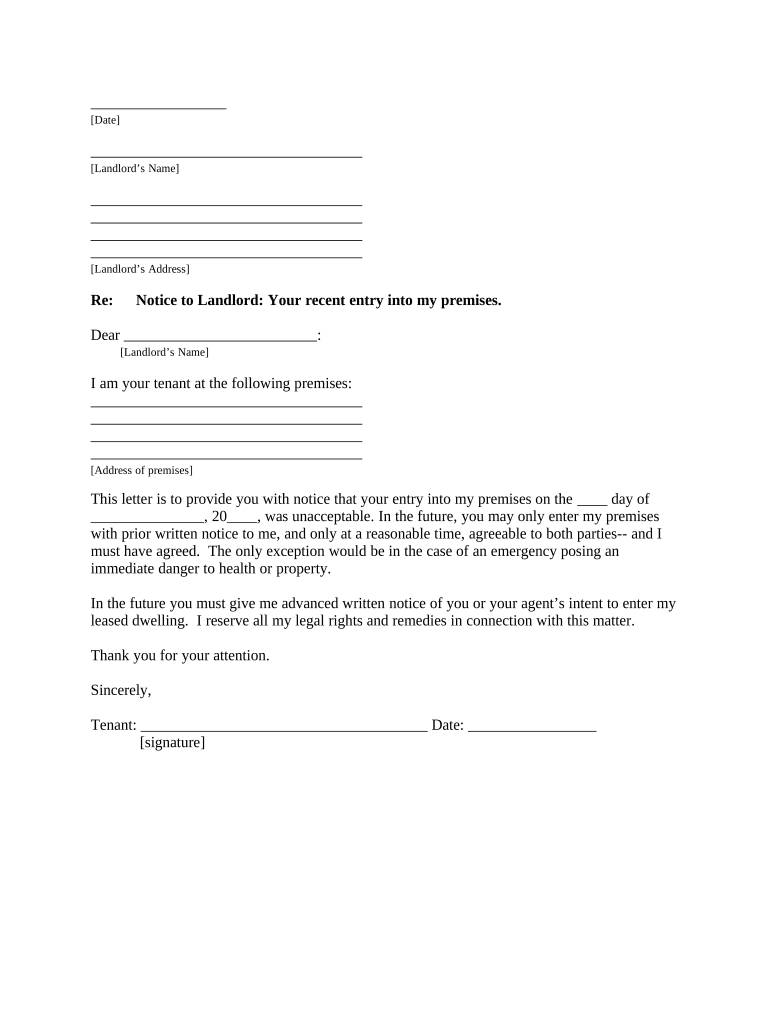
  1. Click ‘Get Form’ to open it in the editor.
  2. Begin by entering the date at the top of the letter. This sets a clear timeline for your notice.
  3. Fill in the landlord’s name and address in the designated fields. Ensure accuracy to avoid any confusion.
  4. In the greeting, address your landlord directly using their name, maintaining a professional tone.
  5. Provide your address as the tenant in the specified section. This confirms your identity and residence.
  6. Clearly state the date of the landlord's entry into your premises. This is crucial for documenting the incident.
  7. Reiterate your rights regarding future entries, emphasizing that prior written notice is required except in emergencies.
  8. Sign and date at the bottom of the letter to validate your notice formally.
  9. Complete the Proof of Delivery section by selecting how you delivered this notice and signing it accordingly.

Start using our platform today to easily fill out and manage your important documents for free!

be ready to get more

Complete this form in 5 minutes or less

Get form

Got questions?

We have answers to the most popular questions from our customers. If you can't find an answer to your question, please contact us.
Contact us
Dear (Landlords Name), I am writing to formally notify you of my intent to vacate the premises located at (Rental Property Address) on (Move-Out Date). This notice is being given in accordance with the (30-day/60-day) notice requirement outlined in our lease agreement. My last day of residence will be (Move-Out Date).
RSA 540-A is a law designed to provide quick relief to tenants whose landlords have tried to force them out of their apartments by: locking them out, entering their apartments without permission, turning off their utilities, or. seizing their property.
RSA 540-A is a law designed to provide quick relief to tenants whose landlords have tried to force them out of their apartments by: locking them out, entering their apartments without permission, turning off their utilities, or.
New Hampshire is a relatively landlord-friendly state. It doesnt impose rent control laws and prevent its cities and towns from creating their own rent control laws, which allows landlords to charge what they deem appropriate for rent.
No landlord shall willfully enter into the premises of the tenant without prior consent, other than to make emergency repairs.

Security and compliance

At DocHub, your data security is our priority. We follow HIPAA, SOC2, GDPR, and other standards, so you can work on your documents with confidence.

Learn more
ccpa2
pci-dss
gdpr-compliance
hipaa
soc-compliance

People also ask

There is no New Hampshire statute limiting how much a landlord can raise the rent. If your landlord tries to raise your rent by an unreasonable amount, there is a legal argument that such an increase is not enforceable by a court.
Most tenants in New Hampshire arent required to leave their homes on just the landlords say-so. Most tenants are entitled to a hearing where they get a chance to defend themselves before a judge. And a landlord must get the judges permission before the tenant has to leave.
In New Hampshire, evicting someone without a lease requires serving a written notice to quit, typically giving at least 7 days to vacate. The notice must clearly state the reason for eviction. If the occupant does not leave, the landlord can file an eviction lawsuit (summary process) in the local district court.

Related links