Revocation of Living Trust - Nebraska 2026

Get Form
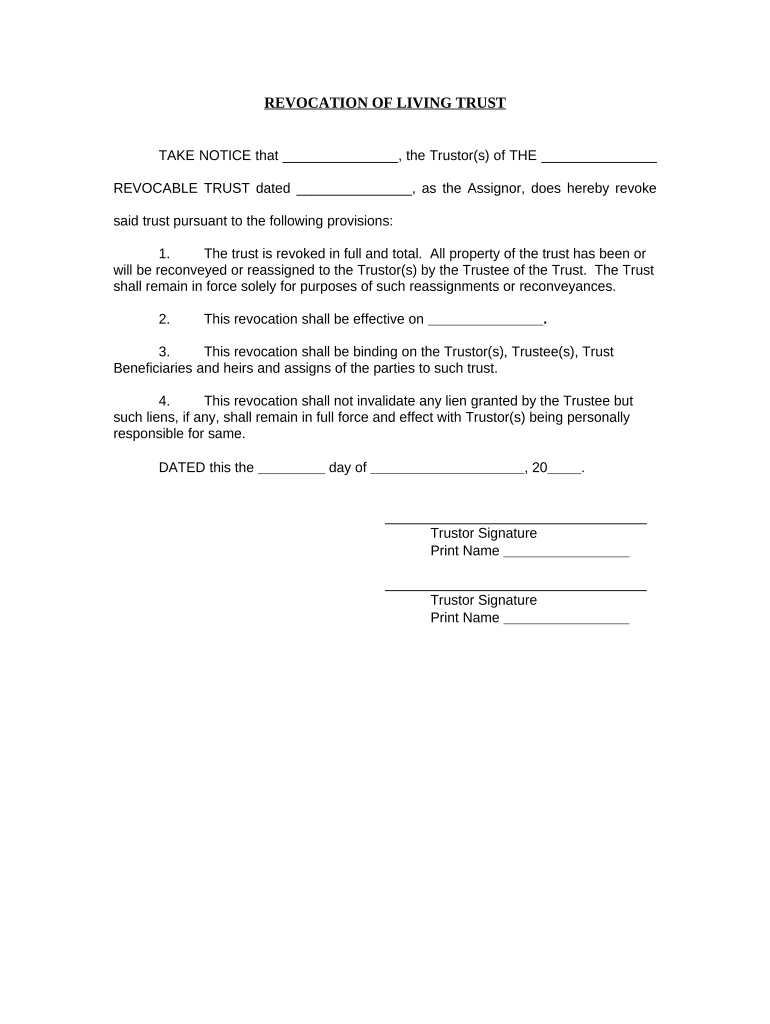
living trust nebraska Preview on Page 1

Here's how it works

01. Edit your living trust nebraska online
Type text, add images, blackout confidential details, add comments, highlights and more.
02. Sign it in a few clicks
Draw your signature, type it, upload its image, or use your mobile device as a signature pad.
03. Share your form with others
Send it via email, link, or fax. You can also download it, export it or print it out.

How to use or fill out Revocation of Living Trust - Nebraska with our platform

Form edit decoration
9.5
Ease of Setup
DocHub User Ratings on G2
9.0
Ease of Use
DocHub User Ratings on G2
  1. Click ‘Get Form’ to open the Revocation of Living Trust - Nebraska in the editor.
  2. Begin by filling in your name as the Trustor(s) in the first blank space. This identifies you as the individual revoking the trust.
  3. In the second blank, enter the name of your revocable trust. This specifies which trust is being revoked.
  4. Next, indicate the date of the original trust in the designated field. This provides context for your revocation.
  5. Complete section 1 by confirming that all property has been or will be reassigned to you, ensuring clarity on ownership.
  6. Fill in the effective date of this revocation in section 2, marking when this action takes place.
  7. Sign and print your name at the bottom of the form where indicated. If there are multiple Trustors, ensure all signatures are included.
  8. Finally, have a Notary Public acknowledge your signature to validate this document legally.

Start using our platform today to easily complete and manage your Revocation of Living Trust for free!

be ready to get more

Complete this form in 5 minutes or less

Get form

Got questions?

We have answers to the most popular questions from our customers. If you can't find an answer to your question, please contact us.
Contact us
Stacy, what it means for a trust to be irrevocable is that the grantor or the person who created it cannot amend or revoke the trust.
Simple amendments, like changing a beneficiary or trustee, can range between $300 to $500. More substantial changes, such as a complete restatement of the trust to reflect significant alterations, could exceed $2,000.
To terminate an active trust, a party with standing must petition the court and provide evidence that persuades a judge to issue an order dissolving the trust or all beneficiaries of the trust must agree to its termination.
A revocable trust allows for flexibility, as you can alter or dissolve it during your lifetime. However, in the context of asset protection from nursing home costs, its effectiveness is limited since the assets in a revocable trust are still considered part of your personal estate.
If you created an individual living trust, you can revoke it at any time. Either grantor can revoke a shared trust, wiping out all terms of the trust. The trust property is returned to each person ing to how they owned it before transferring it to the trust.

Security and compliance

At DocHub, your data security is our priority. We follow HIPAA, SOC2, GDPR, and other standards, so you can work on your documents with confidence.

Learn more
ccpa2
pci-dss
gdpr-compliance
hipaa
soc-compliance

People also ask

Terminating an irrevocable trust is an involved, formal process. Usually, all beneficiaries must consent to termination. In some cases, it may also require court approval depending on the type of trust, whether there are minor beneficiaries and the legal jurisdiction of the trust.
Natural Trust Termination Upon the settlors death. Upon another stated event. Upon conclusion of maximum legal term.

Related links