Type text, add images, blackout confidential details, add comments, highlights and more.
02. Sign it in a few clicks
Draw your signature, type it, upload its image, or use your mobile device as a signature pad.
03. Share your form with others
Send it via email, link, or fax. You can also download it, export it or print it out.
How to use or fill out Quitclaim Deed from Corporation to LLC - Nebraska with our platform
Ease of Setup
DocHub User Ratings on G2
Ease of Use
DocHub User Ratings on G2
Click ‘Get Form’ to open the Quitclaim Deed in the editor.
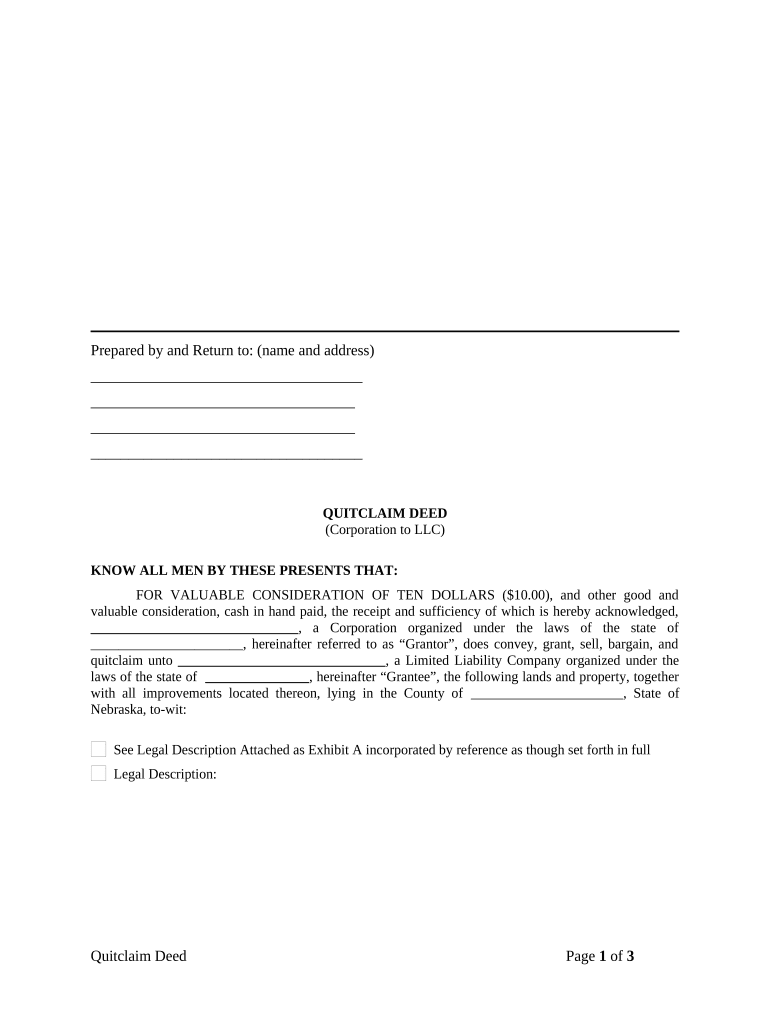
Begin by entering the name and address of the party preparing the document at the top. This ensures proper identification for future reference.
In the 'KNOW ALL MEN BY THESE PRESENTS THAT' section, fill in the Grantor's name (the Corporation) and its state of incorporation. Then, enter the Grantee's name (the LLC) and its state of organization.
Specify the property being conveyed by including a detailed legal description in 'Exhibit A'. If you have this information ready, you can easily attach it using our platform.
Complete any prior instrument references if applicable, noting down Book, Page, and Document numbers as required.
Fill in the date of execution and ensure that an authorized officer of the Corporation signs and prints their name along with their title.
Lastly, include notary details by filling out the acknowledgment section to validate your document legally.
Start using our platform today to streamline your Quitclaim Deed process for free!
Fill out Quitclaim Deed from Corporation to LLC - Nebraska online It's free
Quitclaim deed from corporation to llc nebraska templateQuitclaim deed from corporation to llc nebraska formQuitclaim deed from corporation to llc nebraska onlineQuitclaim deed from corporation to llc nebraska exampleForm 521 real estate transfer statementNotice of organization nebraska exampleNebraska Form 521 InstructionsNebraska deed requirements
Security and compliance
At DocHub, your data security is our priority. We follow HIPAA, SOC2, GDPR, and other standards, so you can work on your documents with confidence.
by ES Miller 2010 Cited by 1 April 15, 2008) (finding LLC was alter ego of related bankrupt corporation under Nebraska and federal law based on transfer of corporations assets to LLC andRead more
In order to qualify for the exemption for family corporations, partnerships, or limited liability companies, the property shall be transferred in the name ofRead more
Cookie consent notice
This site uses cookies to enhance site navigation and personalize your experience.
By using this site you agree to our use of cookies as described in our Privacy Notice.
You can modify your selections by visiting our Cookie and Advertising Notice.